







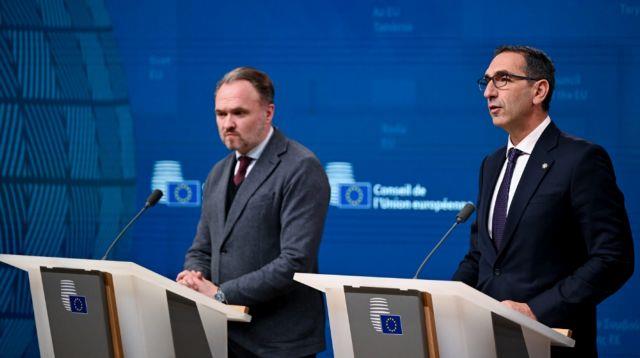
Housing is a social right, Interior Minister Constantinos Ioannou has said after an informal videoconference of Housing Ministers from the 27 EU Member States held under the presidency of Cyprus, brought to the forefront the acute housing crisis affecting millions of Europeans.
Following the 3 February meeting, Ioannou and the European Commissioner for Energy and Housing, Dan Jørgensen, outlined the framework of the ministers’ discussion, which followed the European Commission’s presentation of the European Affordable Housing Plan.
The Minister described the exchange of views as “open, constructive and timely.”
Ioannou stressed the need for a strong European approach that complements national and local solutions, while fully respecting the principle of subsidiarity.
“As the Cyprus Presidency, we are proud to be leading efforts in this field and helping to maintain momentum on an initiative that affects the lives of so many Europeans. Housing is a social right. Without adequate housing, people’s health, their access to employment and education, and their ability to participate fully in society are seriously affected,” he underlined.
The Minister referred specifically to the challenges faced by citizens, noting that "rising prices and rents, limited access to financing and insufficient supply are making housing increasingly unaffordable, affecting not only the most vulnerable, but also middle- and low-income households, young people and families, single-parent households, persons with disabilities and those at risk of poverty or social exclusion.”
The EU's role
Regarding the role of the EU, Ioannou stressed that the housing portfolio can support coordinated and targeted actions, particularly where housing is linked to areas such as climate change, energy and construction.
“In this context, the ambitious European Affordable Housing Plan presented by the Commission last December constitutes a crucial step towards a comprehensive European framework. The Plan includes concrete measures to increase supply, reduce bureaucracy, encourage investment and reforms, and support the areas and people most affected,” he said.
Asked by CNA about the investment dimension of the real estate market and its effect in the housing crisis, Ioannou replied that this was not part of today’s discussion, but that it is certainly an issue that will be assessed in future discussions. He added that the role of the Presidency is to advance the agenda and strengthen dialogue. “The aim is to reach a common, agreed approach and to turn what has been presented as a plan by the Commissioner, after several months of hard work, into action that delivers tangible results for cities across the EU,” he added.
Housing crisis a threat to democracy
EU Commissioner for Energy and Housing Dan Jørgensen described the housing crisis as a threat to democracy and stressed the need for immediate action, as millions of people struggle to find a home. “We have a situation where people with ordinary jobs, such as nurses, police officers or teachers, cannot afford to live where they serve," he said.
This, he added, "is not only a problem for individuals; it is a problem for all of us. It is a democratic issue. Having a place to call home is a human right. And if we do not address this, if we do not fundamentally tackle and solve these problems, they risk undermining our social models.”
Jørgensen presented the key elements of the Commission’s action plan, underlining that the solution will not come from Brussels alone. “Many of the necessary actions must be taken at national and local level, but we can cooperate and facilitate the decisions needed to address some of the biggest challenges,” he noted. The plan highlights the need for more housing, both through new construction and through the renovation of existing buildings that can be refurbished and converted into sustainable and affordable homes.
The Commissioner referred to the creation of a European Housing Platform aimed at attracting investors, developers and local authorities in order to deliver the necessary investments.
“We also have to reduce bureaucracy. We need less red tape when it comes to construction and renovation in Europe. And we intend to review all relevant legislation, identify where action and simplification are needed, and listen to Member States, regions and cities in order to deliver these solutions,” he pointed out.
Short-term rentals
On the highly topical issue of short-term rentals, Commissioner Jørgensen was unequivocal, noting that “short-term rentals are a problem that mayors raise again and again. They tell us that if we do not act, we risk pushing housing prices up and displacing people who used to be able to live in certain parts of our cities and now no longer can.”
He added that by the end of the year the Commission will present a legislative proposal to address the issue. “Mayors, tenants and ordinary citizens who have participated in the dialogues we have held all highlight this problem. There is no doubt that this is an issue, and we will put forward a legislative proposal later this year,” he said.
“What we are therefore proposing is to define criteria for designating so-called ‘pressure areas’. These are areas affected by short-term rentals in a way that is not sustainable, and this has to change," he explained.
In these areas, he added, "there will be a list of different tools that cities can use. We are not forcing cities to do something they do not want to do, but we are giving them the opportunity to tackle this problem." According to the Commissioner the proposal will emerge from a broad and inclusive process.
“We are collecting many good ideas from different parts of our Union, from cities that have already taken action,” he said, adding that the forthcoming regulation will remove possible obstacles stemming from EU legislation, “giving cities the empowerment they need to address these challenges,” he said.
Following this first informal ministerial discussion on the European Affordable Housing Plan, the issue will feature prominently on the agenda of the EPSCO Council on 9 March.
(Source: CNA)
