







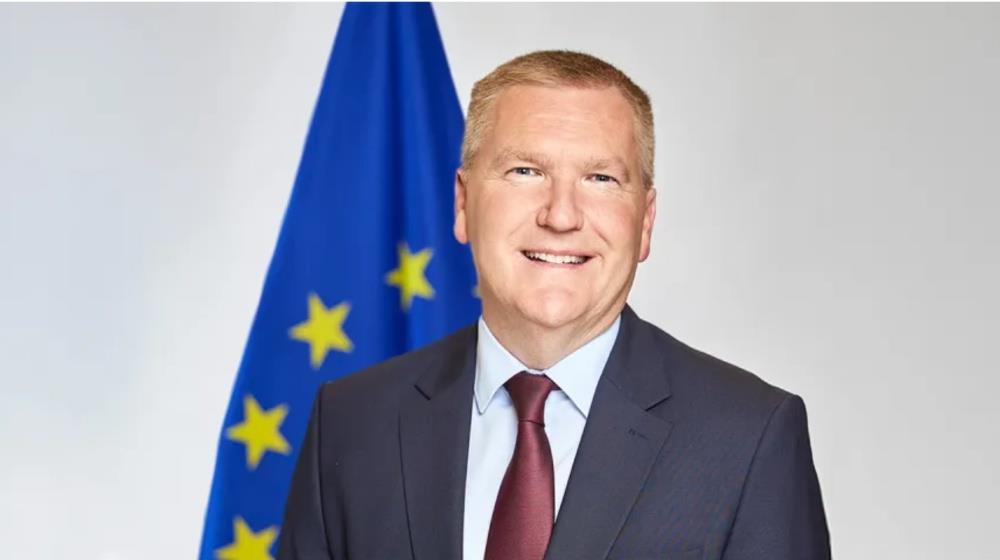
Simplification does not mean deregulation, but smarter, clearer and more workable rules, European Commissioner for Democracy, Justice, the Rule of Law and Consumer Protection, Michael McGrath says.
Talking about the recently adopted Consumer Agenda and the forthcoming Digital Fairness Act, in an interview with the Cyprus News Agency, he stressed that consumer trust and competitiveness can and must go hand in hand.
The Commissioner is in Cyprus and will participate in the informal meeting of Ministers responsible for competitiveness on Tuesday. In this context, he talked to CNA about the Consumer Agenda, the Digital Fairness Act and the proposed 28th regime to build a new, truly European company structure - EU Inc.
Consumers need to believe the system works
Asked to comment on concerns that stricter consumer rules might increase compliance costs and risk stifling innovation, the Commissioner said that the Commission’s starting point is that “consumer trust and competitiveness can and must go hand in hand. The EU Single Market can only function at its full potential if consumers have confidence that the rules protect them fairly and consistently, wherever they are in the Union”, he said, adding that consumers need to believe the system works for them.
“Strengthening consumer protection is therefore not a hinder to competitiveness; it is a precondition for it. We also need to ensure a fair and level playing field in the Single Market, one that benefits businesses that respect the law. We cannot allow unfair competition to undermine European business models and market structures”, he highlighted.
Commissioner McGrath noted that digital disruption is reshaping consumer behaviour and market dynamics at an unprecedented pace. New platforms, intermediaries, and targeting techniques are transforming how goods and services are offered and consumed. “Some of these developments drive innovation and choice. Others rely on practices that undermine trust and distort competition. Our task is to ensure that the regulatory framework keeps pace with this reality”, he underlined.
As he explained, the Digital Fairness Act (DFA), “which we aim to bring forward in the 4th quarter of 2026, will fill remaining gaps in our consumer protection laws. It aims to ensure legal certainty for all market participants. By addressing unfair practices, it will not only strengthen consumer protection but also help ensure that compliant companies are not placed at a competitive disadvantage”.
The DFA will therefore target key sources of unfairness that distort competition and undermine trust, including dark patterns and addictive design, he continued. It will also include a strong dimension for the protection of minors. “Protecting children is not only a moral imperative and I appreciate that there is a growing readiness to act – in Europe and beyond. It is also an investment in the long-term sustainability of the digital market, as it encourages safety and responsibility to be embedded in the design of these applications from day one, and ultimately, supports durable growth”, he stated.
Simplification is a priority
Noting that simplification is a priority for this Commission and himself, he said that this is why the DFA will also contribute to simplification. However, he stressed, “simplification does not mean deregulation. It means smarter, clearer and more workable rules. Drawing on our experience and consultations, we see scope for targeted simplification without lowering the level of consumer protection. We are looking at simplifying certain pre-contractual information requirements, as well as alleviating the rules on the 14-day right of withdrawal from digital media subscriptions and price reduction rules for perishable goods”, he said. He also underlined that EU consumer law is already relatively light in terms of business obligations. “We intend to maintain that approach”, he asserted.
Asked on how the Commission ensures that these rules are enforced uniformly across the Single Market, particularly in small markets, such as Cyprus, he said that “strong and clear rules matter. But rules only matter when they’re enforced, consistently and credibly, across the European Union”.
That is why enforcement is at the heart of the consumer agenda, he explained. Consumers should enjoy the same level of protection wherever they live in the Union, and compliant businesses must be able to enjoy a level-playing field and compete on equal terms, regardless of market size, he commented, adding that smaller markets such as Cyprus are no exception - they are an integral part of the EU Single Market and must benefit fully from it.
He noted that under the current framework, the responsibility for enforcing EU consumer-protection laws lies with the Member States. “The Commission does not enforce consumer law directly, but it plays a central role in supporting and coordinating the enforcement work of the Member States when tackling cross-border breaches under the Consumer Protection Cooperation (CPC) Regulation. This cooperation is essential in a digital economy where illegal practices rarely stop at national borders”, he noted.
The Commissioner referred to the recent coordinated CPC actions against large online traders, such as Temu and SHEIN for illegal practices. They “demonstrate that this model can deliver results. These actions are complemented by the Commission’s own investigations under the Digital Services Act (DSA),” he noted.
At the same time, he said, these cases have also highlighted clear limitations in the way the enforcement of consumer law currently operates. “Coordination among national authorities can be slow, and in fast-moving digital markets, time risks working in favour of those who bend or break the rules. We need to adapt to prevent this”, he highlighted.
A revision of the CPC Regulation by the end of 2026
McGrath explained that coordination among national authorities is time-consuming, which e-commerce traders exploit to gain unfair competitive advantages over compliant traders. Moreover, the absence of effective sanctions in coordinated actions weakens deterrence and risks undermining trust in the system.
“This is precisely why, in the 2030 Consumer Agenda, the Commission announced a revision of the CPC Regulation by the end of 2026. Our objective is clear: to make enforcement faster, more consistent and more deterrent, while preserving an important role for national authorities. As part of this work, we are exploring whether, in clearly defined cross-border cases, a stronger role at EU level could help ensure swift and effective enforcement.”
The Commissioner emphasized that stronger enforcement is not about adding red tape for businesses. “It is about legal certainty, fairness and confidence. A more consistent application of consumer law across the Union benefits consumers, but it also benefits businesses, especially those operating across borders, by providing clear rules, predictable outcomes and a level playing field”, he said, adding that this is where the Digital Fairness Act comes in. “By clarifying and modernising the rules for digital markets, it will make obligations easier to understand for businesses and enforcement more coherent for authorities.”
EU Inc.: a new, truly European company structure
Asked on what problem is the proposed “EU Inc.”, or 28th regime, seeks to address, he said that one of the major challenges business founders are facing across Europe today is a fragmented legal landscape. “Today, despite the Single Market, companies still face 27 different company laws, reporting rules and compliance requirements. This fragmentation generates high legal and compliance costs, making it more difficult to raise capital and slowing down expansions. It acts as a structural barrier to scale”.
As a result, he said, too many companies are forced to look beyond the continent to grow and scale up – because each expansion into another Member State means adapting to a new legal regime. “In practice, the market of 450 million Europeans is not yet a truly unified market for doing business.”
Commissioner McGrath admitted that the EU has attempted to address this issue before. He recalled that the Societas Europaea (SE) was a significant step forward, but it took over 30 years to establish its legal framework. “While that company form exists today, it remains complex, costly to set up, and ill-suited for start-ups or scale-ups. The European Private Company proposal, for its part, never made it to adoption. We have learned our lessons, and will not repeat the mistakes of the past,” he argued.
As he pointed out, what is different today is “the combination of the irrefutable demand of founders and businesses, clear political momentum for more European competitiveness, and innovative digital tools that make delivery possible and within reach.” Existing EU rules coordinate certain aspects of company law, but do not provide a single, uniform corporate framework that applies seamlessly across the Union, he said, noting that that gap remains, and it is holding Europe back.
“This complexity acts as a handbrake on growth, innovation and investment, limiting the potential profit of European companies and weakening Europe’s competitiveness. To enhance Europe’s competitiveness withing the Single Market, European companies must be able to move, operate and raise capital freely and quickly across borders, without facing new legal obstacles at each step”, he said.
A new, truly European company structure
The ultimate aim of our 28th regime is therefore “to create a new, truly European company structure - EU Inc. - with one single and uniform set of rules, avoiding 27 national variations of the same regime. EU Inc. is about simplicity, speed and scale,” he argued.
The Commissioner said that the new framework will respond to the needs of innovative companies but would be legally available to all founders, offering simple, flexible and fast procedures for setting up and operating across the EU, with a strong focus on attracting investment. “Concretely, our entrepreneurs and innovative companies, will be able to register a company anywhere in the EU within 48 hours – fully online, and benefit from a single capital regime across all Member States.”
Under the 28th regime, “we are prioritising a digital-first system that offers digital-by-default solutions to companies throughout the company lifecycle, for setting up, operating and importantly, attracting investment – building on existing tools such as online company formation and the EU Company Certificate,” he said.
Ultimately, the benefits of the new EU Inc. will be felt far beyond the business community. It will translate into better jobs, higher living standards, and greater opportunities for citizens, while also strengthening Europe’s position in the global economy through a more competitive, resilient and well-established European market, he added.
“With these initiatives, we aim to build an environment where more businesses are set up in Europe and can grow and attract capital and investment within our borders. By establishing a modern and simple legal regime for companies, we strengthen our global competitiveness and position Europe as a global leader,” he stressed.
Asked to give a timeframe on when companies will begin feeling the practical impact of the EU Inc. proposal, he said that the EU Inc. initiative is still at a pre-legislative stage. “Work on the forthcoming proposal is well underway, and the focus now is on shaping a framework that is both ambitious and deliverable,” he said.
Once the proposal is adopted and implemented, companies are expected to begin feeling the practical impact gradually, starting with easier and faster company formation and simplified cross-border operations, particularly for SMEs and innovative companies, he estimated.
“There is a clear sense of urgency, as also expressed by EU leaders in the conclusions of the October European Council. The economic need is well understood, and the objective is to translate this momentum into law as swiftly as possible. As the Commissioner responsible, I wish to see the initiative become applicable law as quickly as possible to respond to the present economic need. Fast adoption will depend on strong political buy-in from EU Member States, disciplined legislative choices, close cooperation between the co-legislators – the Council of Ministers and the European Parliament -, and a strong focus on implementation from the outset,” the Commissioner highlighted.
Moreover, he added, just as important as adoption is uptake. “For EU Inc. to deliver its full potential, it must be actively promoted through national administrations, business networks, start-up ecosystems and legal practitioners. Entrepreneurs across Europe need to understand not only that the regime exists, but why it works for them.”
EU Inc. also needs to be embedded in Europe’s wider innovation and competitiveness agenda, he continued, quoting Commissioner for Startups, Research and Innovation Ekaterina Zaharieva, who, in the context of the Innovation Act, said that Europe does not lack ideas or talent - it lacks the conditions for innovation to scale quickly across borders.
“EU Inc. can help provide the missing link: a legal infrastructure that complements innovation policy by reducing fragmentation, lowering transaction costs and allowing innovative companies to grow seamlessly across the Single Market. Aligned with the forthcoming Innovation Act, it can help ensure that breakthroughs developed in Europe are commercialised, scaled and retained in Europe,” he said.
Finally, asked on what political resistance he might anticipate on the issue, he said that as discussions move forward, some Member States may express certain concerns regarding national competences, to ensure that the EU Inc is not used to circumvent national labour, social or tax laws. “We have been clear on this point: EU Inc. is a voluntary corporate framework. It is not a tool to bypass national labour or tax rules, but a means to reduce legal fragmentation while fully respecting Member State competences,” he concluded.
(Source: CNA)
