








At the dawn of 2026, most countries in the European Union have a statutory minimum wage.
Specifically, according to official Eurostat data, out of the 27 member states, 22 had a national minimum wage on 1 January, 2026. The exceptions are Denmark, Italy, Austria, Finland and Sweden, where wages are mainly regulated through collective agreements.
Countries with a minimum wage below €1,000
Eight countries are in the lower tier, with a monthly minimum wage lower than €1,000. These are Bulgaria with €620, Latvia with €780, Romania with €795, Hungary with €838, Estonia with €886, Slovakia with €915, the Czech Republic with €924 and Malta with €994.
The middle class - From €1,000 to €1,500
Another eight countries are in the middle range, with minimum wages between €1,000 and €1,500 per month.
This group includes Greece with €1,027 (this specific amount includes the integration of the two gifts into the twelve regular salaries of the year, as is the standard method of calculation by Eurostat), Croatia with €1,050, Portugal with €1,073, Cyprus with €1,088, Poland with €1,139, Lithuania with €1,153, Slovenia with €1,278 and Spain with €1,381.
Over €1,500
At the top of the ranking are six countries where the minimum wage exceeds €1,500.
France records €1,823, Belgium €2,112, the Netherlands €2,295, Germany €2,343, Ireland €2,391, while Luxembourg stands out with €2,704 per month.
The cost of living
In nominal terms, the highest minimum wage in the EU is 4.4 times higher than the lowest. However, these differences narrow significantly when adjusted for price levels in each country.
Using the purchasing power standard (PPS) approach, countries with a lower cost of living show relatively higher minimum wages.
The purchasing power standard, abbreviated as PPS, is an artificial currency unit. Theoretically, one PPS can buy the same amount of goods and services in each country. However, price differences across borders mean that different amounts of national currency units are needed for the same goods and services depending on the country. PPS are derived by dividing any economic aggregate of a country in national currency by its respective purchasing power parities.
PPS is the technical term used by Eurostat for the common currency in which national accounts aggregates are expressed when adjusted for price level differences using PPPs. Thus, PPPs can be interpreted as the exchange rate of the PPS against the euro.
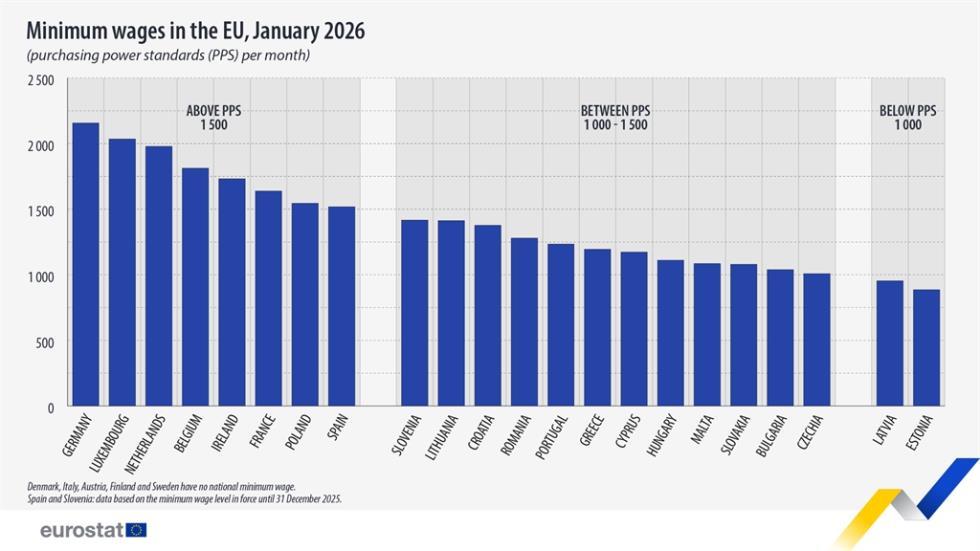
After the adjustment, minimum wages range from 886 PPS per month in Estonia to 2,157 PPS in Germany, which reduces the gap: the highest minimum wage is now 2.4 times higher than the lowest.
Three groups of countries in PPS terms
Based on purchasing power, countries with minimum wages are divided into three groups. The first, with earnings above 1,500 PPS, includes Germany, Luxembourg, the Netherlands, Belgium, Ireland, France, Poland and Spain.
In the second group, with minimum wages between 1,000 and 1,500 PPS, are Slovenia, Lithuania, Croatia, Romania, Portugal, Greece, Cyprus, Hungary, Malta, Slovakia, Bulgaria and the Czech Republic. In the third and lowest category, below 1,000 PPS, remain Latvia and Estonia.
It is noteworthy that compared to January 2025, three countries - Slovakia, Bulgaria and the Czech Republic - moved to a higher category in 2026, as their minimum wages exceeded the 1,000 PPS threshold.
(Source: InBusinessNews)
