




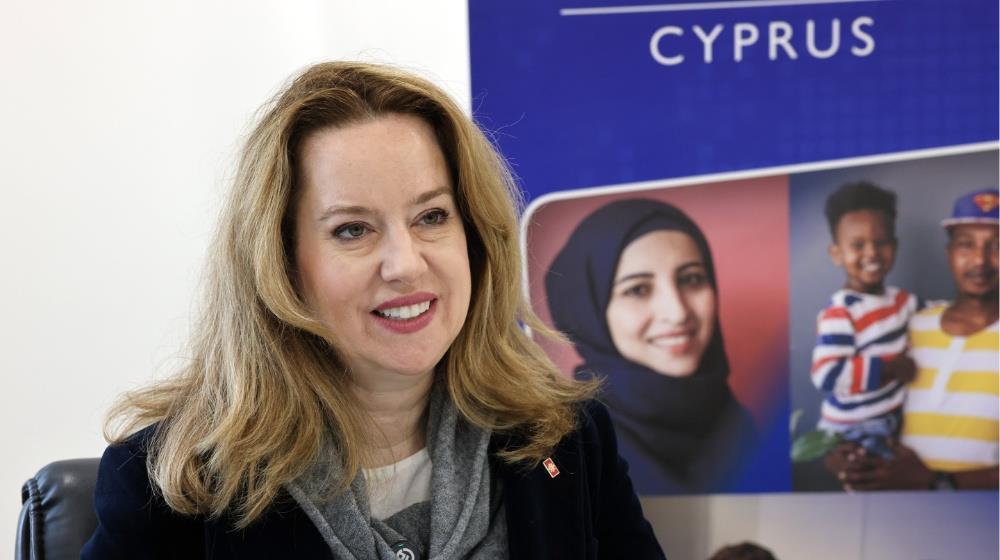
The EU has a unique opportunity at this moment in time, especially as they move forward with the implementation of the Pact on Migration and Asylum, to demonstrate that by working together they can get a better outcome than by working in isolation, Amy Pope, Director General of the International Organization for Migration (IOM), has told CNA in an interview.
Pope, who was in Cyprus for a two-day visit between 22 and 23 January, also spoke of a very constructive relationship between IOM’s mission in Cyprus with the Cypriot government on migration management, adding that it is critical for European governments to demonstrate that they have plans and strategies in place that can manage irregular migration and that people who have the skills that a country needs can come in legally.
Asked about the purpose of her visit, Pope said that Cyprus is a country where IOM's mission has grown quite a lot over the last couple of years, having realised increasingly how important Cyprus is to the situation involving migrants.
She added that the occasion for her visit is the beginning of the Cyprus Presidency of the Council of the EU and the task that is before all of the ministers as they reach the deadline for implementation of the Pact on Migration and Asylum.
“The primary purpose for me was to make sure that we stay well aligned with our member states as they confront that challenge and then also to have some conversations about irregular migration and how the Ministries can work together across Europe to counter the smuggling rings and make sure that migration is safer, is legal and works well for all people”, she noted.
Pairing development actions with migration and returns
Asked about key takeaways from her participation on Thursday, 22 January in the first day of the Informal meeting of EU Justice and Home Affairs Ministers, IOM’s head said that she was very heartened to hear a conversation around how we pair development actions with migration and returns.
“We know, especially because IOM is working with communities who are leaving often because of lack of opportunity at home, we are supporting situations where migrants, maybe they face climate shocks at home and they no longer have a house or they no longer have a job or there are just not enough jobs for all the young people" she added.
Ultimately, Pope explained, "when you look at how do you address that, it is often a development solution, thinking about how do we tie together development and migration policy and when migrants go back home, when they are returned, how do we make sure they become part of the development of their country more generally.”
Asked about IOM's view on the new EU Pact on Migration and Asylum and its upcoming implementation, Pope said it is quite a significant milestone that the members of the European Union have been able to come together and agree to this pact.
“We know from our work around the world that the more countries can share information, the more they have common standards, the more they work together on common policies, the more successful they can be in terms of managing the issue,” she said.
“From our point of view, the fact of having a pact is already extremely important. Our goal is to make sure that countries have the support they need when they look at implementation of the pact and also to make sure that implementation stays fair and humane and ultimately respects the fundamental rights of all people,” she further noted.
Addressing problems in a fair and humane way
Asked to highlight any particular projects or activities that IOM is actually undertaking in Cyprus, Pope said the primary issue that really drove the relationship with the government of Cyprus was the engagement around the unaccompanied children who are coming to the island.
“There has been a fairly significant number, especially of Syrians, young men, teenage boys from Syria. We worked with the government as they tried to address this in a fair and humane way, ensuring that the vulnerabilities were identified, protection needs were identified, but also to just manage logistically,” she continued.
“Through that, the relationship with the government has grown, and we have seen the government take on issues such as integration or job training or skills training for migrants who are here, but also to figure out how do we manage migration in a way that is accountable to the people of Cyprus. It is a very constructive relationship, we really appreciate the support we get from the government here and our ability to work with communities”, she added on the issue.
Asked to comment on the current state of play as regards migration in the wider region, the IOM head said that the discussion starts with the drivers of migration, why people are leaving.
“Because we know most people do not want to leave home, and certainly they do not want to leave home in the circumstances in which they are leaving, often very dangerous, often exploited, often carrying very little of their homeland with them. If you look in this region, we see so much insecurity and instability and of course Cyprus is on the front lines of that, often the country, a first destination for migrants who are coming,” she said.
“Now take the situation in Sudan. The conflict there now has been raging for over two years, particularly as it has become so much worse in Darfur. We are seeing more and more people from the country leave in search of safety and when they show up in neighbouring countries, whether it is Chad or Libya or Egypt, if they cannot find safety, if they cannot find a job, if their kids cannot go to school, then they will move again,” she continued.
“It is really important that we look at these opportunities to support communities the first time they move. Because the pressures on a country like Chad or Libya or Egypt can be quite significant. Often millions of people are coming across their borders, so thinking about are there ways to have solidarity with those countries so that people do not feel compelled to move again and again,” she further noted.
Current political debate in many European countries and the United States
Asked about the current political debate in many European countries and the United States on migration, Pope said that migration often becomes a proxy for concern about management by the government.
“You will see, we have seen, that there are political parties who will exploit the issue of migration as a way to undermine confidence in the government. It is critical on the one hand that governments demonstrate that they have plans, they have strategies that they can manage irregular migration," she noted.
Because, as she pointed out, "often the public is reacting to migrants who come across the Mediterranean or come across the channel or come across the desert. They are reacting to the sense of chaos or lack of order. So that is the first, is having a plan in order to manage irregular migration.”
“At the same time, we know because we hear from companies all over the world, especially in Europe, they need migrants because there just are not enough people to fill some of the jobs, whether it is in construction or agriculture or service or medicine or engineering or technology. So, having plans in place so that people who have the skills that a country needs can come in legally with a visa, with proper documentation, with proper management, ultimately will be critical to the success of the countries here in Europe,” she added.
Invited to say how recent political or geopolitical developments have affected IOM’s work and structure as a global organisation and how she sees the next steps in terms of delivering what the organisation has set out to do, the IOM head said it has been a tough year for anybody who works in the humanitarian space and certainly IOM was not exempted from that.
“We had to let go a lot of staff at the time because there simply were not the funds to keep them on and it was essential to ultimately save the organisation,” she continued.
“That said, there is a real opportunity to rethink how international organisations engage," she noted, adding that "organisations that were built 75 years ago in the wake of World War II do not necessarily have the right models to adjust to the realities of today, so I see it as an opportunity."
She posed the questions: "How do we ensure that we are relevant? How do we ensure that we are using technology to be most efficient with the use of the resources we have? How do we show the public that their investment in the work actually is meaningful for them?, " replying at the same time that "and communicating about that is essential. New ways of working is essential. Partnering with the private sector is essential, but I think it is a moment for all of us who work in the space to demonstrate why our work matters to ordinary people.”
No way one country can solve issues such as migration by itself
Asked if she is optimistic the level of international cooperation that is needed to solve global problems can be attained, Pope said that there is no way one country can solve issues such as migration by itself.
“It depends on the cooperation of multiple countries, whether it is the country of origin or the country of transit or the country of destination. The evidence is there and I really see it as up to governments to use institutions that exist”, she continued.
“My authority to act, our legitimacy as an organisation comes from the states who are members of the organisation, so we think we have something to offer them that they do not have on their own. We offer them platforms for engagement, ways to exchange best practices, capacity to help support when they do not have the capacity. Ultimately, I think that is a valuable asset that countries will not want to lose,” she noted.
Asked finally to give a message for the Cyprus Presidency and the EU, as the EU is an important actor in this area, not only in terms of policy but in terms of means and assets, Pope said that the number one is that states should not underestimate the impact of migration in ways that go well beyond the movement of people.
“We see migration driving political outcomes, we are seeing it drive changes in government. And the EU has a unique opportunity at this moment in time, especially as they move forward with the implementation of the pact, to demonstrate that by working together they can get a better outcome than by working in isolation. That is a message that is critical at this moment in time that will enable the EU to be stronger, to have more leverage and ultimately deliver more for the people of Europe,” she concluded.
(Source: CNA)