








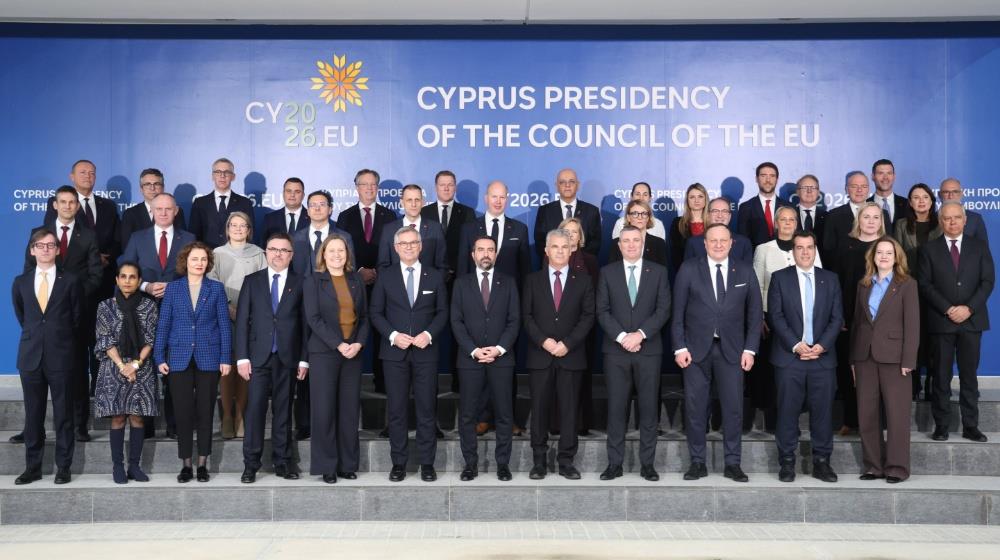
Cyprus’ application to join the Schengen area was at the centre of a press conference that followed the Informal Meeting of EU Justice and Home Affairs Ministers in Nicosia, with European Commissioner for Internal Affairs and Migration Magnus Brunner expressing optimism that solutions can be found to address the island’s particularities, including the Green Line.
Speaking at the Thursday, 22 January event, Brunner acknowledged the sensitivities surrounding Cyprus’ divided status.
“The Green Line is a challenge, definitely. That’s what we are all aware of,” he said. “But I’m very optimistic that we can find a solution also for the Green Line, of course, and for Cyprus altogether,” he noted.
Brunner stressed that Cyprus’ “exceptional situation” would be fully taken into account in the accession process, while maintaining the high security standards required for the Schengen area as a whole. He reiterated the European Commission’s unequivocal support for Cyprus’ Schengen application, describing accession as beneficial not only for the island but for the entire Schengen zone.
“We are fully supporting Cyprus to join the Schengen area,” he said, noting that Cyprus’ participation would strengthen the system as a whole. While declining to commit to a specific timetable, Brunner pointed to tangible progress in recent months and confirmed that a new evaluation report on Cyprus’ readiness is expected soon. “We do everything to support Cyprus on their way to join Schengen,” he added.
Concerns that Schengen accession could harden the island’s division were firmly rejected by Deputy Minister of Migration and International Protection, Nicholas Ioannides. “The Green Line is not a border and will never become a border,” he said, recalling that this principle is explicitly set out in the EU’s Green Line Regulation.
Ioannides clarified, however, that the regulation allows the Republic of Cyprus to carry out checks and controls along the line. “It’s not a border, but we’re entitled to carry out controls according to a specific legal framework,” he said.
Returns to Syria and Afghanistan under scrutiny
On migration returns, particularly to Syria and Afghanistan, Brunner highlighted significant developments in Syria following the fall of the Assad regime, pointing to what he described as a changing environment for returns.
“Over three million Syrians have been returned already,” he said, mainly from neighbouring countries and through internal returns, while noting that EU-supported returns have also increased. “Frontex supported almost 6,000 voluntary returns to Syria already,” he added, referring to what he described as a more stable situation in parts of the country.
Brunner outlined the EU’s broader engagement with Syria, including political dialogue, economic assistance and the gradual lifting of sanctions.
“We spent about €620 million for 2026 and 2027,” he said, arguing that improving living conditions is essential for enabling sustainable returns. EU asylum authorities, he added, assess that conditions have improved “for certain groups of people”.
On Afghanistan, Brunner reaffirmed that the EU continues to follow a policy of non-recognition of the de facto authorities, while engaging pragmatically at a technical level. “We are coordinating with member states to better structure our engagement on readmission,” he said. “We need to find solutions in the interests of European Union citizens,” he further noted.
Ioannides acknowledged that the absence of identification documents remains a major obstacle to returns. “It’s not just Syria and Afghanistan, but it’s a general problem,” he said, explaining that such cases are addressed through contacts with diplomatic or governmental authorities in countries of origin.
Focusing on Syria, he said that around 5,000 Syrian nationals in Cyprus have already revoked their status or withdrawn their asylum applications, with most having returned to Syria.
Questions were also raised about the return of convicted criminals and individuals posing security risks. Justice and Public Order Minister, Costas Fitiris, clarified that transfers of sentenced persons can only take place with the consent of the country of origin. He added that voluntary returns are possible for those who renounce asylum or remain illegally, in line with international procedures.
Ioannides stressed that cases involving convicted individuals are assessed on an individual basis. “We do not revoke international protection status without examining each case carefully,” he said, noting that the EU and international law allow for revocation in cases of serious crimes. “Protection of human rights is our red line,” he added, emphasising that individuals have full access to judicial remedies before any return decision is enforced.
Schengen security and secondary movements
The broader functioning of the Schengen area was also at the heart of the informal Council. Fitiris said Ministers held a substantive and constructive exchange on safeguarding Schengen, with a particular focus on internal security and compensatory measures to prevent and limit secondary movements.
He noted that secondary movements remain a common challenge across Schengen, affecting member states in different ways and requiring coordinated, trust-based responses at the highest level. Ministers underlined that Schengen’s proper functioning depends on mutual trust, shared responsibility and the consistent implementation of agreed rules and tools.
In his concluding remarks, Brunner praised the Cypriot Presidency for a “very good start” and strong cooperation. He said that 2025 marked significant progress in EU migration and asylum policy, with most legislative elements now in place, except for the EU Return Regulation, which remains under negotiation with the European Parliament.
Ioannides said that, as the EU Presidency, Cyprus is determined to translate shared European priorities into concrete results. He stressed that effective, fair and sustainable return policies are a cornerstone of a credible EU migration and asylum system, noting that discussions focused on closing the gap between return decisions and their actual implementation.
Ioannides reaffirmed Cyprus’ commitment to the timely implementation of the EU Pact on Migration and Asylum, underlining that the Presidency’s priorities are strong external borders, streamlined procedures and a reinforced return system, based on solidarity, responsibility and sincere cooperation.
The Ministry of Justice and Public Order said in a press release in relation to today’s proceedings that the Ministers engaged in a substantive and constructive exchange of views on ensuring the smooth functioning of the Schengen area, with an emphasis on internal security and on compensatory measures to prevent and limit secondary movements. It was confirmed that secondary movements remain a common challenge for the Schengen area, requiring coordinated and trust-based responses at the highest level, it is noted.
Cyprus has been divided since 1974, when Turkish troops invaded and occupied 37% of its territory.
(Source: CNA)
