








Across Europe, how people live is changing. Home ownership is gradually declining, renting is becoming more common, and housing costs continue to rise faster than incomes. According to Eurostat’s Housing in Europe – 2025 edition, these shifts are not isolated trends, but part of a wider structural transformation affecting nearly every EU country, including Cyprus.
While Cyprus often appears well-positioned in headline statistics, a closer look reveals a more complex reality.
The Hidden Imbalance Behind the Numbers
Eurostat data shows that Cyprus has one of the lowest overcrowding rates in the EU (just 2%) and one of the lowest housing cost overburden rates, with households spending on average 11% of disposable income on housing — significantly below the EU average of 19%.
At the same time, Cyprus records the highest share of under-occupied homes in Europe: 70% of housing units are larger than the needs of the households living in them.
*Chart below:
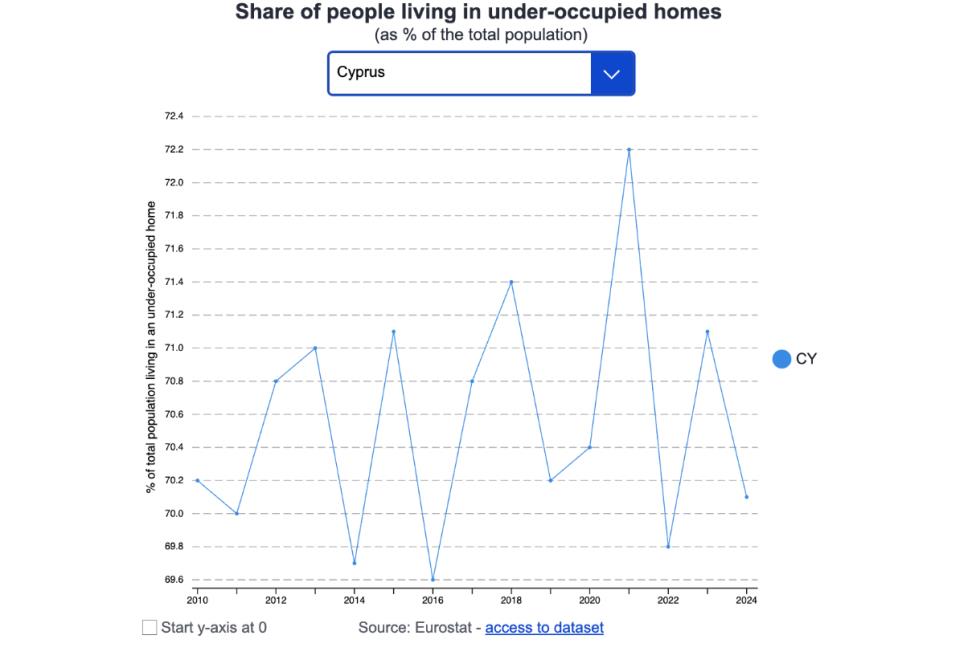
This suggests a structural imbalance rather than abundance.
In simple terms:
-
Homes exist, but not always where, how, or for whom they are needed.
-
Much of the housing stock is tied up in ownership, long-term under-occupation, or investment use.
-
What remains scarce is modern, long-term rental supply, particularly in urban areas.
Does Rising Supply Always Lower Rents?
Eurostat data shows that housing construction and investment across Europe have increased over the past decade. Between 2010 and 2024, housing building permits in the EU rose by 5%, and investment in housing reached 5.3% of EU GDP in 2024. Cyprus stands out, with 8% of GDP invested in housing, one of the highest rates in Europe.
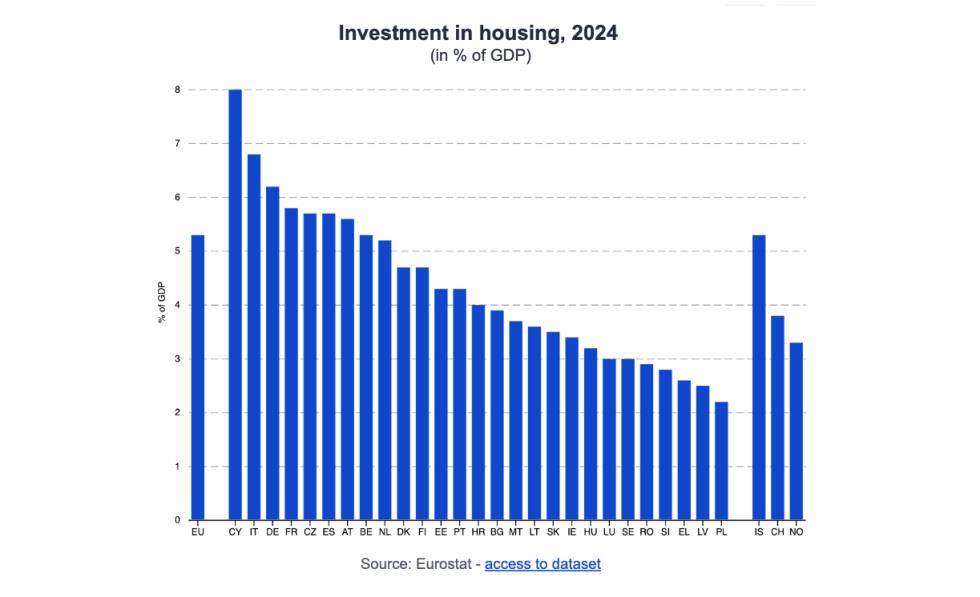
Yet during the same period, rents across the EU increased by 25%, while house prices rose by 53% — a clear indication that increased construction alone does not automatically translate into rental affordability.
The reason lies in how housing supply is used, not just how much is built.
Eurostat’s housing data highlights a structural mismatch in Cyprus in particular:
-
70% of homes in Cyprus are under-occupied, the highest share in the EU.
-
Home ownership remains dominant, while long-term rental supply remains limited.
This suggests that a significant portion of housing stock is locked outside the long-term rental market.
In practice, traditional development models distribute new housing across very different uses, many of which do not address long-term rental demand:
-
Villas and holiday homes, often designed for seasonal or private use, rarely enter the long-term rental market.
-
Homes built for sale, absorbed by owner-occupiers or individual investors rather than renters.
-
Investment-driven properties, held for capital appreciation or intermittent use.
-
Short-term accommodation, which increases total housing stock but reduces availability for long-term residents.
As a result, while construction activity may appear strong, the number of homes that actually reach the long-term rental market remains constrained — explaining why rents continue to rise despite increased supply.
Build to Rent: A Different Supply Equation
Build to Rent (BTR) reverses this logic.
Instead of selling units individually, 100% of homes are designed, delivered, and retained for long-term rental. This creates a direct, measurable increase in rental supply — not potential supply, but real, usable homes.
In markets where BTR is established (such as Germany, Austria, Denmark, and the UK), the model has helped:
-
Stabilise rental prices
-
Reduce speculation-driven volatility
-
Improve quality and security for tenants
-
Professionalise property management
Germany is a particularly relevant example. It is the only EU country where renting is more common than owning, with 53% of the population living in rented housing — supported by a strong, institutionally managed rental sector.
Affordability, Stability, and Social Inclusion
Eurostat data also shows that:
-
9% of EU citizens cannot keep their homes adequately warm
-
Nearly 6% of people report discrimination when looking for housing
-
People at risk of poverty are twice as likely to experience housing discrimination
These challenges point to a broader truth: housing is no longer just a real estate issue. It is a social, economic, and labour-market issue.
As home ownership declines across Europe, the quality and availability of rental housing becomes critical — especially for young professionals, families, and mobile workers who need flexibility without insecurity.
A Supply-Led Path Forward
Cyprus’ housing challenge is not rooted in lack of construction alone. It is rooted in how housing is delivered to the market.
A supply-led approach that prioritises:
-
Long-term rental stock
-
Professional management
-
Predictable pricing
-
Integration with urban planning
All the above mentioned, can help rebalance the system — easing pressure at both the high and low ends of the rental market.
Build to Rent is not a silver bullet. But as Eurostat’s data makes clear, without structural changes to rental supply, affordability pressures are unlikely to ease — regardless of how many units are built.
The question is no longer whether Cyprus needs more housing. Rather, it is what kind of housing will truly meet the needs of the people who live and work here.