







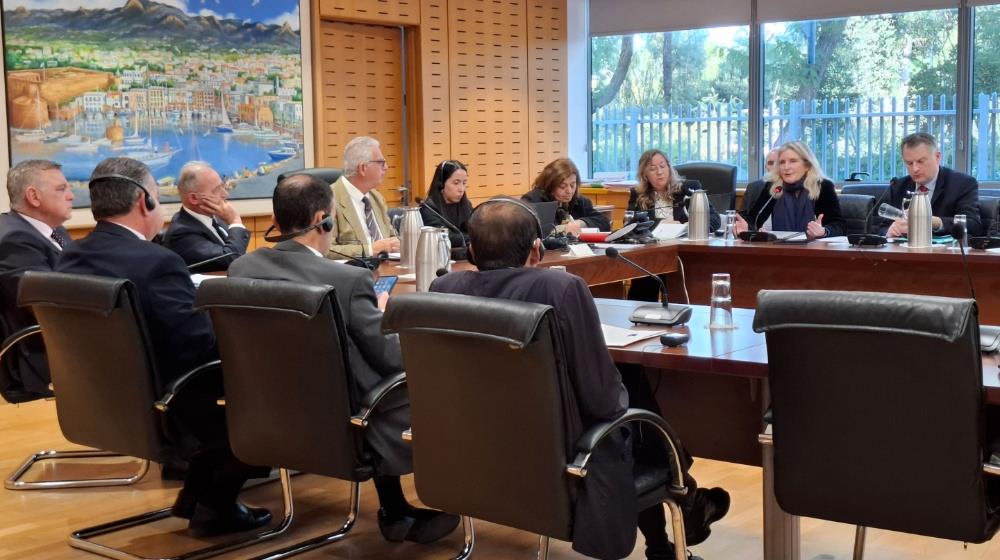
The European Commission counts on the Cyprus’ EU Council Presidency, to help “wake up the single market giant”, European Commission's Director-General for Internal Market, Industry, Entrepreneurship and SMEs, Kerstin Jorna has told the Standing Committee on Energy, Trade, Industry and Tourism of the House of Representatives.
The Committee was discussing the Draghi Report on Tuesday, 16 December. The Committee’s Chair, Democratic Rally (DISY) MP, Kyriakos Hadjiyiannis, noted the need for national parliaments to contribute to the implementation of the actions deriving from the Report. He highlighted the need to move towards implementation of the Draghi Report’s suggestions and asked the Commission to fast-track evaluating the national plans for the Report's implementation.
Jorna compared the European single market economy to a “sleeping giant” with a GDP of €3 trillion, who, however, “is not getting up and flexing his muscle”. Naming some of the problems the EU economy is facing, she noted that innovation is not ending up to the market, she spoke of EU’s dependencies on raw materials, energy exposure, and the weaponization and disruption in supply chains.
“It’s time to wake up the giant”, she said, noting that we need to act on the Draghi Report. “We need Cyprus and its Presidency to wake up the giant,” she stressed.
Giving examples on what the Commission is working on towards that direction, she said that we now have the European Economic Security Strategy, with a common risk analysis and toolbox, on what we can do to make sure that we diversify and that technologies have a chance to get to the market.
“It became very clear that we need a policy to secure supplies, a policy based on promoting projects and investments,” she said, noting that the Commission has chosen 29 projects in the areas of rare earth, batteries and defence materials. These 29 projects, if they go ahead as planned, “then in 2029 we reduce our dependencies on these areas,” she added.
On energy, she underlined Europe’s path to decorbanisation. “Sun and wind are the only energies we have in Europe”, she warned, explaining that decarbonisation means lower cost of energy and no dependencies. “It requires investments. We need to focus and mobilise investments on that. It makes sense long-term”, she stressed.
She then talked about EU’s maritime strategy, that the Commission is presenting during the Cyprus Presidency. “We will look at our EEZ, which is four times our landmass in Europe. Are we able to secure it? No. We don’t have the ships or drones to patrol and maintain cables and pipes,” she said, adding that “we want to make sure that we can build that equipment to have the capability to secure and use our EEZ.”
On simplification, she said that there are two pieces of legislation going forward. The first one is the Accelerator Act and the second the Public Procurement Reform. She noted that importance of these legislations, that will overwrite the national procedures.
Jorna also added that, based on a study, the Commission has identified “the 10 most stupid economic barriers”. Seven of them come from member states and three of them come from the EU. “We count on Cyprus’ Presidency to help us wake up the single market giant”, she highlighted.
The Director General said that the EU is no longer just about rule making. “It’s about creating investment conditions, having the right financial tools,” she said, referring to a new instrument, the Competitiveness Fund. As she explained, for the first time, “we make the money come to the projects rather than the other way around.” Jorna noted that “it will require a lot of grit from the Presidency to negotiate that” fund, which will be funded with €451 billion, for seven years. Additionally, she estimated that with the private sectors contribution, the overall investment could be 10 times that.
DISY’s MP, Averof Neophytou, argued that the EU needs to shape up its political architecture, in order to “wake up the giant”. “In Europe we have 27 national policies and you explained the obstacles, even in the internal market of EU”, he said, naming overregulation and bureaucracy as barriers.
On manufacturing, Neophytou said that “we didn’t plan in advance and we may run out of raw materials”. Additionally, he noted that the EU is an aging continent and will face radical problems pretty soon. “We see in all the EU people against migration. At the same time, without labour hands we’ll be in trouble in continuing to be a competitive economy.” He stressed that the EU needs a stronger leadership that will “wake up the giant and be able to compete.”
Finally, he added that the Trump administration “is a blessing for the EU”, as a wake up call for Europe to shape up, to solve its problems and become competitive.
(Source: CNA)
