







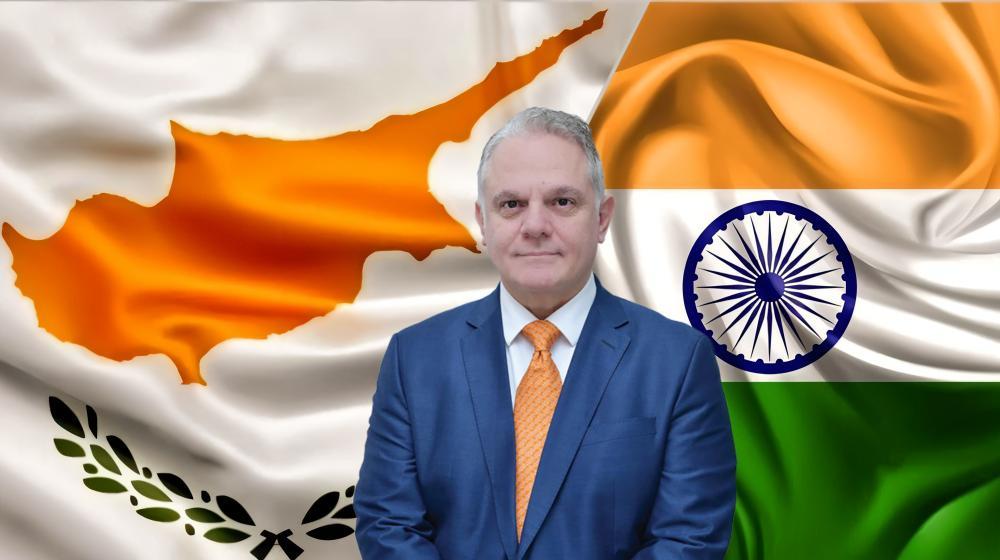
Cyprus’ High Commissioner to India, Evagoras Vryonides, delves into the deepening economic relationship between the two countries and examines how they can grow as strategic partners, with favourable investments by each one in the other.
How would you describe the current state of trade between India and Cyprus in terms of both volume and substance?
Cyprus and India enjoy excellent bilateral relations and close cooperation in international fora. This relationship has been constantly built upon and nurtured since Cyprus’ independence.
As for the current state of trade relations, though not fully explored to their desired potential, they also continue to strengthen steadily. Cypriot exports (excluding re-exports) to India increased to €28 million in 2024, as compared to €27 million in 2023, showing an increase of 3.7%, while total imports from India decreased to €92 million in 2024, compared to €106 million in 2023, indicating a deficit of 13.2%.
When it comes to investment, Cyprus is the 8th largest source of FDI for India, primarily in the sectors of services, IT, real estate and pharmaceuticals, while India ranks among the top ten foreign investors in Cyprus, highlighting the robust two-way nature of the investment relationship.
In addition, the two sides have agreed to promote collaboration in research, innovation and technology, fostering stronger ties among startups, academic institutions and industry, and supporting innovation exchanges in key sectors like artificial intelligence, digital infrastructure and research, with a view to concluding a relevant MoU. This will facilitate networking and attract researchers, start-ups and MNCs to Cyprus, as well as encouraging investment in the digital growth area.
Moreover, Cyprus attaches great importance to the India-Middle East-Europe Economic Corridor (IMEC), which offers significant prospects for inter-regional cooperation and connectivity in the areas of security, trade, energy and technology. Cyprus has expressed readiness to participate in IMEC projects, taking into account its strategic location, its EU membership and business-friendly environment, which includes an English-speaking workforce, a modern infrastructure, an impressive services sector and, in particular, a robust shipping sector.
Both countries share a strategic vision of serving as bridges between regions and underscore the significance of IMEC as a transformative, multi-nodal initiative that fosters peace, economic integration and sustainable development. Viewing IMEC as a catalyst for constructive regional cooperation, the two sides recently reiterated their shared commitment to promoting stability in the Eastern Mediterranean and the broader Middle East and emphasised the importance of fostering deeper engagement and corridors of interconnection from India through the Middle East to Europe.
Recognising Cyprus’ role as a gateway into Europe and, in this context, the prospect of serving as a regional hub for trans-shipment, storage, distribution and logistics, the two sides welcome the prospect of Indian shipping companies establishing a presence in Cyprus, encouraging the advancement of maritime cooperation through joint ventures involving Cyprus-based and Indian maritime service providers as a means of further strengthening economic and logistical ties.
Are there specific goals or milestones you would like to see achieved in India–Cyprus relations over the next five years? In your view, which sectors of India’s rapidly growing economy hold the most potential for Cypriot investors and companies?
Cyprus and India are in the process of implementing a Joint Action Plan for the next five years (2025-2029) which aims to guide the bilateral relationship forward, as agreed during the recent official visit to Cyprus by Prime Minister Modi. The visit was the first by an Indian PM in over two decades, marking a historic milestone and reaffirming the deep and enduring relationship between the two countries.
Both sides are committed and have agreed to promote collaboration in areas of trade and investment, defence and security, including maritime and cybersecurity, as well as in the sectors of research, innovation and science and technology (including emerging technologies such as AI), digital infrastructure and startups.
The energy sector is another area of potential cooperation that can contribute immensely to further developing economic ties. To this end, Cyprus aims to strengthen cooperation on issues related to energy efficiency and promotion of the use of renewable energy, especially solar energy. Cyprus is a member of the International Solar Alliance.
Moreover, Invest Cyprus is interested in establishing cooperation between Nicosia and Indian cities that are very active in technology, as well as between Indian IT and Tech Associations and the Cyprus Tech Association. Cyprus could be an ideal location for these companies to establish a regional presence in the EU.
An MoU between Invest Cyprus and Invest India on Enhancing Bilateral Investment Relations has been in place since 9 December 2021.
The India–Greece–Cyprus Business Council is an ambitious trilateral initiative. What unique value does Cyprus bring to this, particularly in terms of maritime trade, shipping services amd connectivity projects?
The India-Greece-Cyprus (IGC) Business and Investment Council, launched in February 2025 following the signing of an MoU between Eurobank and the Indian Chamber of Commerce in September 2024, is an important platform to accelerate trade and investment cooperation in the areas of infrastructure development, shipping, technology, financial services and SMEs.
The unique assets that Cyprus brings to this trilateral initiative are its strategic position and established image as a gateway to both the European market and the wider Eastern Mediterranean region for Indian entrepreneurs, as well as its evolution as an emerging and strategic hub for trade, sustainability and research & innovation.
As the Council acquires geo-economic importance in the context of IMEC developments, it looks for active participation within IMEC, with one of Cyprus’ objectives being to attract Indian investment and business interests and establish Cyprus as a strategic entry point to the EU market and wider Eastern Mediterranean region.
The Council can also play a vital role in strengthening the strategic relationship between Cyprus, India and Greece in terms of promoting innovation, investment and economic interconnection.
Are you seeing more Cypriot companies using India as a holding or investment platform, particularly in sectors such as fintech, maritime, and start-ups?
Although Cyprus and India already enjoy a strong investment relationship, it is constantly expanding. Eurobank Cyprus is about to establish an office in Mumbai and two Cyprus shipping companies, Interorient Navigation and Danship & Partners, will be investing around €1.2 billion in the Indian shipping sector, the largest ever example of FDI in the industry since it was opened to 100% FDI in 2005.
The recent MoU between Cyprus and the National Stock Exchange of India marks a notable development. What are the key expected outcomes of this collaboration?
The MoU signed during Prime Minister Modi’s recent visit to Cyprus seeks to increase capital flows through India’s GIFT City financial hub and allows European companies to list on NSE’s international arm at GIFT City, while Indian firms gain access to the Cyprus Stock Exchange, opening doors to European investors. The MoU also supports the creation of new financial products, including exchange-traded funds and links GIFT City with Cyprus.
How can Cyprus better position itself as a gateway for Indian capital and talent into Europe?
It should be stressed that Cyprus has already established itself as a leading centre for international business, including for Indian entrepreneurs.
As an EU and eurozone member, it provides access to the EU single market and it is expected to join the Schengen Area in 2026. This is another significant milestone for Cyprus, which will facilitate the mobility of third-country nationals within Europe. In the context of Cyprus’ preparation to enter the Schengen Area, Indian citizens holding multiple entry Schengen visas are exempted from acquiring a Cyprus national visa.
The Mobility Pilot Programme Agreement between Cyprus and India, which is expected to be finalised by the end of 2025, will support the mobility of talent between the two countries and within Europe.
Discussions are currently ongoing for a direct air connection that will help bolster tourism and business, as well as people-to-people ties, which are considered a strategic asset and multiplier for deepening economic and cultural ties.
Additionally, Cyprus offers a competitive corporate tax regime and has concluded many double taxation treaties, including one with India.
Its geographic position is strategic in that it bridges Europe, the Middle East and Asia, making it an important hub for trade, logistics and financing.
Cyprus’ untapped offshore gas reserves, as well as its English-speaking workforce, also contribute to its image of attracting global business and talent.
This interview first appeared in the October edition of GOLD magazine. Click here to view it.