






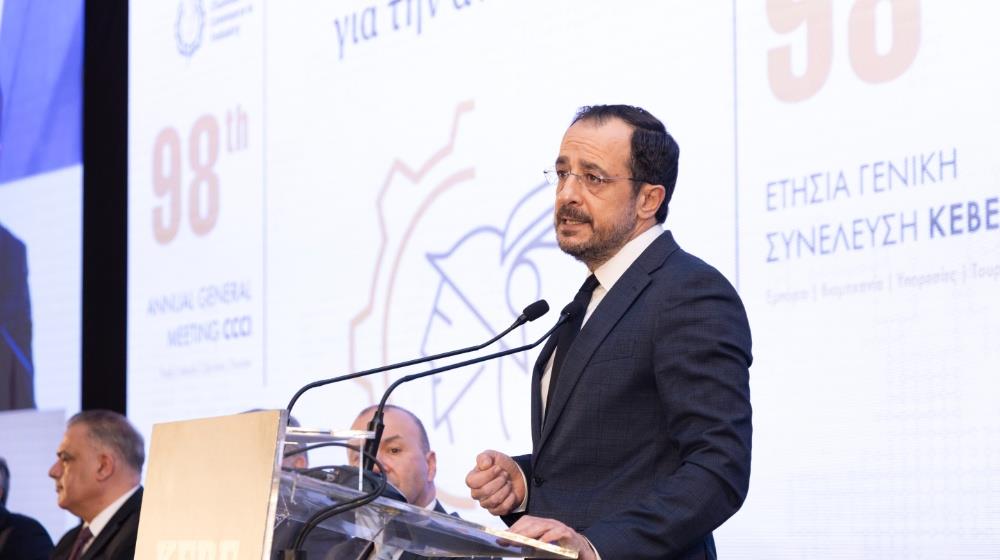
“Extroversion brings opportunities,” said the President of the Republic, Nikos Christodoulides, in his speech at the 98th General Assembly of the Cyprus Chamber of Commerce and Industry (CCCI), announcing, among other things, that in the coming period the Republic of Cyprus will proceed with “three very important agreements” expected to boost the extroversion of Cypriot businesses.
Specifically, during the 8 December evening ceremony, he noted that the agreements, which are expected to be signed shortly, concern one EU member state, one Gulf country, and one Asian country. “These are political and diplomatic agreements that include specific provisions on attracting investments to Cyprus from these three countries, as well as supporting the outward-looking activities of Cypriot enterprises,” the President emphasized.
Referring to the upcoming Cypriot Presidency of the Council of the EU, he stressed that Cyprus will be at the helm of the EU with the main objective of strengthening the Union’s competitiveness. “We need a more competitive Europe, a Europe that produces, innovates, and exports, so that we can also have a more competitive Cyprus,” he said, noting that the EU’s strategic autonomy cannot be achieved without a competitive Europe.
He pointed out that the first requirement for a competitive Cyprus is the extroversion of its businesses. The continuation of the positive course of the economy also depends on access to new trade destinations and on the strategic partnerships we build, he added.
In particular, he said that this means completing major EU trade agreements, such as the agreement with Mercosur countries, accelerating negotiations with Mexico and the countries of Southeast Asia, strengthening trade cooperation with the United Kingdom in the post-Brexit era, and maintaining a stable, predictable dialogue with the United States that reduces the risk of potential new unilateral tariffs.
It also means completing negotiations with two countries that are especially important for the Republic of Cyprus, India and the United Arab Emirates, for Free Trade Agreements, and continuing negotiations with Thailand, the Philippines, and Malaysia on trade and investments, he said. In the same context, he also referred to the full implementation of the EU–Canada Agreement.
Diplomatic footprint
“The strengthening of the diplomatic footprint of the Republic of Cyprus and the upgrading of its international standing have established the view that our country is, in practice and not just in words, a pillar of stability in the region, thus creating many advantages both politically and economically,” the President said. Among other things, he noted that the Strategic Dialogue with the United States and the United Kingdom, as well as the historic visit of the Prime Minister of India to Cyprus last June, “demonstrate our country’s enhanced position in international affairs and how this brings economic and commercial benefits.”
"In the immediate period ahead, we will proceed with three very important agreements, with an EU member state, a Gulf country, and an Asian country, political and diplomatic agreements that include specific provisions on attracting investments to Cyprus from them, as well as on the extroversion of Cypriot businesses,” he noted.
He made special reference to the visit of the Indian Prime Minister, which, he said, substantially upgraded bilateral relations and opened new strategic horizons, both for attracting investments, already producing results in the pharmaceutical, defence, and technology sectors, and for Cyprus’ potential participation in the IMEC trade corridor, “a prospect with clear geopolitical and economic benefits for our country.” He added that during the Cypriot Presidency, at the Informal Council in Cyprus on 23–24 April with the participation of all European leaders and leaders from the region, the EU will move forward with specific projects-investments in countries of the wider region.
Extroversion brings opportunities
“Extroversion brings opportunities. And this is precisely our responsibility: to create a business environment that is simple, functional, predictable, and friendly to entrepreneurship,” President Christodoulides said.
Bureaucracy, numerous and complex regulations, and the wider legislative framework remain the most significant challenges for attracting investments to Europe, he added. Referring to the Draghi Report, he said that “we are in the phase of moving from discussions to the adoption of specific measures.” Specifically, he noted that during the Cypriot Presidency, in the first half of 2026, the goal is to work toward completing the Omnibus Packages, aimed at targeted simplification, promoting a new European culture of regulatory self-restraint in lawmaking, reducing administrative costs for SMEs, and accelerating the single digital market and cross-border service tools.
Following the President's speech, Stavros Stavrou, the President of CCCI, presented the Chamber's proposals for the economy. Among other things, he stated that the agreement on the Cost of Living Allowance does not modernize the institution, that tax reform must strengthen investments and the economy, and appealed to trade unions to handle the right to strike “with the seriousness it deserves,” calling on the government to promote legislation regulating strikes in essential services.
(Source: CNA)
