





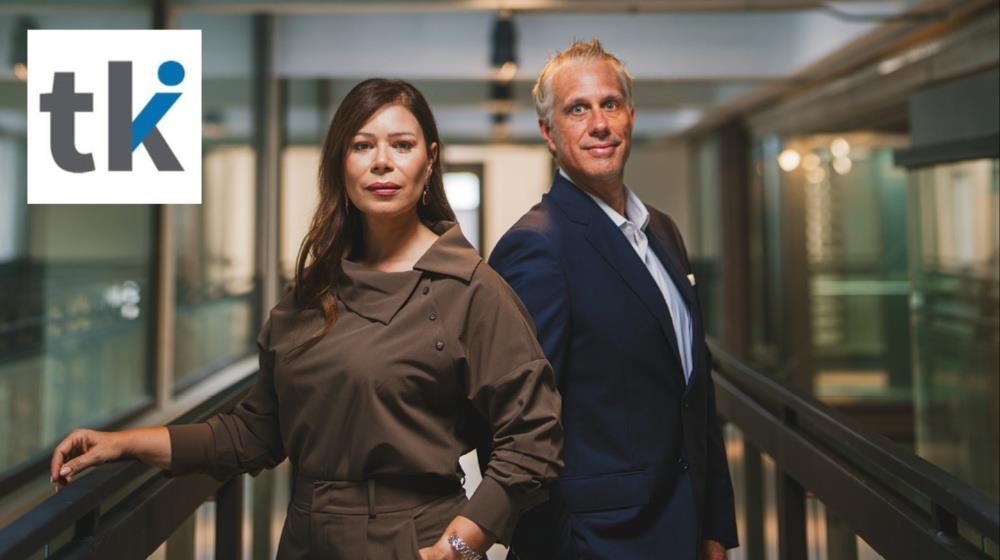
When Monica Ioannidou Polemitis launched Hybrid ConsulTech in 2024, she wanted to find new ways to innovate. A year later, she merged Hybrid with Thomas Gamble’s TKI – a US-based firm chasing bold technology ideas – establishing TKI’s presence in Cyprus to serve Europe, Middle East and Africa (EMEA).
Here, Ioannidou Polemitis and Gamble reflect on the way their worlds aligned and how the new company will drive change in the fast-growing market for enterprise-grade AI and data solutions.
Monica, you’ve spent much of your career helping companies navigate digital transformation and, in early 2024, you launched Hybrid ConsulTech. What prompted you to make that entrepreneurial leap and how did it reshape your perspective on digital transformation?
For more than twenty years, I had stood at the crossroads of innovation, guiding organisations as technology kept reshaping the landscape. Every wave, from the internet to the cloud, brought new possibilities but when AI emerged, I saw something fundamentally different. AI isn’t just another tool or upgrade; it’s a transformative force, challenging us to rethink how we make decisions, create value and lead teams forward. Though my career took me through diverse companies and large organisations, I was always an entrepreneur at heart, constantly finding new ways to innovate, drive change and bring fresh thinking into every environment. Launching Hybrid ConsulTech marked my decision to be an active creator. I wanted to start engineering change, building a company where strategy meets practical execution and where technology serves as an enabler, not just a headline. That shift taught me a profound lesson: true transformation isn’t a box to tick or a project with an expiry date. It’s about nurturing a living capability within organisations, a spark that brings people, data and leadership together in an ongoing evolution.
Thomas, you’ve built a long career at the intersection of technology and business development, from leading digital teams at FTI Consulting to founding TKI. Your favourite band, The Grateful Dead, once sang “What a long, strange trip it’s been.” Looking back, what experiences most shaped the way you now approach building technology partnerships?
That’s a great analogy! When I sit back and think about it, it really has been a long, strange trip. My career experiences have taught me a lot but working out how to blend the best of both worlds – entrepreneurial drive and corporate discipline – has been one of the biggest lessons. I started in direct sales – literally knocking on doors – which taught me how to connect with people and build trust. From there came the telecom IPO wave – pure sales chaos! –followed by the dot-com rise and fall, where I learned about application development and technical strategy through a firehose of information. At that point, I was ready to take what I had learned to market, so I created a small technical consulting and development firm that eventually merged with a company called Kinesis Marketing. That merger led to an acquisition by FTI Consulting, a global consulting company where I soaked up everything I could about enterprise consulting. I never lost my entrepreneurial bug, though. During the same period, my partner Pankaj Dalal and I built an application development company in India from almost nothing to over US$1 million in annual turnover. After several years in the corporate world, I realised that I missed entrepreneurship. Sure, the big job was nice but I missed feeling alive and the freedom to question what is impossible when helping a customer use technology to reach their goals. So, when the time was right, I stepped away from FTI to continue building TK Interactive in the US, which was later rebranded as TKI, as the commercial face of our Indian technology arm and, ultimately, TKI in Cyprus, aiming to serve the EMEA region. That same spirit of creativity and independence still defines us today: thoughtful yet bold, customer-first rather than technology-first, and always grounded in the belief that great partnerships are built on trust, imagination and a clear understanding of where our clients want to go, not just the newest shiny piece of technology.
So, how did your worlds merge? What was the spark that convinced you this merger could offer something greater than the sum of its parts?
Thomas Gamble: This one is a bit of a full-circle story. A very good friend and long-time business partner, Andreas Panayi, who was the CEO of Kinesis Marketing, introduced me to Monica, who was just launching Hybrid ConsulTech. We began collaborating through a joint-venture agreement about a year and a half before we decided to merge. The collaboration worked well but it became clear that a stronger partnership was needed to match the scale of what we were building. Earlier this year, we decided to meet midway in London to explore next steps. After spending a few days together, it was clear that Monica and I shared the same mindset and entrepreneurial spirit. She is tenacious, has a presence, genuinely loves helping clients and knows exactly what she wants. She is also not afraid to go after it. A merger was the natural next move. That shared energy, alignment and recognition of the EU and the region’s exploding tech and AI opportunities made creating TKI in Cyprus an easy decision. It wasn’t just about combining operations but about uniting complementary strengths in strategic consulting, deep technical delivery and a shared belief that technology should empower people, not overwhelm them. That is what made it greater than the sum of its parts.
The company was created to meet the growing demand for enterprise-grade AI and data solutions across Europe and the Middle East. So, what does your vision look like?
T.G.: We see Cyprus as a natural hub for innovation and expansion across the region, with our sights set on Greece, Saudi Arabia, the UAE and other key markets alongside our US and Indian operations. Having just spent my first week in Cyprus, I have to say that the energy is incredible. There is a genuine sense of curiosity, willingness and commitment – both financial and general – around AI growth and innovation. It is refreshing to see. Yes, the US and China may be leading the race today but what is happening here feels unique. There is a thoughtful belief in learning to create better. What I mean by that is that this region recognises the global AI leaders but is also focused on building something more balanced. There is a real opportunity to combine the best in innovation with the best in governance to shape a better, more responsible AI future. That balance between progress and accountability is exactly where we want to lead. This is where we see the greatest opportunity: helping companies become truly ready for AI and agentic systems. Not by chasing the newest shiny object but by guiding organisations through genuine AI readiness. Ensuring that their goals, governance and, most importantly, their data are fully prepared for the AI journey ahead.
Monica Ioannidou Polemitis: Tom really put it best. We see Cyprus as the ideal hub for innovation, seamlessly connecting Europe and the Middle East. When he was here, I had the opportunity to experience Cyprus through his fresh eyes, as someone new to the regional business environment. It was honestly energising. Tom was struck by the region’s ambition, warmth and openness to possibility. Exploring the market together made me appreciate even more the unique potential that Cyprus offers. There is genuine curiosity, a hunger for progress and a strong commitment, both culturally and financially, to embracing technology in new ways. That mix of vibrant local energy and international perspective is exactly why we chose Cyprus as a base.
Looking across the region, where do you see the biggest opportunities for AI-driven transformation? And what projects are you currently working on that illustrate this potential?
T.G.: We are seeing opportunities across many sectors but one of the most immediate areas of focus has been around data itself. Beyond general AI readiness, we are helping organisations design and implement modern datalakes and data warehouses. The reason is simple: companies today want to report and analyse information across multiple systems, departments or even entities within a parent or group structure. Many existing systems struggle to do that effectively. They often cannot bring together data from different sources, normalise it or analyse it historically. Most internal systems are still snapshot-based, which limits the ability to use past data for prediction. Even when these systems add AI features, they often fall short when it comes to cross-system integration and data quality. That is why we see data warehousing as a renewed area of opportunity. The technology itself isn’t new but when you enhance it with AI and agentic principles, it becomes transformative. Once data is extracted, defined and normalised, we can layer in AI capabilities that deliver autonomous processes, predictive insights and meaningful business foresight. In terms of sectors, we are currently seeing strong interest and momentum in shipping, healthcare, financial services and the public sector, each with unique challenges but all united by the same goal: turning their data into intelligent, actionable outcomes.
Successful AI adoption isn’t just about technology; it requires aligning people, processes and data governance. From your experience, what are the most painstaking issues that companies face during this transition and how do you help them overcome those hurdles?
M.I.P.: The toughest challenges in AI adoption are rarely about the technology itself; they’re about alignment. Too many organisations jump into AI with siloed data, outdated processes and teams speaking different languages about what it means to be truly AI-ready. As a result, pilots often stall, scaling becomes impossible and governance, along with accountability, arrives far too late in the game. Our mission is to close these gaps before they become roadblocks. We work side by side with our clients to create strong foundations: clean and unified data, transparent decision frameworks and governance models which ensure that innovation remains responsible, compliant and explainable. We embed AI literacy and thoughtful change management into the process from day one, turning adoption into a core business capability rather than a one-off side project. Ultimately, our approach is about orchestrating the evolution of technology, people and processes together. That’s how organisations move beyond experimentation, ensuring that AI investments translate into sustainable, meaningful value that endures far beyond the hype cycle.
Measuring Return on Investment (ROI) in AI can be notoriously difficult, as many benefits are qualitative or long-term. How do you help clients define clear objectives and metrics so they can track real impact and justify their investments?
M.I.P.: Measuring ROI in AI is really both an art and a science. The truth is that a lot of AI’s biggest wins aren’t immediately obvious; they show up in how teams adapt, make smarter decisions and become more confident using new tools. Too often, companies chase short-term numbers, missing out on this bigger, long-term value. It’s easy to spot the nice wins, like cost savings or quick efficiency gains, but the truly transformational impacts are much harder to quantify. These include changing how your organisation learns, collaborates or even reimagines what’s possible in its industry. These shifts rarely appear in a quarterly report but they lay the foundation for real, lasting progress. That’s why our approach goes beyond tracking what’s easy to count. We work with clients to measure both types of value, building frameworks that capture everything from immediate results to deeper changes in mindset and capability. This way, AI becomes more than just a “nice-to-have.” It becomes a lasting, transformational advantage.
Finally, what is your “secret sauce” – the element that sets you apart in an increasingly crowded market for AI and data consultancy?
T.G.: Our “secret sauce” comes from experience, not theory. We’ve been developing applications and guiding business strategy since 2002, moving through almost every side of the digital landscape: agency, consulting and pure technology delivery. Each one shaped how we think and how we build. From the agency world, we learned the importance of design, usability and storytelling – technology has to look good and feel intuitive. From consulting, we gained the ability to think big but also recognised that big ideas don’t need to be complicated or overly expensive. And from our years in technology delivery, we learned how to actually make things work, to build what’s needed and to stay mindful that technology is the medium, not the solution. Bringing those perspectives together gives us a rare balance. We approach every project with thoughtful solutions, focused on what the client truly needs, not what we as the solution provider want to sell. So, while AI and agentic systems are new and evolving at a pace we have never seen before, they are still technology and should be viewed as such. This mindset has earned us long-term partnerships built on trust, transparency and real outcomes. Because in the end, it’s never just about technology. It’s about people, progress and creating solutions that genuinely make a difference.
M.I.P.: Where to start! Uniqueness is just part of our DNA. We bring together a mix of experiences that’s honestly pretty rare: our team spans continents, from the US to Cyprus, India and beyond. That geographic spread isn’t just a fun fact; it shapes how we see problems and discover opportunities that others might miss. Our cultural and professional backgrounds are just as diverse. We have advisors and engineers, strategists and storytellers, people who grew up in big enterprises and those who thrived in hungry startups. This blend means that we don’t just offer abstract advice or technical quick fixes; we can actually bridge the gap between vision and execution, covering strategy, governance, design and deep technical delivery. All those pieces come together as a kind of perfect storm. We challenge each other, we learn from our clients and we never assume that there’s only one way to get results. In a crowded field, that ability to unite big-picture thinking with nuts-and-bolts engineering across cultures, sectors and regions is what turns our “secret sauce” into real, lasting impact for our clients.
(Original photo by TADOBI)
This interview first appeared in the November edition of GOLD magazine. Click here to view it.