








Cyprus’ housing reality is at a turning point. Rapid population growth, the mismatch between housing demand and supply, and the slow adaptation of institutions are creating a complex environment with significant social and economic consequences.
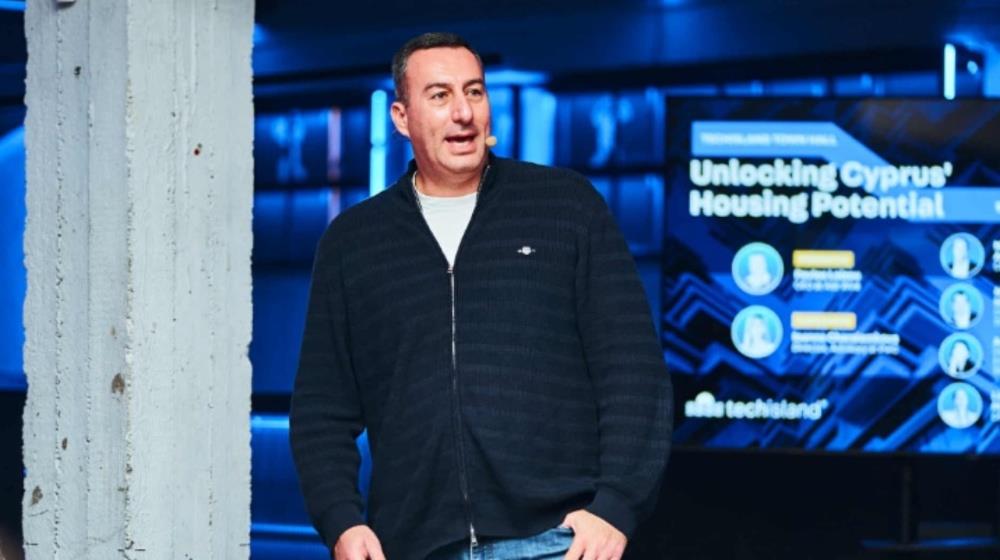
Pavlos Loizou, CEO of Ask Wire, presented a comprehensive analysis of the issue at the Unlocking Cyprus’ Housing Potential event organised by TechIsland, in his lecture “Housing Under Pressure: Aligning Cyprus’ Population, Infrastructure & Supply – Framing the Challenge”, highlighting the true dimensions of a crisis already shaping the country’s future.
As he explained, the discussion cannot be limited to fragmented references about rising prices or the difficulty of finding a place to live. From 2021 to today, Cyprus has added 70,000 to 80,000 new residents. According to Loizou, these belong to two distinct groups: a large group of lower-income workers covering crucial jobs in service sectors, and an even larger, highly skilled group arriving through technology and international companies. During the same period, permits were issued for 43,000 housing units, many of which are still under development and aimed at the middle and upper income brackets. The gap between real demand and the nature of new construction activity is widening.
Sustainability and buildings… worlds away from modern European standards
The picture is further complicated by the fact that a large part of Cyprus’ building stock is old and does not meet modern European energy standards. At the same time, renovation rates remain low, which, as Loizou stressed, constitutes a “structural mismatch that the market cannot correct without institutional tools and financial incentives”. According to the CEO’s presentation, the debate on energy, efficiency and sustainability is set to become one of the central challenges of the coming decade.
Preferences and the existing supply
The country’s demographic profile is changing rapidly. The fertility rate stands at 1.44, while the share of the population aged over 65 continues to rise. Cyprus relies increasingly on foreign labour, which, according to Loizou, directly affects household composition and the type of housing being sought. New arrivals tend to have smaller household sizes, usually from 1.6 to 2.1 persons, and prefer smaller spaces, modern specifications and easier access to employment areas. The existing supply continues to revolve around homes of 100 to 150 square metres in suburban locations, a model which, said Loizou, does not match the profile of new residents.
Structural constraints
The land development sector faces structural constraints that limit its ability to respond. Most companies are small-scale and operate exclusively under a build-and-sell model. The lack of institutional investors who would create a stock of housing for long-term rental leaves the rental market exposed to pressure. Meanwhile, shortages of specialised labour and rising material costs make a rapid expansion of construction activity particularly challenging. As Loizou noted, the result is a country that needs more small- and medium-sized housing, but lacks the mechanisms to produce it at a sufficient pace.
The PODcaST and the housing reality
Summarising the factors influencing housing conditions, Loizou presented the “PODcaST” framework: Population, Old stock, Demographics, Supply constraints, Tourism pressure. He said these five pillars determine the course of the housing system and the policy choices for the coming years. The strategic decisions the country must take are critical. Population growth requires a clear national stance, while infrastructure - water, energy, roads, schools, healthcare services - needs planning over a decade-long horizon rather than piecemeal interventions. The integration of foreign workers and the need for a definitive redefinition of land use are issues shaping the country’s economic development, the CEO pointed out.
Proposals that drive development
At the level of practical policy, Loizou proposed the creation of institutional funds for the development and management of long-term housing, greater transparency in the market through regulation of estate agents and developments, mobilisation of capital for renovations, and a review of tax incentives in the short-term rental market to prevent distortions. Affordable housing policies are required across all market tiers to enable smooth economic functioning and healthy social cohesion.
Is BTR the answer to the shortage of available housing?
Another proposal was adopting the Build to Rent (BTR) model. Build to Rent is a model for developing residential units designed and constructed exclusively for long-term leasing. It is a modern global tool that directly addresses the shortage of available housing, as every new unit is channelled entirely into the rental market. For Cyprus—where supply has decreased dramatically and rents are rising faster than wages—BTR can act as a “pressure-release valve”.
With professional management, stable contracts, energy-efficient units and shared facilities, such developments can quickly increase the supply of affordable housing, stabilise prices and create sustainable communities. The model is already successfully applied in other European countries such as the United Kingdom, the Netherlands and Germany, and could become one of the most effective ways of tackling Cyprus’s housing crisis.
Loizou’s position concludes with a clear message: Cyprus must align its demographic size, housing capacity and institutional organisation. The absence of a national direction allows pressures to build and turns the housing issue into a systemic one.
