







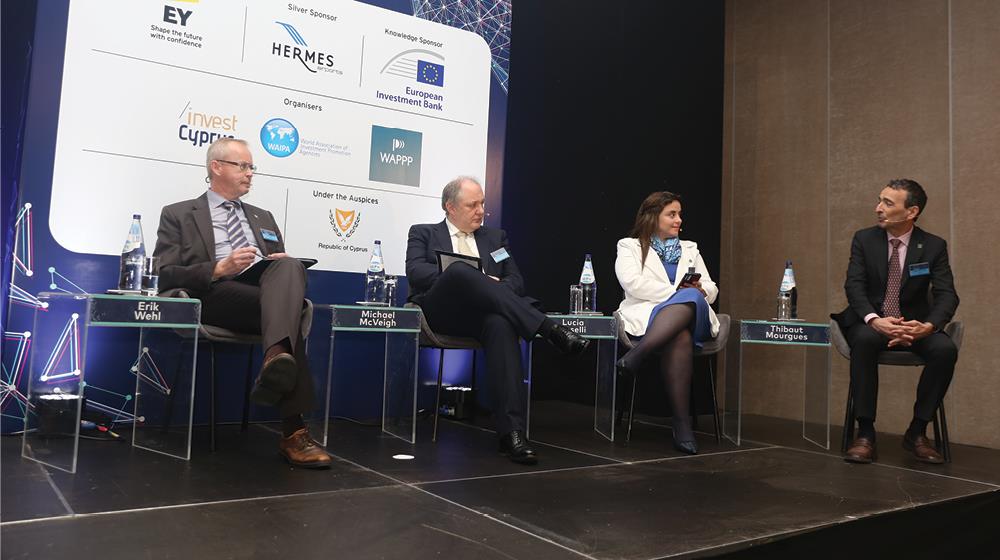
There’s no universal formula for Public-Private Partnerships (PPPs). But if there’s one lesson that emerged from the panel on sectoral strategies at the Unlocking Investment Through PPPs summit, it’s this: well-designed partnerships reflect the specific risks, timelines and regulatory environments of the sectors they serve. “PPPs only make sense if they deliver better outcomes than either public or private actors could on their own,” noted Michael McVeigh, Director, Government and Infrastructure at EY.
A publication edition containing an overview of what was discussed during the summit, is now available online. You can find it here.
Energy: From generation to grids
Lucia Fuselli, Chair of the Energy Chapter at WAPPP, opened with a blunt reminder: Cyprus may be aiming for 33% renewable energy by 2030 but, in 2024, it still struggled to use what it generated, curtailing 29% of its renewables due to grid limitations. “This is not unique to Cyprus,” she said. “It’s a system-level issue – and that’s where PPPs come in.”
She outlined three proven PPP structures for energy: IPP (Independent Power Producer) for generation projects with Power Purchase Agreements (PPAs); ESCO (Energy Service Company) for retrofits and distributed renewables, especially at the municipal level; and Waste-to-Energy, a globally tested model for circular economy initiatives.
But she warned that Cyprus must now move beyond generation to storage and smart grid infrastructure. PPPs can help, particularly in distribution networks and battery storage projects. Countries like Brazil, the Philippines and India have already used PPPs to roll out smart grid technologies and virtual power plants.
In e-mobility, the hybrid PPP model is already emerging: the state funds infrastructure like charging stations, while the private sector provides vehicles and operations. Some projects in Asia have even earned additional revenues through carbon credits. Fuselli also urged Cyprus to explore community energy, where it’s crucial to apply a “people-first” approach that prioritises affordability and social equity.
Water: Stable revenues, proven models
Water infrastructure may not be glamorous but it’s a sector where PPPs have quietly flourished. McVeigh listed the public policy failures that PPPs often help address: ageing infrastructure, underinvestment, water scarcity and climate resilience. “AI might help predict needs,” he said, “but we’re still dealing with outdated systems and a huge investment gap.”
He identified multiple PPP solutions, including project finance for specific investments like treatment facilities, concession or licence models – where a company has full-system operations over decades; privatisation – where private entities run water systems but the government sets strategic rules; and mutualisation – involving community stakeholders. Critically, water PPPs are often linked to energy efficiency. Projects that add solar, wind or biogas to water systems improve both environmental impact and financial viability.
With low-risk and stable revenue streams, water attracts institutional investors. The market is mature, the partners are experienced and the business case is replicable. But, McVeigh warned, success depends on getting the balance right: “Let private players bring efficiency but don’t hand over strategic control.”
Ports: Capital-intensive but well understood
If any sector demonstrates PPP maturity, it’s ports. According to Eric Wehl, Chair of the WAPPP Port Chapter, around 80% of global ports already operate under PPPs. Typically, the public side finances basic infrastructure – breakwaters, access channels and roads – while the private party funds superstructure – cranes, warehouses – and manages operations. In cargo ports, users pay for services, while in passenger terminals, some public support is often needed.
“The benefits are clear: PPPs bring in capital and expertise but they are also expensive and complex projects, which is why port concessions often run for 25–50 years,” he said. Yet the business case is strong. Wehl advocated for the landlord model, endorsed by both the World Bank and WAPPP. In this model, public authorities regulate and retain ownership but private operators handle daily operations. This separation of responsibilities lets the public sector focus on community interests and environmental goals, like energy transition and climate resilience. However, Wehl cautioned against blurring responsibilities. “Sometimes, public bodies still own shares in the operating company. We advise against that – there should be clear separation between regulator and the operator,” he stressed.
Emerging technologies
Fuselli returned to discuss next-generation infrastructure: hydrogen, e-fuels, sustainable aviation fuel (SAF) and carbon capture. “It’s not just that PPPs help enable these projects,” she noted. “In many cases, they are the only way to make them viable. These projects are large, multi-stakeholder and systemic. PPPs are uniquely suited to bring them to life.”
Across Europe, governments are co-investing in hydrogen valleys, refuelling stations and carbon transport infrastructure. Notable examples include the UK’s £21.7 billion investment in carbon storage at Liverpool Bay, Norway’s Northern Lights project, co-developed by Equinor, Shell and Total, and The Netherlands’ Porthos project, co-financed with the EU.
Risk and realism
Throughout the panel discussion, speakers echoed a shared view: successful PPPs depend not just on models but on the integrity of contracts and the realism of expectations. McVeigh stressed that governments must provide revenue certainty and allow for operational flexibility. Micromanaging projects, he warned, often backfires. Instead, contracts should focus on outcomes, not inputs. “And when risks are too big, the private sector needs confidence that the state will step in,” he added.
Panel discussion
"Benefits and Challenges of PPPs in Various Sectors"
- Lucia Fuselli, Chair of the Energy Chapter, Co-Chair of the Sustainability and Resilience Chapter, World Association of PPP (WAPPP)
- Michael McVeigh, Director, Government and Infrastructure, EY
- Erik Wehl, Chair, WAPPP Ports Chapter
Moderator: Thibaut Mourgues, Managing Partner, Camden Advisory, Co-Founder, Head of Editorial Board, Head of AI & Technology chapter, World Association of PPP Units & Professionals (WAPPP)
Read more about PPPs in the online edition here.