







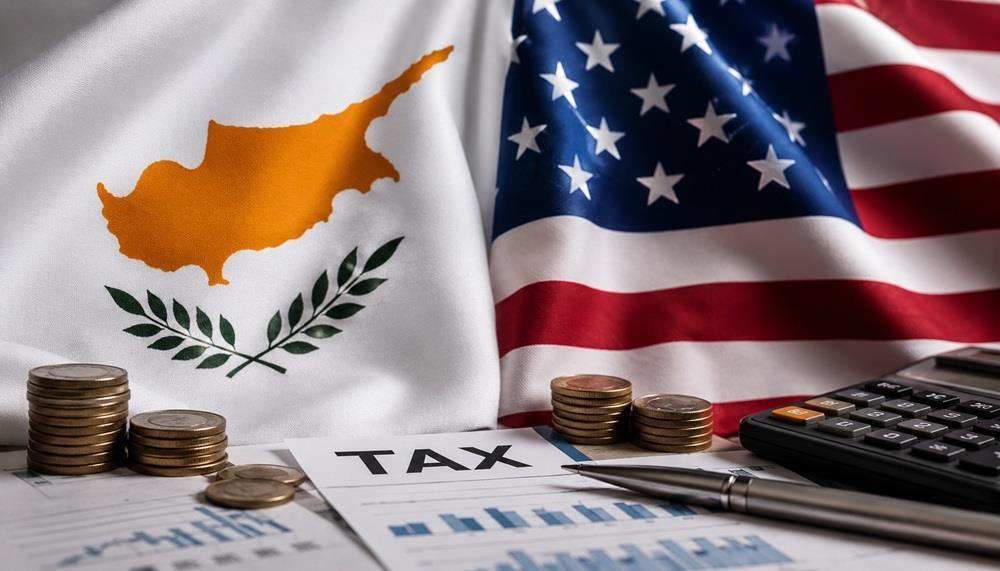
The risk of a mass withdrawal of US multinational groups from Cyprus, with the result of possible tax revenue losses of between €100 and €150 million, has been highlighted by the Chairman of the Tax Planning & Policy Committee at the Institute of Certified Public Accountants of Cyprus (ICPAC), Eftychios Eftychiou.
At the heart of Eftychiou's concern is the implementation of the appropriate domestic supplementary tax, within the framework of Pillar 2, which provides for a minimum effective tax rate of 15% for multinational and domestic groups with an annual turnover exceeding €750 million.
The essence of the issue seems to be the following: Cyprus had correctly chosen to introduce the third optional tax of Pillar 2, as well as to introduce it as a local Cypriot tax, as it was entitled to do, and not as a third tax of Pillar 2, which was the other option. Up to this point, the parties appear to agree. However, after the US withdrew from Pillar 2, at the beginning of 2026, Cyprus' interest would be to abolish the third optional tax. And on this, the parties appear to agree.
Europe, however, argues that Cyprus should, on the contrary, convert the third optional tax from a local Cypriot tax to a Pillar 2 tax, which does not serve the country's interests. The disagreement between the parties therefore seems to be located in the fact that ICPAC claims that there is no technical basis for requesting such a conversion. It also invokes the support of its position from its international member networks. It considers that Europe's demand is purely political and that the Ministry of Finance should demonstrate much greater resistance to specific political pressures.
On the other hand, the Ministry of Finance seems to have been receptive to following the European demand, considering that it also has a technical basis. The coming months will show whether or not the position adopted by the Ministry of Finance will lead to the withdrawal of US multinationals from Cyprus.
However, as Eftychiou stated before the Finance Committee of the Parliament, these groups chose Cyprus as the base for their activities, with lawyers, the Government and ICPAC having a significant contribution in attracting them. According to the expert, these are businesses in which a significant part of the country's tax revenues are concentrated.
Eftychiou explained that US groups affected by this regulation are now required to be taxed at 15%, while until now they paid a tax of 2.5%-3%. He estimated, therefore, that this change is already leading to a mass exodus of groups, estimating the possible total annual losses for public revenues at €100-150 million, based on the measurement of taxes paid by US groups in Cyprus.
The choices Cyprus had and the pressures from Europe
Referring to the history of the tax regulation, the Chairman of the ICPAC Tax Planning Committee explained that there are two mandatory taxes under Pillar 2, while Cyprus subsequently adopted, in 2025, the third, optional tax.
He described the country's initial choice to adopt the third optional tax as excellent, before the pressures exerted by the US on Europe. However, as he stated later, and especially after the US's exemption, Cyprus should cancel it.
Eftychiou argued that Europe was pressured by the US to implement the third optional tax, while he noted that Malta and the Baltic countries have not introduced this specific regulation, nor do they participate in Pillar 2, citing their small size and their exemption.
He added that Cyprus has received significant pressure from Europe to convert the optional tax into an appropriate domestic supplementary tax, pointing out that, according to him, no legal or tax arguments have been given by the European side for this conversion.
Minister of Finance: There is no room for deviation from the European directive
On the part of the Ministry of Finance, its spokesperson, Nayia Symeonidou, stressed that Cyprus's non-compliance with the European directive and OECD guidelines would have disastrous consequences for the country.
As she explained, the OECD has already found that Cyprus is not compliant with the appropriate domestic supplementary tax and is currently evaluating it. The draft law was prepared on the basis of the European Union's suggestions and the OECD guidelines, was submitted to the two organisations and all their comments were incorporated. At the same time, it was put out for public consultation.
Symeonidou stated that every possible effort was made, at a technocratic and political level, including through the Legal Service and the Council's Legal Service, to explore the scope for deviation from this specific provision of the directive, but this was not possible. However, she refrained from providing any technical basis, which ICPAC disputes even exists.
She noted that the voluntary tax has been secured for 2025, with the relevant Commission department having accepted the relevant arrangement. However, Cyprus will have to comply from 2026 onwards, while the legislation must be passed within the year, as otherwise it will have retroactive effect.
According to the spokesperson for the Ministry of Finance, approximately 60 foreign groups operate in Cyprus with a turnover exceeding €750 million.
Tax Commissioner: Risk of losing recognition status
The Commissioner for Taxation, Soteris Markides, moved in the same direction as the Ministry of Finance, and described the failure to pass the legislation as dangerous for the country, emphasising that the outcome to which this specific regulation has led is not a choice for Cyprus, but an obligation.
As he explained, a possible failure to pass the legislation could lead to the loss of qualified status in OECD countries for groups currently operating in Cyprus. In such a case, the taxes they pay in Cyprus will not be recognised by other countries, resulting in them being forced to pay additional tax outside Cyprus. According to Markides, the natural outcome would be their departure from the country.
Markides estimated, however, that the cost of a possible flight of groups will not be as great as ICPAC estimates, noting that, although Cyprus may lose some US groups, it will collect more than the rest. The ICPAC impact assessment recommends that Cyprus will not collect more than €20m per year from the rest. The gap is obviously very large between the parties.
On his part, the General Manager of ICPAC, Andreas Papadatos, stated that ICPAC had expressed certain comments and concerns, which it shared with the Ministry of Finance and the Taxation Department.
The Deputy Ministry of Shipping, on its part, agreed with the Ministry of Finance regarding the bill.
Finally, the Finance Committee of the Parliament itself suggests a middle ground: the introduction of this appropriate tax and at the same time a provision within the same law for its abolition. If this automatic abolition is determined at the end of 2027, then things can be manageable and the losses can be limited to the extent possible. The hope is that the Finance Committee will demonstrate its own resilience given that other member states do not seem to be as pressured as Cyprus.
(Source: InBusinessNews)