

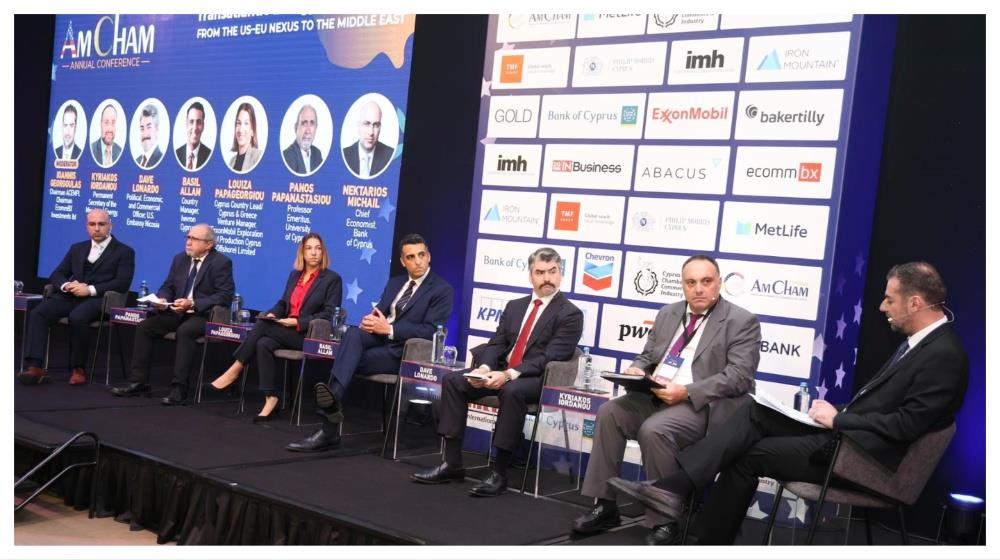
Top government officials and senior executives from the global flour-milling industry and energy giants analysed in depth the strategic developments, challenges and investment plans surrounding the Eastern Mediterranean energy ecosystem at the AmCham Annual Conference.
The panel included Kyriakos Iordanou, Director General of the Ministry of Energy, Dave Lonardo, Political, Economic and Commercial Affairs Officer at the US Embassy in Nicosia, Basil Allam, Country Manager of Chevron Cyprus, Louiza Papageorgiou, Cyprus Country Lead and Cyprus & Greece Venture Manager at ExxonMobil Exploration and Production Cyprus (Offshore) Limited, Panos Papanastasiou, Professor Emeritus at the University of Cyprus, and Nektarios Michail, Chief Economist at the Bank of Cyprus. The discussion was moderated by Ioannis Georgoulas, Chairman of ACEMPI and Chairman of EcommBX Investments Ltd.
Kyriakos Iordanou: Exports from the Cronos field to Egypt in 2038
Mr Kyriakos Iordanou stated that energy should not be taken for granted, nor should it be considered cheap or abundant, particularly after the Russian invasion in 2022. He noted that the European Union is now actively pursuing the diversification of its energy supplies. Within this framework, Cyprus is in an advanced process of commercialising its natural gas reserves.
Referring to the official timetables for the three main fields in Cyprus’ Exclusive Economic Zone, he noted that “the first export of natural gas will take place from the Cronos field to Egypt in 2038,” to be followed by the Aphrodite field a few years later. He also stressed the importance of the “3+1” format (Cyprus, Greece, Israel and the United States) for creating a strong energy alliance connecting the Eastern Mediterranean basin with the United States.
Expanding on his analysis of Europe’s new strategic architecture, Iordanou emphasised that Cyprus is fully integrated into the new European strategic mindset, which focuses on the green transition, electrification and the development of resilient electricity grids. He particularly highlighted the discussion on energy storage systems, describing them as “the next big thing” after the widespread expansion of photovoltaics, while reminding attendees of the role of the Vertical Corridor in providing alternative sources of natural gas to the European market, reducing dependence on traditional suppliers.
Dave Lonardo: “More energy means greater resilience”
Dave Lonardo stated that the United States’ position is clear: “More energy is better for everyone, as it creates resilience.” He noted that the massive increase in US natural gas production reduced the economic shocks Europe suffered, and stressed that producing more energy from the Eastern Mediterranean benefits the entire world.
As the commercial officer at the US Embassy, he pointed out that stability, transparency and the rule of law allow American companies to invest in Cyprus with absolute confidence. He even reminded the audience that “over the past year, American offshore services companies secured three major contracts in the Cypriot market,” demonstrating that they bring world-class technology to the island.
Analysing his role at the Embassy, Lonardo explained that his focus remains on promoting commercial cooperation between American and Cypriot businesses, stressing that offshore activities on the island open up enormous opportunities for American providers of offshore services, even in maritime blocks not managed by American companies. Summarising Washington’s philosophy with the phrase “short and sweet,” he reiterated that energy self-sufficiency is the foundation of industrial strength and shared security.
Louiza Papageorgiou: Glaucus and Pegasus are commercial discoveries
Louiza Papageorgiou noted that ExxonMobil, together with its partner QatarEnergy, recently took a decisive step by “declaring the discoveries at the Glaucus and Pegasus fields commercial.” She announced that the company is moving forward immediately with the resumption of its drilling programme, with appraisal wells for these two fields, while analysing the results for Block 5 of Cyprus’ Exclusive Economic Zone.
At the same time, in Greece, in cooperation with Energean and Helleniq Energy, the company is preparing to launch a new drilling campaign at Block 2 towards the end of the year. Papageorgiou stressed that, for investments worth billions of dollars, predictability and stability of the fiscal and regulatory framework are essential, with the Eastern Mediterranean having the potential to safeguard European energy security until 2050.
Papageorgiou explained in detail the transition from geological success to commercial development, emphasising that finding hydrocarbons underground does not automatically guarantee their exploitation. The critical question for an international investor is whether the resource can be developed with absolute safety and at a competitive cost, while responding to market demand over the long term. She highlighted that the strategic position of the Eastern Mediterranean between the markets of Europe and Asia, combined with the continuous and excellent cooperation with regional governments, ensures that the region will remain at the centre of the global energy supply, to the benefit of local communities.
Basil Allam: Egypt as the ultimate catalyst for Cypriot gas
Basil Allam stressed that, for Chevron, the mission begins with attractive geology, the use of cutting-edge technology and the availability of vast capital for deepwater drilling. Explaining why energy projects in Cyprus took longer than expected, he identified the problem as the absence of a natural domestic market.
“The major change occurred with the emergence of the Egyptian market, a country of 140 million people with a vibrant economy and enormous energy needs,” he stated. Egypt offers the unique advantage of LNG infrastructure, allowing not only domestic consumption but also the export of gas to global markets. Allam stressed that finding the commercial balance between geology, market access and a competitive fiscal framework is extremely complex in cross-border developments, making close cooperation between the governments of Cyprus and Egypt the absolute foundation.
Referring to the geological nature of the Eastern Mediterranean, Allam explained that the region tends to be “gas prone” (rich in natural gas), a fact that makes financing and finding markets much more challenging compared to oil. In Cyprus’ case, where the reserves are of medium size, achieving a sustainable economic balance is the key issue on which all stakeholders are currently focused. He stressed that transporting molecules of natural gas across national borders for decades requires resilient and time-tested investments, which can only be unlocked through the expansion of intergovernmental and business cooperation.
Panos Papanastasiou: The turning point and the need for cheap electricity
Panos Papanastasiou stressed that energy projects involve enormous costs, ranging from hundreds of millions to several billion euros, and therefore must be fully economically justified and must not ignore the laws of physics and geography. He reminded the audience that, after the first discovery at the Aphrodite field, initial estimates of 7.5 trillion cubic feet (tcf) led to discussions about a domestic LNG terminal, which stopped when appraisal wells reduced the field to approximately 4 tcf.
He characterised 2015 as the absolute turning point for Cyprus, due to Egypt’s stabilisation and the availability of its infrastructure. He noted that Cyprus must ensure that part of the gas from the Cronos field can be returned in liquefied form to supply the domestic market, enhancing competition. In closing, Papanastasiou stressed that Cyprus must focus immediately on energy storage with large-scale battery systems. As he stated, “today, the cost of electricity generation from photovoltaics combined with batteries is extremely efficient,” which will allow greater penetration of renewable energy sources and a drastic reduction in electricity prices for businesses and households.
Analysing the technical parameters further, Papanastasiou clarified the confusion that often prevails in public discourse between an LNG plant and a regasification terminal, stressing that efforts to complete the domestic import terminal must continue intensively despite management difficulties. He also explained that the construction of a direct subsea pipeline exclusively to supply the Cypriot market was deemed unviable due to the small size of domestic demand. Instead, the development of large-scale storage systems offers the necessary flexibility to the grid, allowing Cyprus to manage energy curtailments and reduce operating costs for local businesses.
Nektarios Michail: Economic shielding and investment stability
Nektarios Michail highlighted the macroeconomic parameters and the importance of investment visibility for the banking system and the wider Cypriot economy. He stressed that the implementation of energy infrastructure and adherence to timetables are key to maintaining investor confidence and the financial stability of major capital-intensive projects.
Within this framework, Michael explained that delays in the development of energy resources affect macroeconomic planning and forecasts for the country’s capital flows. Ensuring a stable and predictable framework of cooperation between the state and international investment giants reduces country risk and facilitates the attraction of high-value-added foreign capital, strengthening the resilience of the Cypriot financial sector against international inflationary pressures.
The discussion took place within the framework of the AmCham Annual Conference 2026.