

SmartSea is a maritime digital solutions and services company backed by SITA, a global leader in air transport technology, and Columbia Group, a world-class ship manager and maritime services provider.
Combining aviation-derived digital capabilities with deep maritime operational expertise, SmartSea delivers practical technology and managed services while developing SmartSea Vision, its open, composable platform for the next generation of maritime operations. CEO Kris Vedat tells GOLD about the company and his own journey from the UK to Cyprus.
SmartSea, based in Limassol, was launched in 2024, through a collaboration between SITA, founded in 1949, and Columbia Group, founded and headquartered in Limassol since 1978. Explaining the company’s key mission of changing how shipping companies operate, CEO Kris Vedat says, “We didn’t have to reinvent the wheel. If we look at the two verticals, they’re not that dissimilar, are they? Maritime refers to the movement of people, cargo and management of assets, which can quite neatly refer to the aviation industry as well,” he says.
Crucially, however, he emphasises that, “Commercial aviation is about 75 years old, whereas commercial shipping is centuries old,” so the two sectors have developed different procedures. That’s where SmartSea sees exciting opportunities to deliver.
Connecting the maritime and aviation sectors
“That link with Columbia Shipmanagement’s deep maritime experience and credibility, connected with SITA’s pioneering work in aviation technology really captures the scale of our offering to the industry,” Vedat tells GOLD.
“In aviation, SITA became an underpinning infrastructure for the industry, enabling it to grow and connect. That’s what’s really missing in maritime and what SmartSea has set out to do. SmartSea Vision, our open and composable maritime platform, is being developed to connect data, applications and stakeholders across maritime operations. Together with our comprehensive services portfolio, it supports our ambition to elevate maritime technology towards the standards achieved in aviation,” he says.
He acknowledges that some areas within maritime have embraced digitalisation more successfully than others, pointing to container logistics. “UN/EDIFACT created internationally agreed standards for the electronic exchange of structured data between independent systems. Container-related messages, for example, allow shipping lines, agents, terminals and other trading partners to exchange loading, discharge and related operational information more consistently,” he explains.
However, he says, progress has remained uneven across the wider maritime value chain. “A clear example is the noon report, or daily vessel report. Although the underlying operational data is broadly similar, companies and systems have historically used different formats and definitions. Greater consistency in how that data is captured, interpreted and exchanged would make processes more efficient for all stakeholders,” Vedat clarifies.
The need for harmonised data and interoperable systems
The maritime sector increasingly recognises the need for harmonised data and interoperable systems. Bodies including the International Maritime Organization (IMO) have already developed reference models and standardised datasets to support electronic reporting and information exchange. Vedat points out, however, that agreeing standards is only part of the challenge; organisations must also be able to implement them consistently and integrate them into daily operations. That practical adoption challenge is a key focus for SmartSea.
“Our vision is for SmartSea to be an enabler of that data exchange, to allow the industry to connect better,” Vedat explains. “Increasing regulatory compliance, certainly with emissions reporting, means that each company has to find a way of identifying data, collecting it, verifying and submitting it, but because there’s no standard method, each company’s effort factor is much greater,” he says.
Looking at the wider landscape, he notes, “There’s a lot of disruptive technology out there but we must ensure that the right foundations are in place to successfully, safely and efficiently adapt and adopt it.”
Today’s ships are connected in ways they never were before but, as they are no longer siloed environments, they can become exposed. “Cybersecurity, for example, is no longer something nice to have; it’s a license to operate,” he says.
An oppurtunity to improve the sector
However, these changes and challenges are precisely what Kris Vedat finds exciting, and where he sees opportunity to improve the sector. He recognises that the maritime sector doesn’t always attract young people with tech backgrounds but, he insists, they are overlooking what’s really on offer and here, he speaks from experience.
“For me, it’s been incredible: I’ve seen a lot of the world, I’ve worked across many countries and regions, and that’s not a career you can get with many other industries these days.”
The journey from studying Computer Science in the UK – where he was born and raised – to becoming the CEO of a maritime technology company may not the most obvious one but, he explains, it was a natural one.
“Technology was always my core interest and what I enjoyed doing – I found a niche in maritime and I’ve stuck with it through the years, as it is something that I’ve always been passionate about, and it has served me well,” Vedat tells GOLD. “Did I just ‘fall into’ shipping? I probably did, to some degree, but I’ve never left it and never looked back,” he says. “It’s incredible.”
He is quick to add that, at the start of his career, his role went beyond technology and had a key operational focus on managing the container management system. That blend of tech and operations gave him a deeper understanding of the sector, one that grew steadily. He later secured a job at United Arab Shipping Company – beginning in London, then moving to the Gulf – where he spent close to 15 years. He then worked for Topaz Energy and Marine, P&O Maritime Logistics and DP World, with roles including Head of Information Technology and Head of Technology and Logistics. His next port of call was Limassol and SmartSea, where, prior to his appointment as CEO in 2025, he first served as Chief Technology Officer.
“Coming to Cyprus wasn’t a completely new experience for me and I was keenly aware of shipping as a core entity for the island. The embracing of technology companies and welcoming them here has been phenomenal – it’s very exciting,” Vedat tells GOLD. Emphasising Columbia’s unique role in the partnership with SmartSea, and its history in Limassol, he says, “That heritage really puts SmartSea at the heart of the maritime community, where technology can be shaped around real operational needs. With Columbia Group there’s a direct connection to the people, the expertise and day-to-day realities of global shipping. Being based in Limassol keeps us very close to that partnership with the industry,” Vedat explains. As if to confirm his belief, SmartSea has been awarded a strategic Information Technology Outsourcing Contract with the Maritime Company for Navigation (MACNA) in Saudi Arabia.
For SmartSea, working in such a globalised and interconnected industry, Cyprus is a natural, strategic choice as a base from which to cover the company’s global clients’ needs.
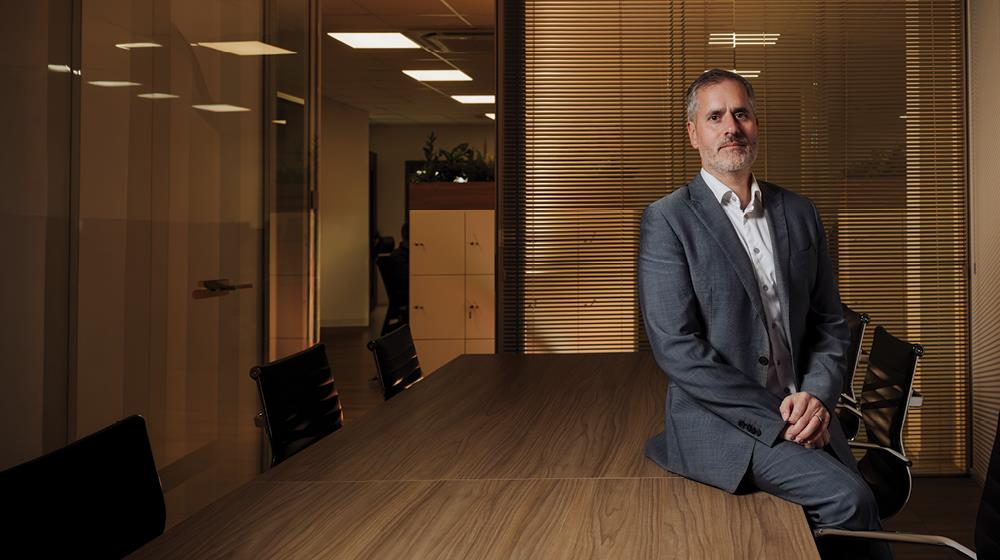
(Photo by Giorgos Charal.)
This interview first appeared in the October edition of GOLD magazine. Click here to view it.