


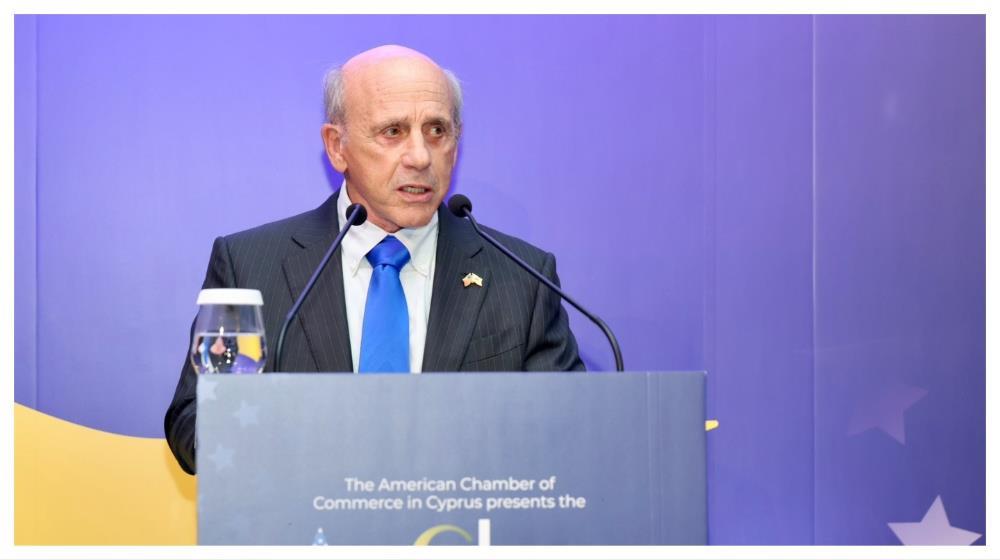
The importance of further strengthening relations between the United States, Europe and the Eastern Mediterranean was highlighted by the US Ambassador to Cyprus, John A. Breslow, during the opening session of the AmCham Annual Conference.
Speaking on the topic “Cyprus at the Crossroads: Advancing Transatlantic Cooperation and Regional Connectivity,” Breslow described AmCham as an essential partner in understanding the expectations and concerns of American businesses. Linking the island’s historical heritage with contemporary geopolitics, he recalled that Zeno, the founder of Stoicism, was born in Larnaca, stressing that this heritage carries a responsibility for the future.
Breslow stated that the US-Cyprus partnership provides a positive answer to three critical questions underpinning American foreign policy: does it make America safer, stronger and more prosperous? He emphasised that “security is what makes investment possible, and every defence agreement between friends creates jobs and stronger partners on both sides of the Atlantic.”
Military Cooperation, CYCLOPS and the Paphos Milestone
In his address, the US Ambassador spoke extensively about developments in bilateral defence cooperation. He highlighted that since 2022, US warships have made “more than 100 visits to Cypriot ports”, while a five-year Roadmap for Defence Cooperation was signed in 2024.
He placed particular emphasis on the fact that Cyprus has signed its first Foreign Military Sales (FMS) agreement, which “will help expand Paphos Air Base for American and Cypriot forces”.
He also praised the operation of the CYCLOPS regional training centre, which was funded with US resources, as well as Cyprus's sending of its 100th military student to the United States for training. Furthermore, for the first time, a Cypriot cadet is attending the US Naval Academy.
Breslow noted that a haven must be safe for friends, not for enemies or “dirty money”, while acknowledging Cyprus' significant efforts to strengthen financial oversight.
Energy, IMEC and the Bureaucracy Model
Addressing regional influence, Breslow focused on the “3+1” cooperation framework (the United States, Cyprus, Greece and Israel).
He recalled that last June, US Secretary of Energy Chris Wright met with his counterparts from the three countries to establish the Eastern Mediterranean Energy Centre at Rice University in Houston, to turn innovation into practical investment projects. He also described Egypt as a cornerstone of the region through the East Mediterranean Gas Forum, based in Cairo.
In the energy sector, he highlighted Cyprus’s cooperation with leading American corporations, including ExxonMobil, Chevron, Halliburton, Baker Hughes and McDermott, to connect regional infrastructure.
“Energy security is national security,” he stressed, making particular reference to the India-Middle East-Europe Economic Corridor (IMEC) and to subsea electricity and data cables, noting that “Cyprus sits right at the centre of this map”.
Warning Over Missed Opportunities and Red Tape
However, Breslow expressed serious concern about bureaucratic obstacles, delivering a clear message: “I worry about the opportunities that are not being seized; even one company leaving is one too many.”
He urged Cyprus to reduce the red tape that is stifling investment and to provide businesses with the certainty they need to undertake long-term projects. He welcomed Cyprus’s efforts during its recent Presidency of the Council of the European Union to bring the issue of European bureaucracy to the forefront.
Finally, he proposed the recent US-Greece agreement on secure supply chains, critical minerals and investment screening as an ideal model.
He expressed satisfaction with Cyprus’s legislation on foreign investment screening, while calling for its extension to public procurement procedures, in order to fully safeguard the business environment.