








Cyprus has ranked 24th among 165 countries and jurisdictions in the Fraser Institute’s Economic Freedom of the World 2026 report, earning an overall score of 7.78 out of 10.
Cyprus ranked highest in international trade freedom and monetary stability, while scoring lower in the size of the state and regulatory framework.
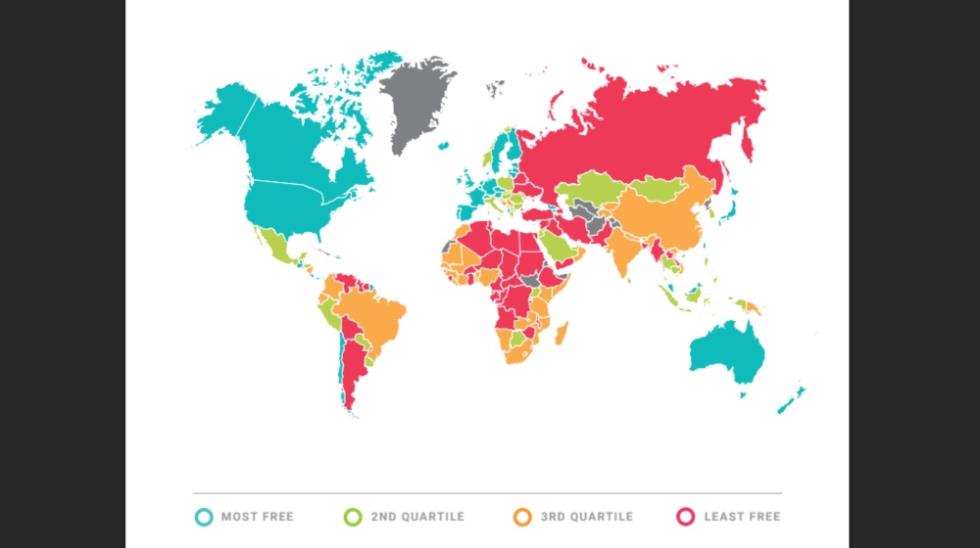
The study, published on 6 October, measured data collected in 2024. Cyprus ranked alongside Spain in the first quarter of the global ranking, placing it among the top 25% of economies offering the highest levels of economic freedom.
The island’s performance
When it comes to international trade freedom, Cyprus scored 9.00 points, ranking ninth worldwide. The area examines tariffs, non-tariff and administrative restrictions on trade, exchange restrictions, and controls on the movement of people and capital.
In monetary stability, its score was 9.47 points, placing it 12th. The assessment includes money supply growth, inflation volatility, inflation over the past year and the ability to maintain bank accounts in foreign currency.
Examining the country’s legal system and property rights, Cyprus ranked 39th, with a score of 6.69. The assessment covers judicial independence, court impartiality, property protection, the integrity of the legal system, contracts and police effectiveness. The score was also adjusted to take into account differences in the legal treatment of women.
When it came to the regulatory framework, Cyprus ranked 54th, with a score of 6.87 points. The assessment covers restrictions on credit and labour markets, business regulation and competitive freedom, while also taking into account hiring and dismissal procedures, wage adjustments, bureaucracy costs, tax compliance and business licences.
Cyprus’s lowest individual ranking was recorded in the size of the state, where it placed 71st with 6.85 points. According to the methodology, this area evaluates government consumption, transfers and subsidies, government investment, top marginal tax rates and government ownership of assets.
In the overall ranking, immediately ahead of Cyprus was the Czech Republic, in 23rd place with 7.81 points. Lithuania ranked 22nd with 7.82 points, while Malta and Chile were tied for 20th place with 7.85 points. After Cyprus and Spain, Georgia and Guatemala followed, tied for 26th place with 7.76 points.
The first ten places
Hong Kong remained in first place in the global ranking with 8.53 points. It was followed by Switzerland in second place with 8.45, Singapore in third with 8.43, New Zealand in fourth with 8.38 and the United States in fifth with 8.21 points.
Ireland ranked sixth with 8.16 points, Denmark seventh with 8.13, Australia eighth with 8.06 and Mauritius ninth with 7.97. Finland, the Netherlands and the United Kingdom were tied for tenth place, with 7.96 points. Due to the tie, the top ten includes a total of 12 economies.
Despite maintaining its top spot, the report noted that Hong Kong’s score has fallen by 0.68 points since 2009, with most of the decline occurring after 2018. The decline has been linked to deterioration in the areas of the regulatory framework, the legal system and property rights, as well as the size of the state.
Among other major economies, Japan ranked 13th, Canada 18th, Germany 19th, France 39th and Italy 47th. China ranked 110th, while Russia was in 143rd place.
The last ten positions
At the bottom of the ranking was Venezuela, in 165th place with 2.94 points. It was preceded by Zimbabwe, in 164th place with 3.62, Sudan in 163rd with 4.16 and Libya in 162nd with 4.29 points.
Myanmar ranked 161st with 4.44 points, Iran 160th with 4.51 and Algeria 159th with 4.54. The bottom ten positions were completed by Malawi, in 158th place with 4.75 points, Egypt in 157th with 4.79 and the Democratic Republic of the Congo in 156th with 4.80 points.
The report noted that many developing economies have a small fiscal size but underperform in other areas. According to the authors, a small government size is not sufficient to ensure prosperity without the rule of law, property protection, monetary stability, trade openness and limited regulation.
Read the report here.
