








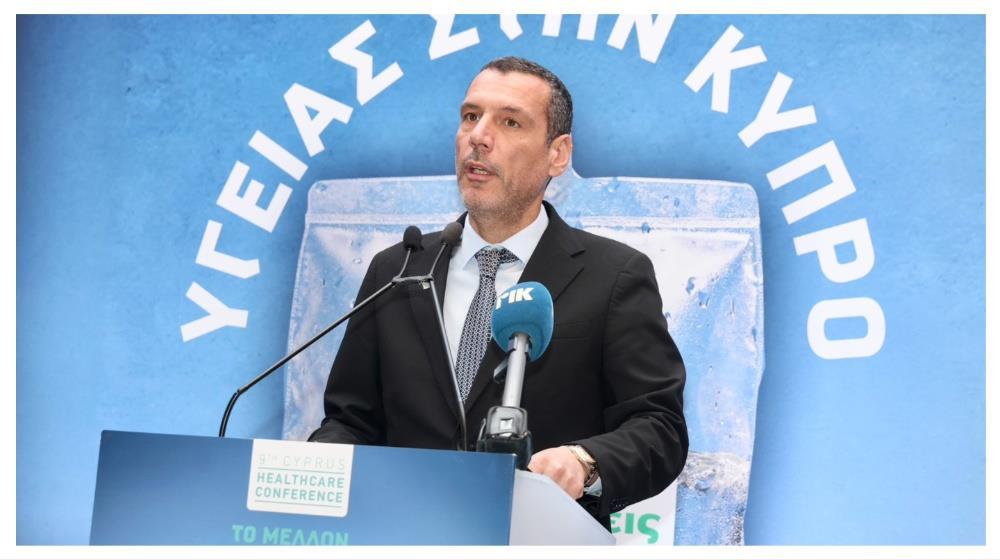
The Government's strategy for the future of the healthcare sector in Cyprus was presented by Neophytos Charalambides, Minister of Health of the Republic of Cyprus, in the context of the recent 9th Cyprus Healthcare Conference.
Welcoming the conference proceedings on 17 September, Neophytos Charalambides delivered a speech in which he referred extensively to the fact that seven years after the implementation of the General Healthcare Schem (Gesy), the system has succeeded in reducing inequalities and ensuring universal access. However, he stressed that the discussion must now shift from the simple number of medical procedures to demonstrably quality care, prevention and the integrated continuity of services.
In this context, he announced the establishment and recent appointment of the first Board of Directors of the National Center for Clinical Documentation and Quality of Health Services. This new independent mechanism will develop clinical guidelines and quality indicators adapted to the data of Cyprus, allowing for the gradual linking of provider funding to actual clinical outcomes.
The expansion of population programs and the role of the gatekeeper
At the same time, he made special reference to the crucial importance of prevention for the long-term sustainability of the system, presenting the expansion of free population screening programs. In addition to the existing programs for breast and colon cancer, an organised plan for cervical cancer is being promoted, an early detection program for prostate cancer is being prepared, while a population program for autism spectrum disorder is being designed.
The Minister of Health also announced the appointment of the Board of Directors of the National Cancer Institute, an autonomous scientific body that undertakes the central coordination of national policy. For the success of these actions, Charalambides noted that primary care cannot be limited to issuing referrals, but the personal physician must actively play his role as a gatekeeper and a constant guide to the citizen.
Digital transformation and staffing of the system
In his statement, he also emphasised the importance of digital transformation and the interoperability of information systems for the secure exchange of data, the reduction of unnecessary repeated examinations and the enhancement of safety in prescribing. Commenting on the use of artificial intelligence, he clarified that the new applications have a supporting role and do not in any way replace the scientific judgment or responsibility of the health professional.
The Minister of Health presented the broader government initiatives, such as the National Strategy for Mental Health 2025–2028, the institutional framework for the operation of university clinics in public hospitals, as well as the recent grant plan for Nursing studies in combination with the European Nursing Action initiative to address the shortage of personnel.
Finally, reference was made to the creation of the institution of the Patient Ombudsman, sealing the clear government direction for the active participation of patient representatives (OSAK) in decision-making.
(Source: InBusinessNews)
