






Riverland Biofarm is more than an organic dairy farm. Located in Kampia, just outside Nicosia, it has evolved into a multifunctional rural enterprise that combines organic livestock farming, premium dairy production, agritourism and environmental education.
Founded by livestock specialist Vassilis Kyprianou, the farm reflects a long-term vision of producing high-quality food while promoting sustainability, animal welfare and community engagement.
Its development also highlights how the European Union's Common Agricultural Policy (CAP) supports innovative rural businesses that combine agricultural production with education, tourism and environmental responsibility.
As part of the Eat Wisely Cyprus project, co-funded by the European Union under the IMCAP programme and implemented by IMH, Eat Wisely spoke with Vassilis Kyprianou about Riverland's journey, its production philosophy and its role in promoting sustainable agriculture in Cyprus.
Building an organic farm with a clear vision
Riverland Biofarm was established in 2010 after Vassilis Kyprianou returned to Cyprus following studies in animal production and practical experience on organic farms in Ireland.
"I always wanted to create my own organic farm. After studying animal production and gaining experience on organic farms in Ireland, I decided to return to Cyprus and make it happen."
The project became a reality with support from the EU Rural Development Programme 2007–2013, which provided the initial funding needed to establish the farm.
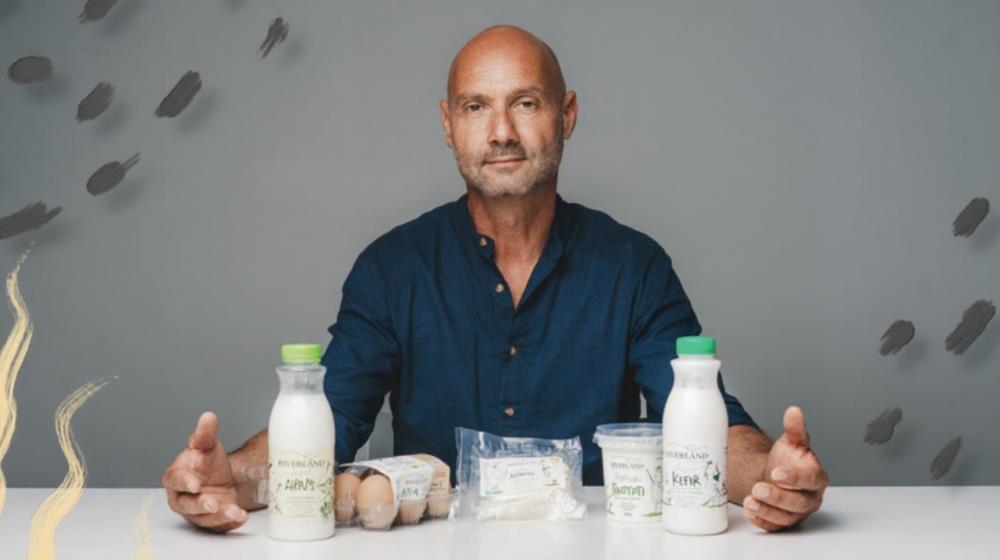
Today, Riverland produces a wide range of organic dairy products, including kefir, halloumi, anari, yoghurt, trahanas, ayran and ice cream, all made without preservatives or artificial additives.
Among them, kefir has become the farm's flagship product.
"We produce everything possible from milk, but kefir has become our signature product because of its nutritional value and its potential in international markets."
Farming with nature, not against it
Environmental responsibility shapes every aspect of Riverland's operation.
The farm applies organic cultivation practices including crop rotation, intercropping and natural soil improvement techniques while avoiding synthetic pesticides and fertilisers.
Renewable energy and efficient resource management are equally important.
"We produce compost, collect rainwater and generate around twice the energy we consume through solar panels. Our goal is a circular, zero-waste approach to agriculture."
The surrounding natural environment also plays a significant role.
Located on the edge of the Machairas forest, the farm benefits from an area free from intensive agriculture, providing ideal conditions for organic livestock farming.
Nevertheless, climate change presents growing challenges.
"The dry, hot climate and limited water availability remain among our biggest challenges, particularly for producing animal feed."
Quality begins with animal welfare
At Riverland, high-quality dairy products begin with healthy animals.
Livestock are raised according to certified organic standards, with daily grazing, natural feed and continuous veterinary care. Regular inspections by independent certification bodies and public authorities ensure full compliance with European organic farming regulations.
"Product quality starts with the animals."
The farm also applies natural methods to improve soil fertility and biodiversity, reinforcing its commitment to sustainable food production from field to finished product.
More than a farm
Since opening its doors to visitors in 2012, Riverland has expanded beyond agriculture to become one of Cyprus's best-known agritourism destinations.
Schools, families and organised groups participate in interactive workshops where they learn how to make halloumi and traditional bread while experiencing rural life first-hand.
"We want children to experience nature, respect animals and understand organic farming—not spend their time with electronic games."
Outdoor activities including hiking, cycling and archery complement the educational experience, creating a destination that connects visitors with Cyprus's countryside.
Learning through experience
Education remains one of Riverland's defining characteristics.
The farm hosts international volunteers through the European Solidarity Corps, offers internships for university students and participates in European initiatives that promote lifelong learning.
One of these is the SeniORGarden project, which encourages older adults to remain active through organic gardening.
"The response has been remarkable. People enjoy learning, working with nature and sharing experiences."
Growing together with the community
Riverland's contribution extends beyond food production.
By creating employment, attracting visitors and collaborating with local businesses, the farm contributes to the wider economy of the region while promoting sustainable rural development.
Its growth strategy remains deliberately measured.
"We move forward with small, steady steps while preserving the simplicity that defines us."
A model for the future of rural Cyprus
Riverland Biofarm demonstrates how agriculture can successfully combine food production, environmental responsibility, education and tourism within a single business model.
By embracing innovation while respecting nature, the farm has created a sustainable model that delivers value not only to consumers but also to local communities and future generations.
Its experience shows how the Common Agricultural Policy can support modern rural enterprises that generate economic opportunities while protecting the environment and strengthening the connection between people, food and the countryside.
About Eat Wisely Cyprus
This feature was produced as part of the Eat Wisely Cyprus project, co-funded by the European Union under the Information Measures Relating to the Common Agricultural Policy (IMCAP) programme and implemented by IMH.
The views and opinions expressed are those of the authors and do not necessarily reflect those of the European Union.
This article first appeared, in Greek, in the July edition of InBusiness magazine. Click here to view it.
