







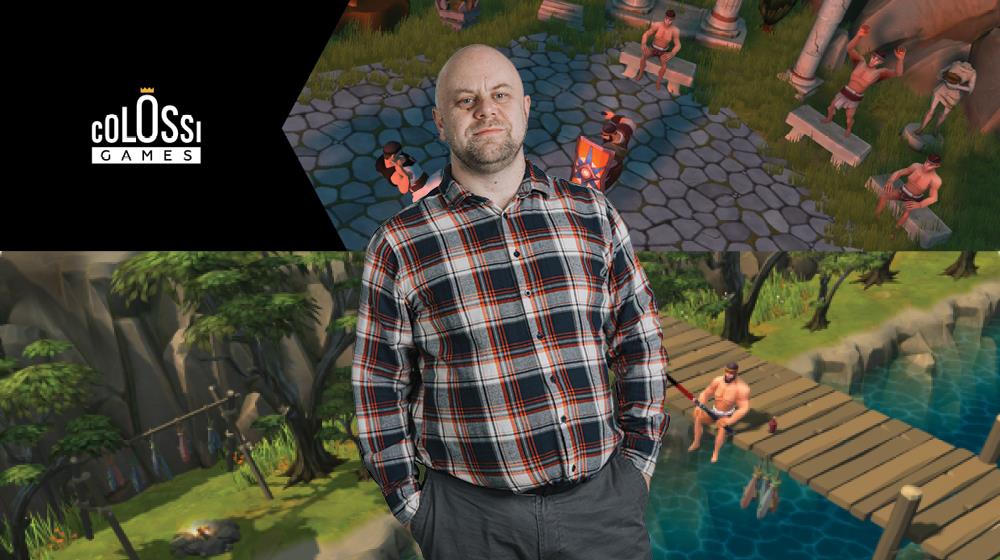
"Discoverability has become a pay-to-play scheme, with a 15% rise in price per user yearly but stagnant or even receding revenue," Manuel Prueter, the Co-Founder & CEO of Limassol-based Colossi Games, suggests.
In a recent interview with GOLD magazine, Prueter goes on to add that, among other solutions, "The AI angle is exciting, not just for the value it adds to being able to create but also for the potential it adds to the discoverability aspect of the industry."
Established in Cyprus in 2020, Colossi Games has four employees and counts Gladiators: Survival in Rome, Daisho and Vinland Tales among its most successful titles. With an annual revenue of approximately €500,000, with a peak of roughly €2.5 million, the company's notable achievements include Gladiators and Daisho being named Best of Google Play in 2022 and 2023, and Gladiators reaching the Top 10 of Google's Indie Games Festival in 2021.
As Pruter explains in his interview with GOLD, "At Colossi Games our focus is on free-to-play action role-playing games (RPGs) for mobile phones with cross platform access on the PC through the digital distribution platform Steam."
Among other things, he also talks about the company's core business model and game development strategy and comments of what he considers to be the most significant recent industry trends and growth drivers? Which of these do you expect to shape the sector over the coming years.
How would you describe your company’s core business model and game development strategy?
At Colossi Games our focus is on free-to-play action role-playing games (RPGs) for mobile phones with cross platform access on the PC through the digital distribution platform Steam. Our audience is primarily male, aged 25 and over. Our player base is typically in Eastern Europe and in the US. Notably, however, Daisho has most of its audience in South-East Asia and South Korea.
What are the key factors currently influencing your company’s operations and strategic decision-making?
Discoverability has become a pay-to-play scheme, with a 15% rise in price per user yearly but stagnant or even receding revenue. The mobile games sector is in a stranglehold by AppLovin (70-80% market share in video ad mediation). Another factor is the Google and Apple duopoly as platforms. Indeed, most profits come from bypassing these actors: webshops for payments, virality social ads and incentivised play-and-get-paid ad networks. Everything else is secondary to this. AI certainly helps and is exciting as it achieves adoption within the industry. The AI angle is exciting, not just for the value it adds to being able to create but also for the potential it adds to the discoverability aspect of the industry.
What do you consider to be the most significant recent industry trends and growth drivers? Which of these do you expect to shape the sector over the coming years?
In the video games investment community, 90% of companies these days are either in Turkey or Vietnam due to far-reaching government incentives. An ongoing topic of discussion is the ability of Chinese companies to publish unhindered in the West when no-one except the Chinese can publish there. That creates an imbalance in usable market size and capital allocation – the entire strategy and merge games genres are now dominated by Chinese companies and their Singaporean holdings.
This interview first appeared in the June edition of GOLD magazine. Click here to view it.