








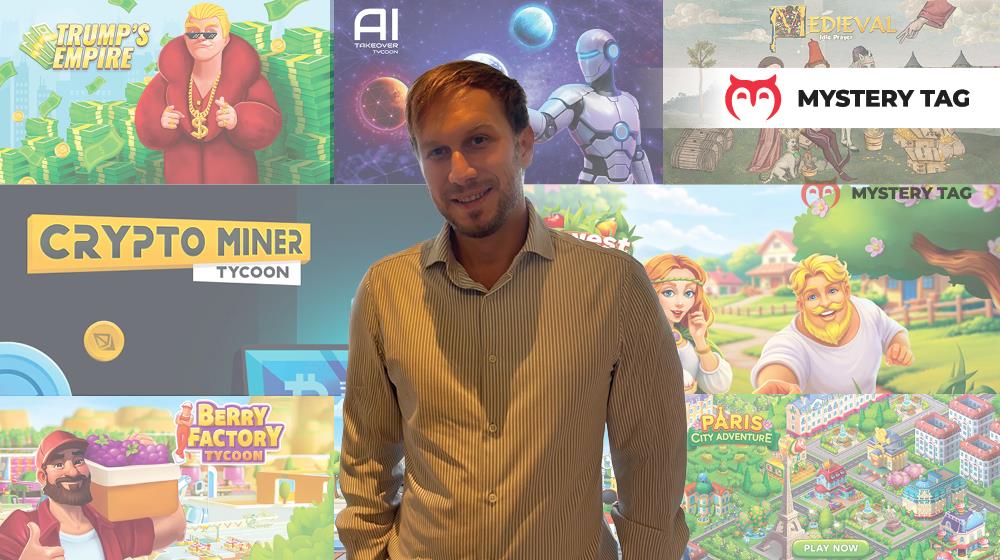
"Our strategy relies on staying highly agile and closely monitoring market trends," Leonid Zhuravskyi the CEO & Founder of Limassol-based Mystery Tag reveals.
In a recent interview with GOLD magazine, Leonid Zhuravskyi explains that this allows Mystery Tag to "rapidly identify high-growth genres – whether we are developing titles internally or partnering with third-party studios."
He also suggests that, "From an operational standpoint, AI is fundamentally reshaping our structure and internal roles, requiring significant strategic reorganisation. For us, this isn't about reducing headcount but rather about rethinking and reassigning roles and responsibilities to maximise our human potential alongside automation."
Having established a presence in Cyprus in 2021 and with additional offices in Ukraine, supported by a distributed network of remote employees across Europe, Mystery Tag has 100 employees globally with 10 in Cyprus.
With Train Ride and Harvest Land among its most successful titles, the company's most notable achievements include Train Ride being in the Top 10 most downloadable games in 50 countries in March 2026 while Trump’s Empire was in the Top 3 most downloadable games in All Tier 1 countries, including the US, in 2016. Mystery Tag has an annual revenue of €20 million.
How would you describe your company’s core business model and game development strategy?
We develop and publish mobile games for both the App Store and Google Play, targeting a wide range of demographics across multiple genres. Our strategy relies on staying highly agile and closely monitoring market trends. This allows us to rapidly identify high-growth genres – whether we are developing titles internally or partnering with third-party studios. At the same time, we maximise the value of our portfolio by actively supporting and updating our legacy titles to ensure long-term player engagement.
What are the key factors currently influencing your company’s operations and strategic decision-making?
From an operational standpoint, AI is fundamentally reshaping our structure and internal roles, requiring significant strategic reorganisation. For us, this isn't about reducing headcount but rather about rethinking and reassigning roles and responsibilities to maximise our human potential alongside automation. While this shift exponentially drives operational efficiency, the challenge is that our competitors are leveraging the exact same tools. As a result, the entire industry's velocity has accelerated; the market shifts much faster now, demanding that we remain hyper-aligned with rapidly evolving trends in both product development and marketing.
What do you consider to be the most significant recent industry trends and growth drivers? Which of these do you expect to shape the sector over the coming years?
The most significant driver right now is AI integration across the entire lifecycle – from art and development to marketing. It is a matter of 'align or die.' For those who adapt, production speeds are increasing exponentially, resulting in a higher volume of engaging, high-quality games. Over the coming years, this will completely redefine the competitive landscape through hyper-accelerated market velocity. This environment creates a massive opportunity for agile, small-to-medium studios that can pivot instantly to capture new trends. Conversely, it poses a severe threat to industry giants that have become too rigid and bureaucratic to keep up.
This interview first appeared in the June edition of GOLD magazine. Click here to view it.
