






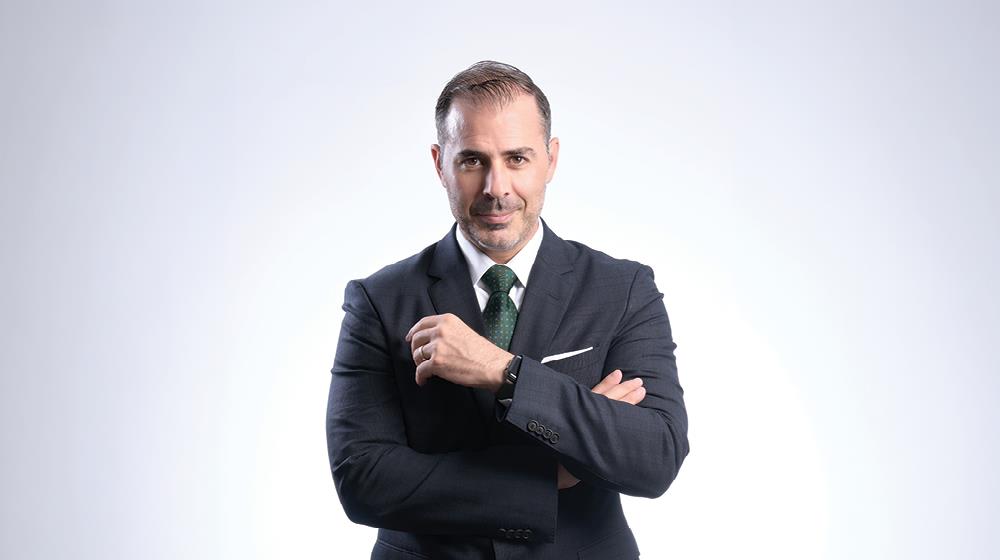
Thomas Papantoniou attributes his success to being in the right place at the right time. That’s mostly him being modest about his impressive career trajectory which, in 2024, led him to becoming CEO of Coinbase Financial Services Europe, the Cyprus entity of US-listed crypto exchange Coinbase, but there is something to his simplified view of how he reached his present position. A lot had to happen first: cryptocurrencies, spearheaded by Bitcoin and underpinned by a broader technological revolution, had to break into the mainstream and earn their place alongside traditional financial services. And – crucially – Cyprus had to evolve into the financial hub it is today. Then, of course, there is 44-year-old Papantoniou himself.
As we settle into the plush sofas of the café at the Parklane Resort & Spa in Limassol, Thomas Papantoniou recalls how he started at the very bottom in the tough forex industry. “I was a salesperson, no shortcuts,” he tells GOLD. “I was on the phones, learning about the products, how markets move and getting to know the clients from all over the world.”
Born and raised in Birmingham, England, Papantoniou had insights into the world of business from a young age. “My father had a business in England and, obviously, with our Cyprus roots I became keenly aware of financial exchange rates,” he says.
The family moved back to Limassol when he was 10, long before the coastal city had become what it is today. He would witness that transformation – and be a part of it – in the years that followed.
“When people ask about Cyprus, it’s not just a professional calculation for me; it’s a personal connection,” he says.
After completing his military service, he studied Business Information Systems at the University of Salford, Manchester, before returning to the island and starting to make his way in the online forex industry. That was roughly 20 years ago, he notes, when the sector was just shifting into gear.
“Back then there were maybe two or three companies,” he recalls. “It was at the very beginning of the great influx.”
He cut his teeth in a cutthroat industry. New recruits were given two weeks to study the material, then tested. Pass, and you were on the phones. Miss your targets, and you were out. Papantoniou is proud to have gone through that particular baptism of fire. “It was almost as if I had trained to become an athlete and then, all of a sudden, I was released onto the track,” he says. “It was perfect.”
Climbing the ranks in a regulated industry
He rose quickly up the ranks: From salesperson to sales manager, then sales and marketing manager, then Chief Business Development Officer, Chief of Operations, and on through a series of Managing Director, General Manager and CEO roles across different firms. Still in his mid-twenties, he was made an Executive Director – to his knowledge the youngest person to hold that position at a Cyprus Investment Firm (CIF) at the time.“Since then, I have served on the Boards of approximately 10 CIFs,” he says, “so when I say I know this regulatory environment, I mean it – inside and out.” That institutional knowledge, accumulated over two decades, has given him a perspective on regulation that he values above almost anything else.
“When faced with legislation, many people’s initial reaction can be, ‘Now what do they want? It means more work.’ Which is true, it certainly does. But I can appreciate where it comes from, why it’s necessary. I know what things were like before the legislation; I know what clients went through; I know what investment firms went through. Because of that I have a different appreciation of the legislation we come across.”
His career has evolved in step with Cyprus’ own development as a financial centre and it is that evolution, he argues, that made it possible for a company like Coinbase to arrive in Cyprus. Founded in the United States in 2012, Coinbase has become a leading global digital asset platform, listed on the US market with $202 billion in quarterly trading volume and $294 billion in digital assets as of the end of Q1, 2026. In the context of its expansion, Papantoniou explains, Europe represents a core international growth market.
Moreover, he emphasises, being regulated by CySEC – one of the first regulators to introduce crypto guardrails in 2020 – reinforces transparency for European customers. That, he says, builds trust and confidence. Crucially, it has also given companies such as Coinbase the confidence that Cyprus is a serious player to engage with, which led to its 2024 acquisition of the Cyprus-based unit of BUX and the creation of Coinbase Financial Services Europe. Securing a CIF licence meant greater access to the European market. “We have since expanded our derivatives offerings in the EU by acquiring a MiFID II-licence in Cyprus earlier this year,” he tells GOLD.
Crypto goes mainstream
For Papantoniou, the arrival of Coinbase represents something that Cyprus has earned. “CySEC deserves a pat on the back. It structured this environment,” he says. The wider landscape for crypto in Europe has also shifted significantly. The EU’s Markets in Crypto-Assets Regulation (MiCA) – a licence which Coinbase received via Luxembourg in 2025 – now provides a unified framework across member states and Papantoniou sees it as a foundation rather than a ceiling.
He also points to developments in the US, such as the Genius Act and the Clarity Act, as evidence of the kind of regulatory certainty that allows capital to move with conviction. Clear frameworks, he argues, are not a constraint on growth but its prerequisite.
“We’re at a pivotal moment for crypto, as we see mainstream adoption accelerating and increasing institutional engagement,” Papantoniou explains, noting moves such as BlackRock having launched a physically backed Bitcoin Exchange-Traded Product (ETP) with Coinbase selected as its custodian. Last year, JPMorgan Chase announced a partnership with Coinbase to make it easier for customers to access digital assets.
“Sentiment has certainly shifted,” he says. “Traditional institutions have started embracing crypto in ways which signal that digital assets are no longer a niche offering but are becoming part of the mainstream financial system. That’s something that everybody was striving for from the very beginning and I think it’s fair to say we’re finally there.”
He points to Germany as a particularly telling example: major institutions, including Commerzbank, have introduced crypto services to customers, a notable step for one of Europe’s most financially conservative markets.
“With the regulatory guardrails that MiCA provides, I think the pace of banks adopting crypto will only increase,” he states confidently.
That in itself is a testament to how far the sector has come. Bitcoin and the wider crypto ecosystem – with Ethereum among the most prominent alternatives – emerged, in part, from obscure online forums. It introduced a world of blockchains, cryptographic keys and decentralised networks, among many other complicated steps that didn’t feel widely accessible to the average user. But a key part of Coinbase’s aim is to strip away that complexity by adding familiarity, efficiency and trust, making it accessible to a wider audience.
“People want something that feels familiar and safe. Cryptocurrencies used to be more complicated and cumbersome,” Papantoniou explains, adding that what makes Coinbase so exciting is not simply its scale – though that is real enough – but its culture and its standards.
“We have the rules of the regulator but we also have the Coinbase rules. We adhere to our own very strict thresholds and parameters that go beyond the minimum,” he says proudly.
By his own modest telling, he is also still learning. He gives the adoption of AI within Coinbase as an example. “If somebody had told me a year ago that I would be using AI on a daily basis, I’m not sure I would have believed them,” he says. “But that’s the culture here. Front-running, forward-thinking. And it really is on a different level.”
He is, by any measure, well-suited to the role: an international background combined with twenty years of deep local knowledge, fluent in the regulatory environment, known to the regulator and rooted in the community. However, he resists any suggestion that his present position was ever a mere certainty.
More seriously, he admits: “ To have been given the opportunity to work in a company like Coinbase and to have earned the title of CEO as well is my proudest accomplishment. In a twenty-year career, with all the bells and whistles, that’s what I’m most proud of: to be able to say that I’m actually part of it.”
This interview first appeared in the June edition of GOLD magazine. Click here to view it.