








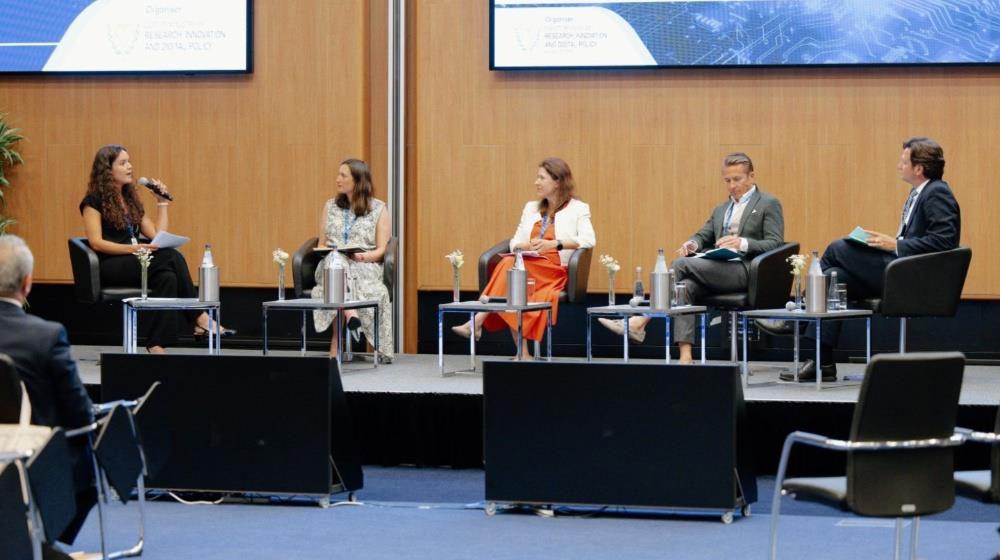
During the discussion on “What does smart regulation means for regulators and industry alike” at the Digital Conference ‘Shaping the Next Digital Frontier’ held on Wednesday as part of the Cyprus EU Council Presidency, panelists expressed that the simplification of regulations would benefit all member states, but highlighted that there are differing views.
The panel was moderated by Sophia Zakari, the Director Enterprise Policy and Legal Affairs at SMEunited, who discussed the issue of regulatory changes with Wojciech Saryusz-Wolski, the Head of Policy Implementation & Planning Unit, DG CNECT at the European Commission, Secretary General at the European Tech Alliance Victoria de Posson, Margarete Rudzki, Head of Unit, Digital Economy & SMEs at German Confederation of Skilled Crafts & Small Businesses European Office, and Samuel Laurinkari, Vice President International Public Policy at Doordash, Deliveroo & Wolt.
Discussing regulation, De Posson said: “Politically, we are getting there with simplification of regulations. We still have a jungle to navigate.”
She added that a threshold needs to be put on bureaucracy. “Every euro spent on compliance is a euro not spent on innovation,” she said.
According to De Posson, every digital company operating in Europe needs to respect the rules, but these need to be clear and predictable.
On his part, Laurinkari said that competitiveness has always been on the European agenda, but it has recently started to take off. He also highlighted that a lot of the regulation issues are still about trust.
“Trust is more about creating trust with companies and investors,” he said, whereas back in 2012 trust was about getting consumers to have faith in e-commerce.
He also pointed out that potentially there have not been many practical improvements yet. “So far, there was a reduction of administrative burden,” he said.
Speaking next, Rudzki said that SMEs are extremely sensitive to changes in regulations. Some of the simplifications, she said, are beneficial for SMEs, but other changes seem to be more about removing issues perceived as inconvenient. “We have seen more effort to create ambiguities to not share data,” she said.
“Simplifying the life of businesses does not always need to go through simplifying regulation,” she said.
Commenting further on regulations in Europe, Saryusz-Wolski said: “The objective of the AI omnibus was to have a basis and then see what can be fine-tuned to our AI economy.”
He added that the European Commission is also looking into asymmetric regulation, to reduce burden on different scales of businesses.
