







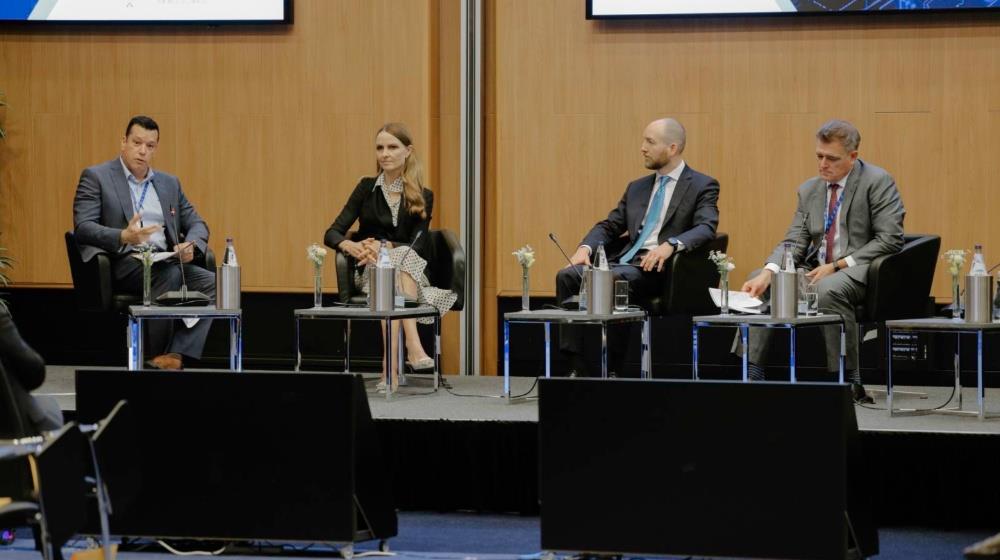
During the panel discussion on ‘The Global AI Race: Where does Europe Stand?’ as part of the Digital Conference ‘Shaping the Next Digital Frontier’ held on Wednesday, panelists said that Europe cannot remain in a bubble and must be open to global partnerships in the new digital age.
The panel, as part of the Cyprus EU Council Presidency, moderated by Dr Constantinos Adamides, a professor at the School of Law of the University of Nicosia, featured a discussion with Nanna-Louise Wildfang Linde, Vice President of European Government Affairs at Microsoft, CEO of the American Chamber of Commerce Europe (AmCham EU) Malte Lohan, and John Miller, the Executive Vice President of Policy and General Counsel of the Information Technology Industry Council.
Commenting on how the EU can maintain talent within the continent in the new digital age, Linde said: “The EU wants to and should build its own capacity, but that doesn’t mean we should exclude international cooperation.”
She added that Europe needs to embrace collaboration, while building its own capacities. Linde also made a special point that Europe in this effort needs to work with “trust partners”, who are committed to transparency, cybersecurity, and the rule of law. In this vein, she said that Microsoft has formed the trusted technology alliance with EU and Asian partner, who are committed to the assurances of sovereignty.
Also commenting, Miller said that Europe needs to figure out a way to do both, as strategic interdependence is important. “Europe needs to have strong international partnerships with not only countries but also companies,” he said.
On his part, Lohan said that the EU has been late for the governance discussion. “Some of the governance is being made up as we go,” he said. He added that in this contect Europe needs to catch up fast, and it is great to see the US and the EU having a dialogue about this governance issue.
“To remain competitive the EU needs to diversify access,” he said.
