







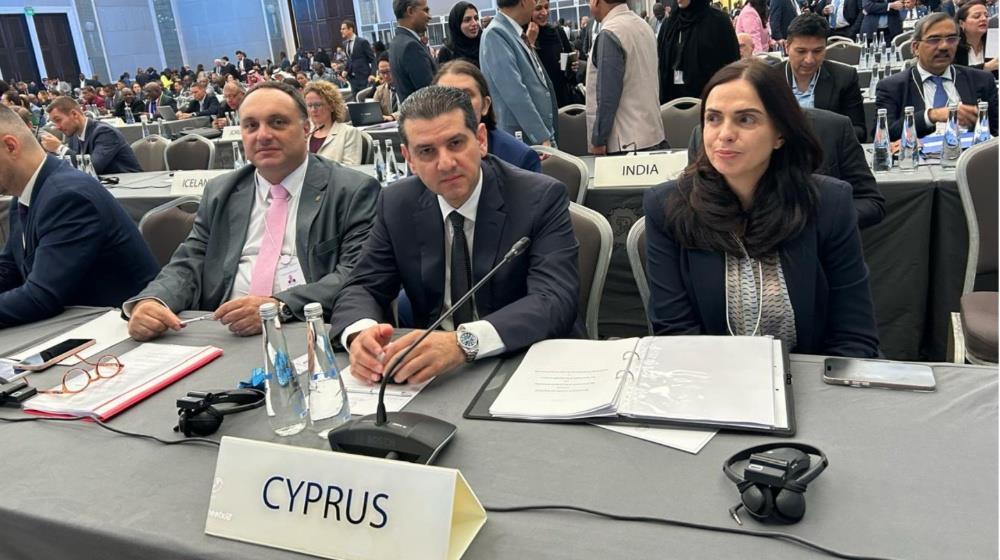
The Minister highlighted from the outset the importance of today’s 3+1 Ministerial Meeting, underlining that the cooperation between Cyprus, Greece, Israel and the United States is gaining even greater significance at a time of intense geopolitical shifts and growing challenges to energy security.
He stressed that the Eastern Mediterranean can play a substantive role in diversifying energy sources and supply routes, strengthening states’ resilience and contributing to the stability of the wider region. He noted that cooperation within the 3+1 framework rests on a strong political foundation, as each country contributes distinct and complementary advantages: the United States through its political support, expertise and investment capacity; Greece as a strategic gateway to European markets; and Cyprus and Israel through the energy potential of the Eastern Mediterranean.
He made particular reference to the significant prospects opened up by the development of natural gas fields in Cyprus’ Exclusive Economic Zone. Since 2011, 11 exploration wells and four appraisal wells have been drilled, leading to six confirmed natural gas discoveries with a total estimated capacity of approximately 20 trillion cubic feet. These are the Aphrodite, Cronos, Zeus, Calypso, Glaucus and Pegasus fields.
The Minister pointed out that the presence of international energy companies in Cyprus’ EEZ, including leading American companies such as Chevron and ExxonMobil, constitutes a tangible vote of confidence in the prospects of the Republic of Cyprus and in the role it can play as a reliable energy partner.
He referred specifically to the progress being made in the development of the fields. For the Aphrodite field, the plan provides for the transport of natural gas to Egypt through a subsea pipeline. For the Cronos field, a fast-track development process is being promoted, using Egypt’s existing infrastructure and enabling exports to regional and European markets. The use of available infrastructure in the region is a key element of a realistic and implementable strategy.
A central point of his intervention was the importance of energy interconnections. The Minister stressed that, for Cyprus, ending its energy isolation is a strategic priority. Electricity interconnections strengthen security of supply, create the conditions for greater use of renewable energy sources and integrate the Eastern Mediterranean into the broader European energy planning.
In this context, he referred to the importance of the Great Sea Interconnector, which can serve as a platform for broader regional cooperation, connecting Cyprus and Israel with the European Union’s internal electricity market through Greece. At the same time, he underlined the importance of United States support for the implementation of strategic connectivity projects.
The Minister also placed emphasis on the protection of critical energy infrastructure. As he noted, modern challenges are not limited to conventional threats. Cyberattacks, hybrid threats and the risk of physical sabotage make closer cooperation, the exchange of expertise and the development of common preparedness and response mechanisms necessary.
A special place in his intervention was given to the launch of the Eastern Mediterranean Energy Center in Houston. The Minister noted that this is an initiative that began as an idea in 2019, when the Eastern Mediterranean Security and Energy Partnership Act was adopted by the US Congress, and is now taking concrete form.
He said the Center creates a new platform for cooperation among governments, universities, research institutions and businesses. It can act as a catalyst for joint research programmes, exchanges of scientists and professionals, training programmes for engineers and regulatory authorities, the development of common technical standards and the organisation of investment forums.
The Minister’s message was that 3+1 cooperation is entering a new phase of maturity. Political will must be translated into projects, investments, infrastructure and measurable results. Cyprus is participating in this effort with a concrete plan, making use of its geographical position, its status as a member state of the European Union and the close relations it maintains with the states of the region.
(Source: CNA)
