






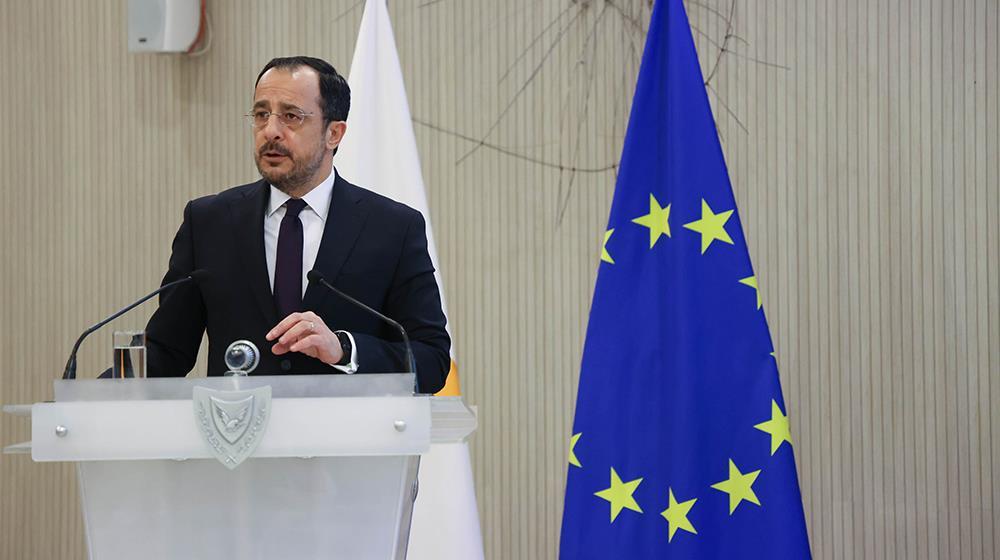
The Cyprus Presidency of the Council of the EU aims to complete the negotiations and the signature of the joint declaration “Europe for Culture, Culture for Europe”, the President of the Republic, Nikos Christodoulides said on Thursday evening, addressing the European Heritage Awards, held in Nicosia Municipal Theater.
President Christodoulides highlighted the Presidency’s priorities regarding culture and noted that it has prioritised the protection of cultural rights and cultural heritage with a particular focus on combating the illicit trafficking of cultural goods.
“A key highlight of our Presidency has been the agreement on a partial general approach on the Agora EU regulation, marking a very important milestone”, he noted, stressing that this outcome confirms member states' shared commitment to strengthening support for culture, media and civil society as a strategic pillar for Europe's resilience and democratic vitality.
He also added that, during Cyprus’ Presidency, “we also aim to complete the negotiations and the signature of the joint declaration Europe for culture, culture for Europe.”
President Christodoulides noted that Cyprus has always been a timeless crossroad of civilizations and a bridge between European Union and the region. “We deeply value the role of culture as a universal language, one that transcends nations and connects citizens of different member states,” he said.
The President noted that this cultural dimension, complements and reflects the Presidency's political priorities and core themes. “We have had the unique opportunity to convey our messages to a much broader audience through the diverse pathways of culture in all its forms, and expressions. It is a celebration of the values that unite us as Europeans, strengthening our bonds and reaffirming our shared European identity,” he pointed out.
Since Cyprus joined the EU in 2004, it has grown into a reliable and constructive member state within the Union and its immediate neighborhood, the Eastern Mediterranean and the greater Middle East, always fully committed to the European project, the President continued. “Our Presidency builds on this commitment, maturity and experience in contributing to European policies and decisions,” he said, highlighting that since day one, Cyprus’ Presidency, under the motto “An autonomous Union, open to the world”, has focused on delivering results on the European agenda.
He stressed that during the Presidency, Cyprus has sought to strengthen the bonds of the Union by promoting culture as an essential tool for political cohesion and by highlighting culture's strategic role in safeguarding European Union values.
Concluding, the President said that cultural heritage and heritage values transfer through generations can serve as a bridge not just between different cultures, but also between the past, the present, and the future. “In 2026, cultural heritage is threatened by geopolitical tensions and ongoing armed conflicts, climate change, globalization, and even over tourism. We all share the responsibility to protect it against these threats for our children and for the future generations,” he said.
In recorded message, Glenn Micallef, European Commissioner for Intergenerational Fairness, Youth, Culture and Sport noted that behind each of the projects awarded, there are people who dedicate their passion and their time to safeguard Europe’s shared heritage.
“These people give us hope, that culture can bring people together, memory can endure” and that the future generations will be inheriting also the values and stories that connect us as Europeans.
Nicosia’s Mayor, Charalambos Prountzos, in his opening remarks, noted that Nicosia, the last divided capital of Europe, carries the complex history of Europe. “Our city demonstrates the transformative power of heritage as a force of reconciliation, dialogue and hope,” he said.
Prountzos referred to the Buffer Zone, noting that it cuts through the historic core of the city, separating the two communities. Over time, he noted, many important medieval and neoclassical buildings fell into severe decay, while others now stand on the brink of irreversible collapse. “This reality was documented through detailed surveys carried out by the bicommunal Nicosia Master Plan team and led to the inclusion of the historic buffer zone in the 7 most endangered programmes by Europa Nostra and the European Investment Bank Institute”.
He stressed that this recognition was not simply a warning, but a call to action, to preserve not only monuments and buildings, but also the memory, identity and shared humanity embedded within them. “Today, the buffer zone remains one of the greatest challenges and at the same time one of the greatest opportunities for the future of Nicosia," Prountzos said.
"The objective is not simply conservation. It is a gradual rehabilitation and reintegration of this historic urban landscape into the city through structural stabilization projects, restoration interventions, improved crossing points, and strategic planning initiatives that can reconnect communities and create spaces of coexistence,” he noted.
