







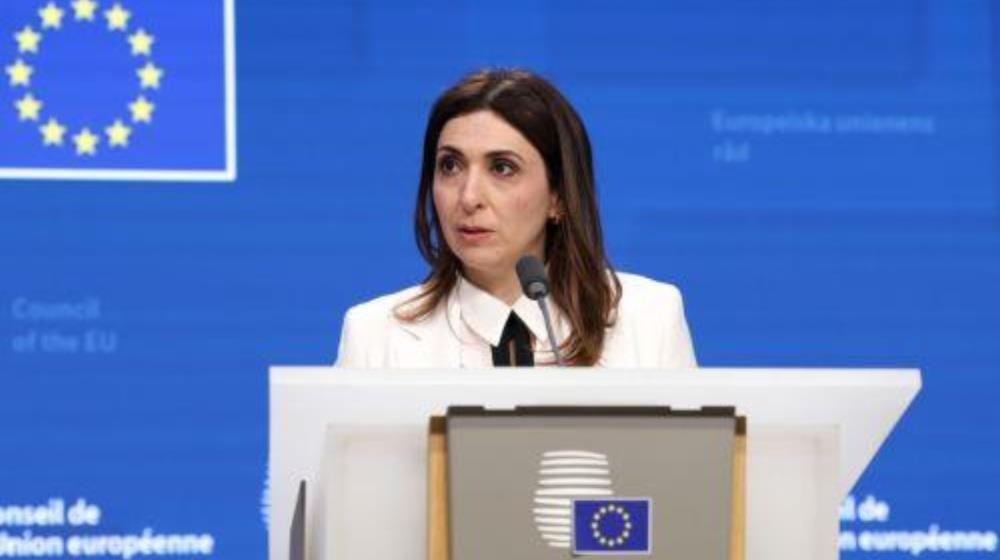
Cyprus' Deputy Minister for European Affairs Marilena Raouna expressed optimism over the progress of negotiations for the next Multiannual Financial Framework (MFF) following Tuesday's General Affairs Council in Brussels, stating that the Cyprus Presidency intends "to include concrete figures, rather than mere ranges in the negotiating box" that is to be presented to member states ahead of the June European Council.
Tuesday's Council agenda covered the preparation for the European Council, EU-UK relations, the rule of law, and enlargement.
"We had initially considered including indicative figures or ranges in the negotiating box," Raouna said. "We believe that the intensity of the discussions we have held with member states will allow us to actually place figures", she added.
Responding to questions about the divergent positions expressed by member states during the session, Raouna acknowledged that differences exist but insisted that progress is tangible. "Are there divergences? Yes. Are we bridging those divergences? Yes. Do we see landing zones on the various issues? Yes, we do, and we will keep working and exerting every effort," she noted.
Tuesday's Council discussions focused on how the new MFF can contribute to completing the Single Market through support for reforms, enhanced cross-border integration, and the mobilisation of public and private investment. The central political question, according to Raouna, remains how to reconcile the new MFF priorities, namely security, defence, competitiveness, energy sovereignty, with Treaty-based policies such as cohesion policy. "They are often two sides of the same coin," she noted.
The Cyprus Presidency confirmed its commitment to reaching a political agreement on the MFF by end-2026, in line with the mandate received from the European Council in December 2025. "We will work until the last day of our Presidency to deliver on this critical file," Raouna stressed.
As part of the preparation for the June European Council, ministers held a first exchange of views on the annotated draft agenda. Leaders' discussions are expected to focus on Ukraine, taking stock of the latest developments and the full range of EU support actions, as well as maintaining pressure on Russia through sanctions. The agenda also includes the situation in the Middle East and the Gulf, global economic challenges and European competitiveness, the strengthening of European defence and security, migration, and for the first time at leaders' level, the issue of illicit drugs, following the presentation of the EU Drug Strategy last December.
On the margins of the Council, ministers reviewed the current state of EU-UK relations over a working lunch. The Cyprus Presidency presented a series of concrete deliverables: a political agreement on the EU-UK Agreement on Gibraltar, authorisation for the Commission to open negotiations with the UK on electricity trading and a financial contribution to cohesion policy, and the decision enabling UK participation in the Erasmus+ programme from 2027. "These are concrete results that reflect steady progress towards a constructive, balanced and forward-looking partnership with the United Kingdom," Raouna said.
On enlargement, Raouna underlined that it "constitutes a geopolitical necessity and not merely a priority," stressing that the process remains merit-based and results-driven. She recalled that the Cyprus Presidency has held two accession conferences with Montenegro and is working towards a third before the end of its term, while an Intergovernmental Conference with Albania took place on Tuesday evening. The goal remains holding a first Intergovernmental Conference for Ukraine and Moldova before the end of the Cyprus Presidency. "We will exert every effort until the last day," Raouna said.
Commissioner for Justice Michael McGrath presented for his part the results of the annual rule of law dialogue, which this year covered France, Croatia, Italy and Latvia. He stressed that in an era of increasing political polarisation and economic volatility, safeguarding the rule of law "becomes more important than ever." According to the Commissioner, "the rule of law remains the bedrock of our European values, fundamental rights and freedoms. These are values that all member states have committed to uphold".
On France, the Commissioner highlighted progress in the digitalisation of court proceedings and transparency of media ownership, while calling for resolution of outstanding issues on lobbying. On Croatia, he welcomed the reduction in the backlog of cases and the development of a solid track record of prosecutions for corruption. On Italy, he acknowledged positive trends in the timeliness of criminal justice proceedings and a strengthened national anti-corruption plan, while calling for comprehensive rules on party and campaign financing. On Latvia, he praised the efficiency of the justice system and the establishment of a judicial academy, while noting the need for effective implementation of existing lobbying legislation.
McGrath also addressed Hungary, expressing satisfaction at the new government's commitment to rule of law reforms. "It is encouraging to see the commitment and dedication of the new Hungarian government to swiftly proceed with rule of law reforms," he said, adding that the Commission will continue to engage constructively with the Hungarian authorities, including on the disbursement of EU funds.
