






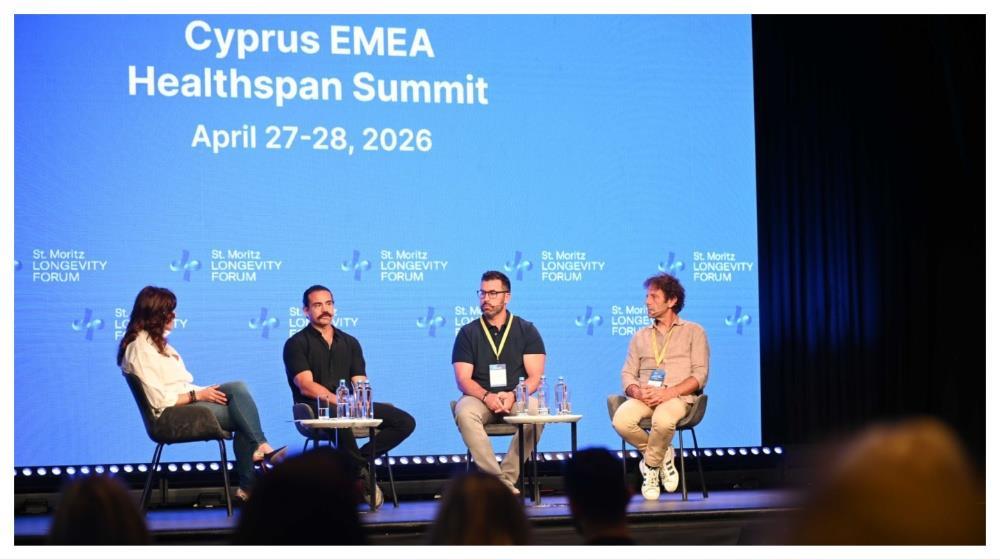
“High performance only has value if you can sustain it,” said Christina Michael, Wellness Consultant, Professional Fitness Coach and visionary entrepreneur, opening the “ZERO BURNOUT” masterclass at the CYPRUS EMEA Healthspan Summit and setting the tone from the outset for a discussion on the limits of endurance, performance and mental resilience in modern professional life.
Speaking from personal experience, she explained that this discussion began from a deeply lived reality of constant pressure and prolonged overperformance. As she noted, over the past four years she has been working daily at extreme intensity, often for 14 hours a day without interruption, in an environment where professional demands remain active well beyond the end of the working day. As she pointed out, the real challenge was not achieving a “better life,” but finding a more effective way to manage energy, mental strain and continuous alertness without collapsing.
She described burnout not as a theoretical risk, but as a daily condition for a generation operating in a state of constant overstimulation, permanent connectivity and relentless cognitive load. As she stressed, the real question today is not only how far one can push the body to its limits, but how to keep the brain functional, clear and productive in an environment that never truly switches off.
Read also: Renzi and Sarkissian: Longevity requires political courage and a new governance blueprint, say the two former heads of state
Presenting the broader picture, she also referred to data illustrating the scale of the phenomenon in Cyprus. According to the European Working Conditions Survey 2024, published by Eurofound in April 2026, 44% of employees in Cyprus report feeling physically exhausted “always” or “most of the time,” the highest rate among 35 countries and more than double that of the Netherlands, which stands at 18%. At the same time, according to Gallup’s State of the Global Workplace 2026, 56% of employees in Cyprus experienced significant stress the previous day, the second-highest rate in Europe after Greece, which stands at 61%.
In the discussion that followed, Dr. Vittorio Sebastiano, Ph.D., Associate Professor in Obstetrics & Gynecology – Reproductive Biology at the Stanford School of Medicine and Co-Director of the PhD Program in Stem Cell Biology and Regenerative Medicine at Stanford, approached the issue through the lens of scientific pressure and the uncertainty that accompanies high-level research. As he noted, pressure in science stems not only from workload, but from the constant need to prove that what you are building has value, scientific depth and future potential. Describing the realities of research, he pointed out that the funding system remains extremely competitive, with approval rates below 10%, meaning that, on average, only one out of ten multi-page proposals is funded. As he emphasized, this creates an environment of continuous pressure, high risk and sustained mental strain.
Dr. Ryan Greene, D.O., M.S., Co-Founder and Medical Director of Monarch Athletic Clubs, spoke about the need to redesign prevention beyond the narrow clinical model, describing the creation of a new type of space that integrates preventive medicine, wellness and everyday care without the burden of the traditional hospital experience. As he explained, the goal was to create an environment where health is treated as the most important personal investment. Reflecting on his own path, he noted that in traditional medical training, exhaustion was almost normalized, with 30 consecutive working hours considered acceptable, despite the obvious cost to performance, judgment and safety.
Moha Bensofia, Entrepreneur and Investor and Co-Founder & Chief Evangelist of Mendi, approached the topic from the perspective of personal resilience, speaking openly about a journey that included war, a severe health collapse and a long period of recovery. As he stated, the real challenge is not how to completely avoid difficult periods, but how to move through them and emerge stronger. As he noted, the key lies in access to practical tools that enable individuals to accelerate recovery, strengthen resilience and regain functionality with greater consistency.
The discussion highlighted that burnout is not an individual weakness, but a structural condition of modern professional life. The real challenge, as became clear, is not only to reduce exhaustion, but to develop new tools of biological and mental resilience that allow for sustained high performance, clarity and psychological stability.
The CYPRUS EMEA Healthspan Summit was organized by the St. Moritz Longevity Forum in strategic partnership with MHV Group.