







Longevity is dynamically entering geopolitics and public governance, transforming the question of longer life into a front-line political, institutional and social issue.
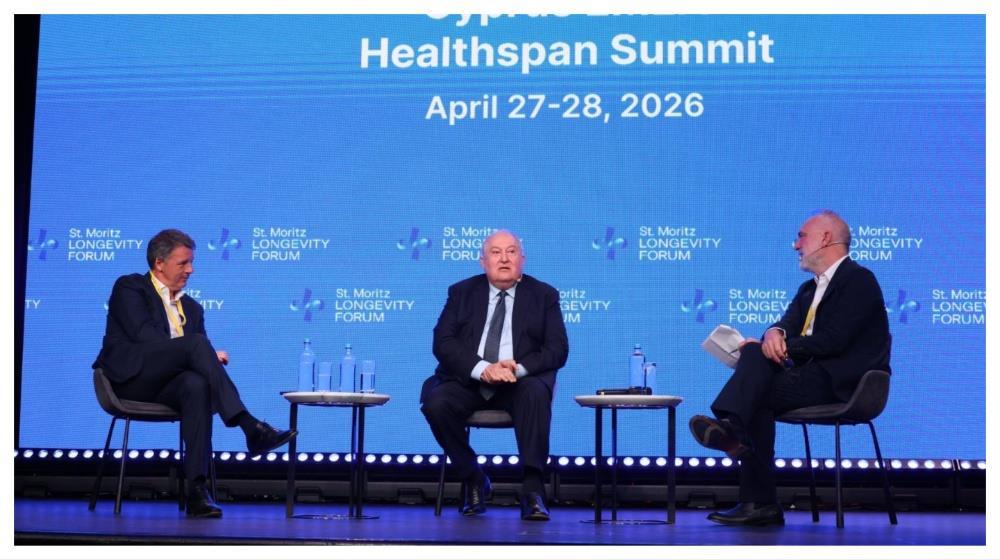
At the Leaders' Panel of the CYPRUS EMEA Healthspan Summit entitled 'Longevity Geopolitics: Governing a New Human Era', the former Prime Minister of Italy, Matteo Renzi, and the former President of Armenia, HE Dr. Armen Sarkissian, highlighted the political, institutional and philosophical dimensions of a new era, where longevity redefines the way in which states, institutions and societies themselves are organised.
The discussion was moderated by Prof. Nicola Palmarini, Director, UK National Innovation Centre for Ageing (NICA), Co-Founder, Edelman Longevity Lab, CEO, Voice® Italia and Affiliate, Harvard Meta Lab, setting the framework for a strategic discussion on how national leadership and global health systems are called upon to adapt to a multi-generational society, with new demands, new expectations and new forms of political responsibility.
A former Prime Minister of Italy, Matteo Renzi, approached longevity through the lens of political reality, noting that long-term strategy remains extremely difficult when governments operate under the constant pressure of daily crisis. As he noted, today’s political leaders wake up every morning faced with a chain of immediate and successive crises, from geopolitical conflicts and inflation to energy pressures and international instability, which constantly shifts the center of gravity of governance from long-term planning to political survival of the moment.
In this environment, as he noted, the first priority of political power is to manage the present and maintain social cohesion, but that is precisely where the greatest challenge lies: to enable politics to generate hope for the future, even when it is called upon to operate under conditions of constant pressure. He argued that longevity needs institutional status and political representation, proposing the creation of a Ministry of Longevity as a clear political signal that longer life spans require a new center for strategic planning.
On his part, the former President of Armenia, HE Dr. Armen Sarkissian, approached the issue from a deeper existential and technological perspective, arguing that the concept of longevity has already changed radically. As he stated, man has already entered a new form of duration, where physical presence ceases to be the only limit of existence. Through data, images, speeches, texts and the digital footprint, each person begins to acquire a new, non-material continuity, which will be able to survive, reproduce and interact well beyond his biological life.
In characteristically graphic fashion, he described a future where technology would be able to reconstruct human presence with ever greater precision – first as a digital image, then as a hologram, and later as a form of biological representation. As he noted, the next generation would inherit not only memory, but also a new form of active presence, capable of participating again in life, knowledge, and the transmission of experience.
However, he clarified that the true essence of longevity remains deeply human. As he underlined, the essential issue is not the extension of existence as a digital footprint, but the ability of a person to live longer years with health, functionality and personal dignity. Longevity acquires value only when it is accompanied by quality of life and by the ability of a person to remain themselves over time.
Contrary to the proposal for a new Ministry of Longevity, Sarkissian argued that the solution lies not in adding another institution, but in integrating longevity into every level of public policy. The answer, he noted, lies in a horizontal reorganisation of the state, where health, education, technology, labour and social cohesion are redesigned based on the new human lifespan.
In conclusion, the discussion highlighted that longevity is not just a medical or demographic challenge, but a new field of geopolitical thinking and institutional redesign. The real question is not just how much longer people will live, but how to govern a world in which life, memory, work, and human presence acquire a whole new duration.
The CYPRUS EMEA Healthspan Summit was organised by the St. Moritz Longevity Forum in strategic partnership with the MHV Group.
(Source: InBusinessNews)
