









Cyprus is one of Europe's fastest-growing economies. However, businesses across the island are struggling to find the staff they need.
These two facts may seem contradictory, but they are actually the same problem viewed from different perspectives.
A thriving economy running out of workers
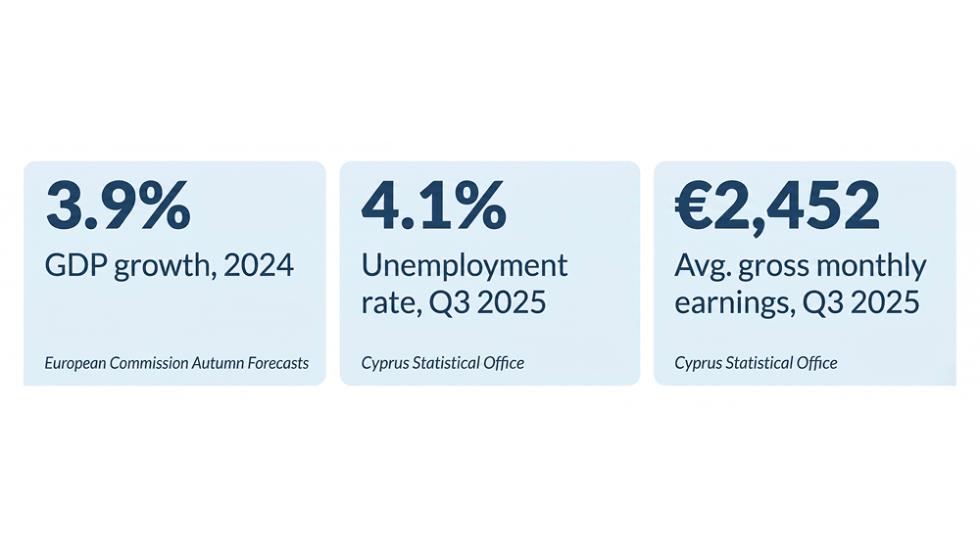
The Cypriot economy grew by 3.9% in 2024, according to the European Commission, consistently outpacing the EU average. Unemployment fell to 4.1% by the third quarter of 2025, nearing historic lows. The labour market is essentially full.
This poses a challenge for business leaders, as there are not enough workers available to support current growth rates, let alone increase them.
The demographic reality
The shortage is not just a temporary issue. In 2024, Cyprus's fertility rate was 1.4 children per woman, which is well below the replacement level of 2.1, according to Eurostat. The country has been below this threshold since 1995. With fewer births happening now, it means there will be fewer workers in 15 to 20 years' time. The pool of local talent is getting smaller, and no short-term policy change can reverse this quickly.
There is also a mismatch between skills and jobs. Youth unemployment is at 13.1%, which suggests that many young workers do not have the skills that the sectors with job openings require. This is a structural problem, not a temporary one.
What vacancy rates tell us
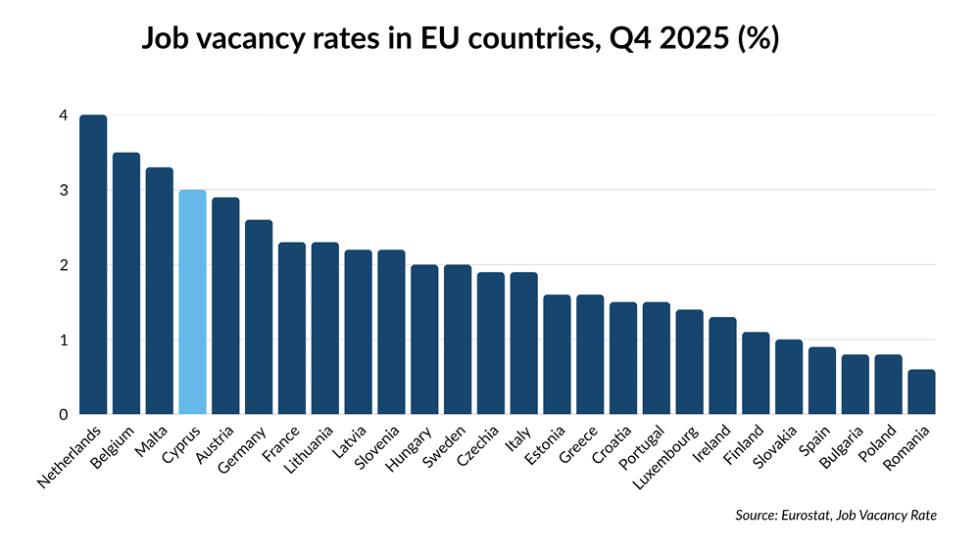
A job vacancy rate measures the percentage of unfilled positions relative to all available roles in the economy. A high rate indicates that employers are finding it hard to hire, rather than there being a lack of jobs. Cyprus has a 3% job vacancy rate, one of the highest in the EU, according to Eurostat.
At a sectoral level, the picture is stark. The vacancy rate for accommodation and food services is 6.6%, while administrative services have a rate of 4.0%. ICT stands at 2.9%. These industries are central to Cyprus's economy, given its status as a tourism and financial services hub. Many businesses are struggling, and their challenges go beyond just trying to grow; they are trying to maintain normal operations.
The workforce is already becoming more international
The proportion of Cypriot nationals in employment fell from 80.1% in 2015 to 72.0% by 2025, according to the Cyprus Statistical Office. Since 2015, approximately 48% of employment growth has come from EU nationals and third-country nationals. Migration reforms introduced in 2025 now permit certain sectors to hire up to 100% foreign staff.
The question is whether organisations are building the capacity to manage it well. To source international professionals, organisations need structured pipelines, rather than one-off placements. Retaining them requires investment in integration, including clear career pathways, cultural onboarding, and practical relocation support.
The cost of inaction
Some organisations have delayed addressing workforce strategy, assuming conditions might ease. The evidence does not support that assumption. Wages are rising by 4.3% year-on-year, driven by scarcity. Minimum wage legislation introduced in January 2026 and the partial restoration of the Cost-of-Living Allowance have added further structural upward pressure on labour costs.
If costs keep rising and the talent pool does not grow, it will mean smaller profits, burnout among existing staff, and slower growth. Having no one to fill jobs in professional services is a risk to Cyprus competitiveness. Foreign investors tend to go where the talent is, so if the talent is not here, the investment will go somewhere else.
"Businesses that wait for the local talent pool to recover will find themselves waiting indefinitely. The organisations that are getting the best talent now are the ones that have got international hiring pipelines in place today." — Christiana Palla, Director and Country Manager, KonnektTalexio.

Building for the long term
The organisations best positioned for the next decade are building international hiring pipelines, reviewing whether their HR functions are equipped for cross-border compliance, and asking whether their leadership teams are ready to manage diverse workforces effectively.
Konnekt is a specialist recruitment agency connecting businesses with exceptional talent. Founded in Malta in 2007, the agency has grown across Malta, Greece, Cyprus and Poland by building long-term relationships with both clients and candidates, grounded in honest conversations and genuine market knowledge. The team at Konnekt takes a thoughtful approach, going beyond filling roles to understand each organisation's culture, goals, and long-term vision, ensuring the right match between companies and professionals.
For business leaders navigating today's tight labour market, the Konnekt Cyprus team is available to help with challenges such as building international candidate pipelines, developing resilient workforce strategies, or hiring the right person for a critical role. They can be contacted directly at cyprus@konnekt.com.
Data sources: European Commission Autumn Forecasts; Eurostat (Real GDP, Job Vacancy Rate, Fertility Rates); Cyprus Statistical Office (Employment, Earnings).
