







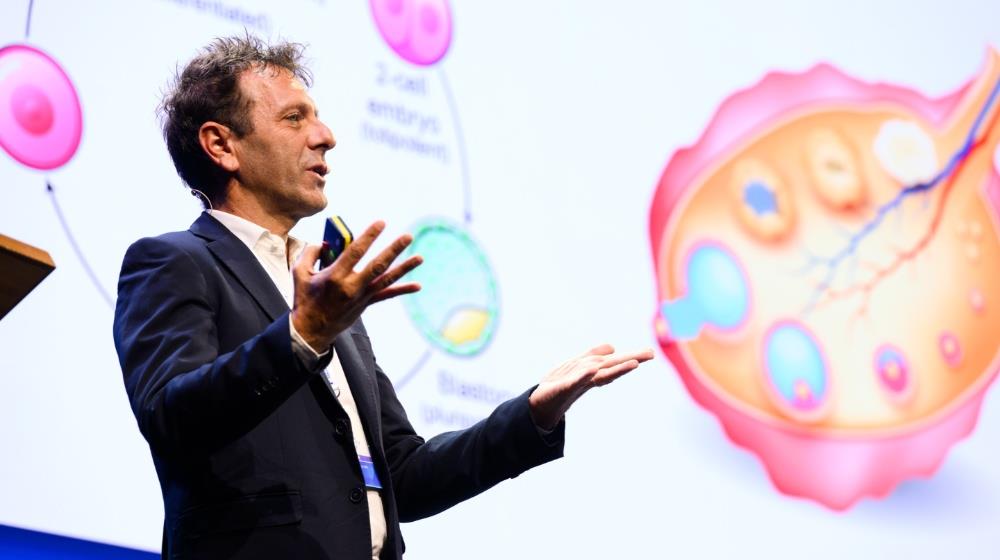
We are entering an era where biological decline is no longer a mandatory cost of doing business. While the markets have long been obsessed with "anti-aging" trends, Professor Vittorio Sebastiano is pioneering something far more radical: a total reset of the human cells.
A standout visionary at University of California, Irvine and Stanford University and enterpreneur, Sebastiano is a leader in Epigenetic Reprogramming, a technology designed to "reboot" old cells back to their peak youthful performance.
His most disruptive work targets the ovary, the body’s fastest-aging organ. By cracking the code on Ovarian Rejuvenation, Sebastiano isn't just addressing fertility; he is proving that we can restore the body's most complex systems.
This April, Sebastiano arrives in Limassol as a Key figure to the scientific agenda of the Cyprus EMEA Healthspan Summit, organized by the St. Moritz Longevity Forum. In this exclusive conversation, InBusiness explores how Sebastiano is leading a scientific revolution that could fundamentally extend the productive years of the human race.
Prof. Sebastiano, your work centers on the ability to "reprogram" a cell to its youthful state. From a leadership perspective, does this suggest that "retirement age" will soon become a flexible choice rather than a biological necessity?
It is definitely a plausible future. Epigenetic reprogramming demonstrates two complementary and important outcomes: first, it decouples biological age from chronological age; second, it shows that biological age of cells and tissues can be reset to a more youthful state. This indicates that physical and cognitive decline may no longer dictate when a person must stop working. Retirement will increasingly become a lifestyle choice, not a biological deadline.
Your research identifies the ovary as the primary indicator for human aging. If you can successfully reverse decline in the body’s most time-sensitive organ, does that provide the definitive blueprint for rejuvenating the rest of the human system?
Absolutely. The ovary is the body's fastest-aging organ, the most complex to restore, but it is also the single organ with the most dramatic implications to systemic aging. Successfully reversing its decline is the ultimate proof-of-concept ; if we can rejuvenate the hardest system but simultaneuously obtian the most significant systemic impact on health span, we have a validated framework for applying the same reprogramming principles to other organs and tissues throughout the body.
The economic toll of menopause and age-related decline runs into the billions. What is the macro-economic potential of restoring these "lost years" of peak performance to the global workforce?
The economic cost of menopause alone exceeds $150 billion annually in lost productivity and healthcare spending globally. Broadening that to all age-related decline, restoring even few years of peak cognitive and physical performance per person could add trillions to global GDP, reduce healthcare burdens, and sustain aging workforces that would otherwise exit the economy prematurely.
You pioneered the use of mRNA as a delivery system for rejuvenation. From a manufacturing and global scaling standpoint, why is mRNA the superior vehicle for taking this technology out of the lab and into the market?
mRNA is transient and it does not permanently alter DNA, making it inherently safer than viral delivery methods. Critically, the COVID-19 vaccine era proved that mRNA can be manufactured at massive global scale, rapidly and cost-effectively. For rejuvenation therapies, this means we have a technology that is precise, dose-controllable, and already supported by established manufacturing infrastructure worldwide.
With Epigenetic Reprogramming entering human trials this year, why is this "Phase 1" milestone the most critical validation point for the biotech investment community?
Phase 1 is the bridge between laboratory promise and clinical reality. It generates the first human safety data, which is the single most important de-risking event in biotech. For investors, it signals that the science is no longer theoretical. It confirms tolerability in humans and opens the pathway to efficacy trials and, ultimately, commercialization. It is the moment that transforms a promising startup into a credible investment thesis.
How are you structuring your commercial model to ensure these cellular resets eventually become accessible mass-market solutions rather than exclusive tools for the elite?
The mRNA platform is key to democratization. Unlike gene therapy or surgical interventions, mRNA-based treatments can be manufactured at scale and at decreasing cost. The commercial model must follow a phased approach , initial premium pricing funds R&D and trials, while partnerships with healthcare systems, insurers, and governments drive broader access. The long-term goal is for rejuvenation therapies to be as accessible and affordable as vaccines. A fundamental right to everyone.
As a key figure to the scientific agenda of the Cyprus EMEA Healthspan Summit, what is the single most important message you want to leave with the regional investment community?
The longevity economy is not a future trend, it is a present-day investment opportunity. The window to be an early mover in Age-Tech is now. Those who build the infrastructure, clinics, and investment frameworks today will define and capture the enormous economic value of the healthspan revolution.
Beyond the logistical advantages, what strategic potential does Cyprus have to establish itself as a specialized hub for "Age-Tech" and longevity clinics?
Cyprus has a compelling combination of advantages: EU membership, a Mediterranean climate proven to support wellness, an established medical tourism infrastructure, a skilled healthcare workforce, and a favorable regulatory and business environment. These factors make it an ideal location for longevity clinics, Age-Tech research centers, and clinical trial facilities serving the entire EMEA region.
Could the export of "Rejuvenation Services" eventually rival traditional Cypriot sectors like shipping or financial services as a pillar of the national economy?
I would not say rival but rather synergistically complement and support them. The global longevity market is projected to reach several trillion dollars within the next decade. If Cyprus strategically positions itself as a premier destination for rejuvenation services and Age-Tech investment, the sector could dramatically enhance and add to ist already existing economic returns. The key is acting decisively now, before the market matures.
If we integrate these breakthroughs today, how do you envision the Cypriot workforce in 2035?
Will we see 70-year-old professionals contributing with the same cognitive and physical energy as those decades younger? By 2035, we could see 70-year-old professionals contributing with the cognitive sharpness and physical energy of someone in their 40s. This fundamentally transforms workforce demographics, reducing pension pressure, extending tax-contributing careers, and bringing decades of accumulated skilled and wise expertise back to peak performance. For Cyprus, this means a more productive, dynamic, and economically resilient society built on the science of healthspan extension.
As the science of rejuvenation moves from the laboratory to the front lines of clinical reality, the strategic focus shifts to Limassol. Prof. Vittorio Sebastiano’s presence at the Cyprus EMEA Healthspan Summit marks a pivotal moment for the regional business community to engage with the future of human productivity. For those ready to explore the next frontier of the global economy, the conversation begins this April!
To register for the Summit: stmoritzlongevityforum.ch/cyprus-emea-healthspan-summit/
To explore Prof. Sebastiano’s research:
https://www.linkedin.com/in/vittorio-sebastiano-36605538/
