







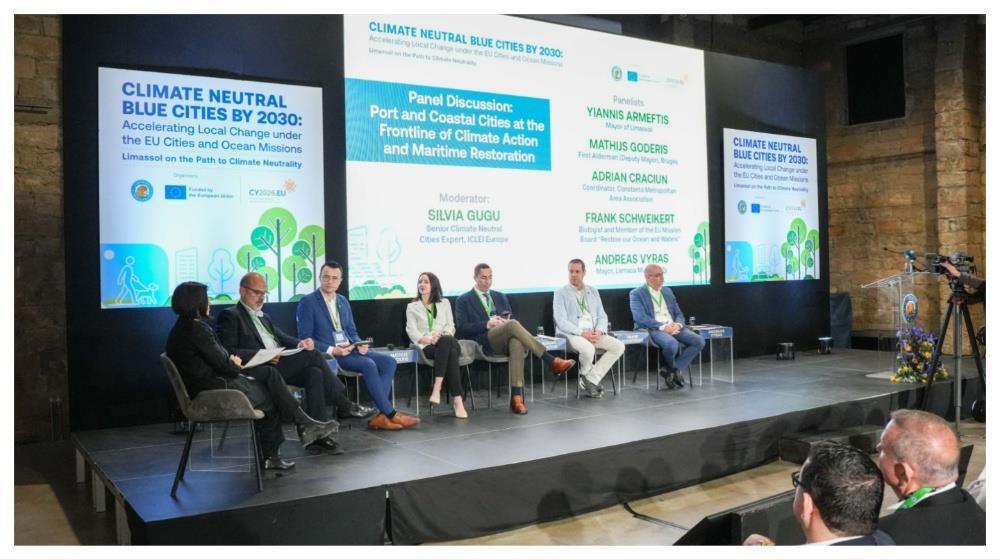
Issues concerning the role of coastal cities in addressing climate change, the interconnection of urban and maritime space, as well as the exploitation of the "blue economy" were at the centre of a panel discussion entitled 'Port and Coastal Cities at the Frontline of Climate Action and Maritime Restoration,' within the framework of the 'Climate Neutral Blue Cities by 2030: Accelerating Local Change under the EU Cities and Ocean Missions - Limassol on the Path to Climate Neutrality' conference.
The discussion focused on practical solutions for the sustainable development of coastal cities, the management of environmental risks, as well as cooperation between cities, ports and local communities, while examining specific examples of projects and strategies from European cities.
The panel included the Mayor of Limassol, Yiannis Armeftis, the First Alderman (Deputy Mayor) of Bruges, Mathijs Goderis, the Coordinator of the Constanta Metropolitan Area Association, Adrian Craciun, the Biologist and Member of the EU Mission Board “Restore our Ocean and Waters”, as well as the Founder and Chairman of the German Ocean Foundation, Frank Schweikert, and the Mayor of Larnaca, Andreas Vyras.
During the discussion, Yiannis Armeftis referred to Limassol as a city moving towards a more integrated development approach, noting that “an interaction between development, energy, mobility, tourism and the coastal ecosystem is needed.” As he explained, small interventions can have a substantial impact, citing as an example the creation of new routes connecting the city to the coastal front, while he also referred to actions such as energy communities and efforts for a “greener” operation of the port.
On his part, Mathijs Goderis, referring to Bruges, emphasised that water is a key pillar of the city's energy transition, noting that approximately 70% of energy needs are already covered by renewable sources, with the goal of reaching 91% by 2030. As he stated, coastal cities not only have challenges but also the means to lead the change.
Adrian Craciun, referring to Constanta, provided a comprehensive picture, emphasising that, despite the challenges the city faces, there is significant progress. As he stated, “the region is already moving towards climate neutrality,” with 13 cities participating in the relevant effort, including three in the European 100 Cities program.
At the same time, he noted that Romania has already achieved the target of reducing emissions by 55% compared to 1990, while the projects being implemented are even exceeding the national targets. He also stressed that Constanta, although facing vulnerabilities such as sea level rise and coastal erosion, is proceeding with coastal zone upgrading and urban regeneration projects, with an emphasis on the building sector, which is a main source of emissions.
The Mayor of Larnaca, Andreas Vyras, referred to the significant changes being promoted in Larnaca, expressing satisfaction with the progress that has been achieved, particularly with regard to the relocation of energy facilities from the coastal zone. As he noted, this development paves the way for the development of approximately four kilometers of coastal frontage, creating new prospects for a more sustainable and attractive city, while at the same time referring to innovative projects related to the "blue economy".
Frank Schweikert, in a broader European approach, underlined that the biggest challenge for the oceans is climate change, stressing the need to strengthen citizens' knowledge and connection with the marine environment. As he said, Europe has a significant wealth of data and knowledge about the oceans, which can be used to develop solutions, noting that understanding and contact with the sea are key elements for its protection.
The discussion highlighted both the challenges and significant opportunities for coastal cities, confirming that through collaborations, innovation and targeted interventions, they can play a leading role in the green transition.
The panel was moderated by ICLEI Europe's Senior Climate Neutral Cities Expert, Silvia Gugu.
The conference, which took place on Wednesday, 19 March, was organised by Limassol Municipality.