








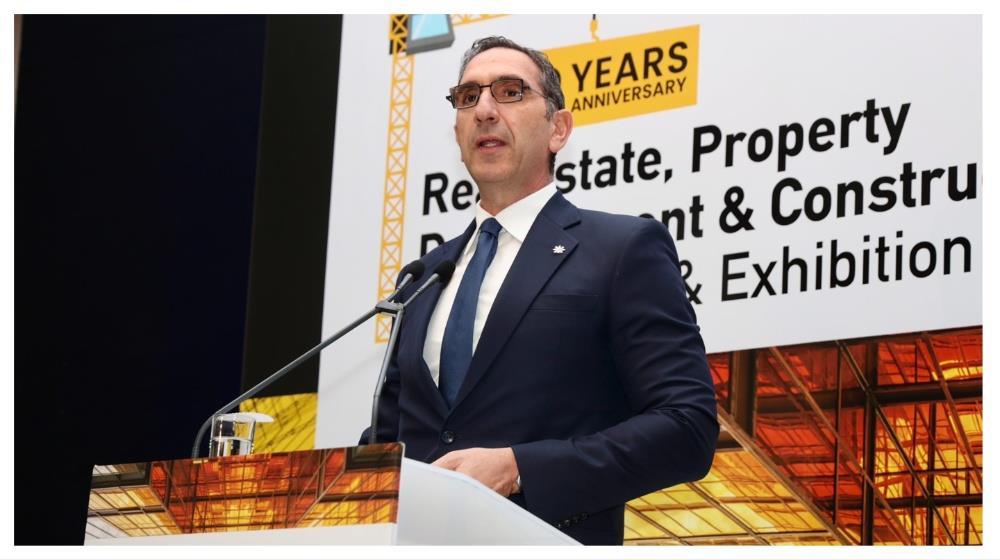
The position that "access to affordable and quality housing is a basic prerequisite for social cohesion and sustainable development" was stated at the 20th Real Estate, Property Development & Construction Conference & Exhibition organised by Altia, by the Minister of Interior Constantinos Ioannou.
The lack of affordable housing options now affects a wide spectrum of society in all European states, with a particular impact on low and middle-income earners, young people, but also on workers in critical sectors, such as health and education, he said, outlining the current situation.
In this context, he continued, the Cyprus Presidency of the Council of the European Union places the issue of housing high on the European agenda. In line with the objectives set by the European Commission and with respect for the specificities of the Member States, the Cyprus Presidency focuses, he explained, on four axes:
Firstly, access to affordable and sustainable housing for all, with particular emphasis on low- and middle-income households and young families, in a way that meets their modern requirements.
Secondly, to strengthen and facilitate investments in the housing sector, by leveraging all available financial tools and encouraging cooperation between the public and private sectors, through the promotion of the new Pan-European Investment Platform for affordable and sustainable housing.
Thirdly, increasing the supply of affordable housing through new construction, renovation and reuse of existing buildings.
And fourthly, in the exchange of knowledge through the collection of reliable data and the exchange of knowledge and best practices between Member States, so that policies are designed on the basis of real market data.
Therefore, the Minister stated, the government has set housing policy as a key priority, implementing a comprehensive housing strategy based on two main pillars. The first concerns the increase in the housing stock, with particular emphasis on the production of affordable housing units. The second concerns the strengthening of citizens' purchasing power, focusing on young people, young families and socially and economically vulnerable groups.
Given that the demand for housing remains high, while the supply is not increasing at the same rate, it was deemed necessary, he said, to adopt a series of measures aimed at both the construction of new housing and the utilization of existing housing units. The gradual balancing of supply and demand, with an emphasis on increasing the supply of affordable housing, is expected, he estimated, "to contribute to the decompression of purchase and rental prices and to facilitate access to housing for all citizens, without exclusions."
The Urban Incentive and Build to Rent Schemes, through which an attempt is made to increase the supply of housing, are moving in this direction.
At this point, the Minister said, "To our great satisfaction, these two Schemes, which constitute the State's most substantial intervention in addressing the housing problem, have already attracted significant interest from the land development sector."
To date, 46 applications have been submitted for the utilisation of urban planning incentives and the additional building coefficient. These applications correspond to the gradual construction of over 2,500 housing units over the next two years, of which 400 will be placed on the affordable housing market.
At the same time, in another 24 applications, the option of purchasing the building factor is utilised with a total compensation of €12.5 million to the Special Affordable Housing Fund of the Cyprus Land Development Corporation, for the implementation of its own affordable housing programs.
At the same time, through state support and having secured sources of funding, an attempt is being made to strengthen the implementation of the development program of the Cyprus Land Development Corporation According to the Minister, within 2026, the Corporationis on track to implement 244 residential units for sale at an affordable price and 192 units for affordable rent, while the process of separating 135 plots of land in areas of Nicosia, Larnaca, Limassol and Paphos is progressing.
In addition, last December, the Scheme for the construction of approximately 500 affordable rental units on state land was announced, with a total investment of over €75 million and a completion date of 2029. The aim is to increase affordable housing options for the benefit of young people, young families and low and middle-income earners. The apartment buildings will be constructed by the private sector, using the “design and build” method on state-owned land, while the management of the units will be undertaken by the Cyprus Land Development Corporation. As he noted, “Currently, we are in the stage of preparing the necessary studies and documents” to state with confidence that “as with all the efforts of the State, the private land development sector will respond constructively to the implementation of this ambitious project.”
At the same time, to meet specific housing needs, the Scheme for the Construction of Collective Accommodation Units is being implemented, for workers in the sectors of commerce, industry and tourism. The Scheme includes specific conditions for the location and minimum technical requirements, with the possibility of application in new and existing buildings.
Furthermore, a month ago, the start of implementation of the Student Accommodation Construction Scheme was announced, which aims to address the growing demand for student rooms and stabilize rental prices in areas with a strong student presence.
This is a new, modern type of student accommodation units that differs from the traditional type of student residences, with reduced requirements regarding the total areas of supporting and common areas, without the obligation to provide common infrastructure and with greater flexibility in the provisions for parking spaces. The construction of Student Accommodation Units is permitted in autonomous developments and in combination with other uses, such as residential, commercial and office, and is possible both in new developments and in existing buildings under certain conditions.
At the same time, and in order to give the remaining Schemes time to deliver units to the market, the State, as he said in his speech, proceeded with substantial improvements to the “Renovate-Rent” Scheme, which, despite initial estimates, had a low performance. With the aim of making the Scheme more attractive and contributing in the short term to the increase in the available housing stock, in collaboration with the Hellenic Housing and Urban Development Agency, we proceeded with significant amendments, which include, among others, the increase in the grant by €5,000 per type of housing unit, the inclusion of existing non-residential units, such as offices and professional spaces, the expansion of the application areas, the expansion of the limit of the maximum permitted electricity consumption, etc. He himself expects that with the improvements made, the response will be greater.
In parallel with the implementation of the housing policy, priority was given, Ioannou noted, to the reform of the land development licensing system. The new, simplified and more flexible framework reduces time-consuming and complicated procedures, introducing a fast-track licensing process for low and medium-risk developments. In this context, so far, almost 2,100 applications for developments of up to two dwellings have been completed within the time limit of 40 working days, while another 660 applications concerning apartment buildings of 20 apartments have been examined within 80 working days.
Based on these figures, it is estimated that almost 5,800 households will meet their housing needs approximately one year earlier. The simplification of licensing is a substantial reform, which contributes to increasing the supply of housing, decompressing prices and stabilising the market.
Concluding, Ioannou said that the housing challenge we face today requires coordinated action, a long-term strategy and, above all, substantial cooperation between the State and the private sector, and that the State must create the appropriate framework of policies, incentives and institutional tools. " Our common goal is to maintain a dynamic and healthy land development sector, in order to ensure the country's economic stability and social cohesion," he said, concluding his speech.
(Source: InBusinessNews)
