




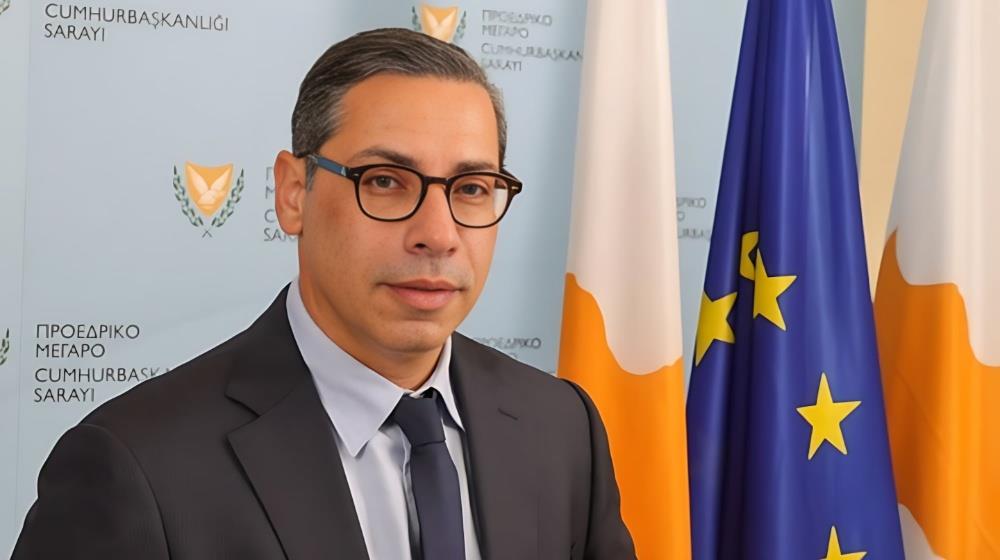
The need to strengthen the European Union’s presence and action in the Middle East was stressed by Cyprus’ Foreign Minister, Constantinos Kombos, in statements upon his arrival at the meeting of the EU’s Foreign Affairs Council of the European Union in Brussels on Monday morning.
Referring to the war in the Middle East, the Minister said that it should no longer be treated as a purely regional conflict. “I believe that we should move away from the illusion that this is a regional conflict. It’s global and it’s affecting our Europe in terms of energy, in terms of maritime lanes, in terms of maritime navigation safety,” he noted.
He also recalled “two of the main priorities of the Cyprus Presidency: to put emphasis on the Middle East and the Gulf, and also maritime security. We did not have a crystal ball, but unfortunately these priorities have now become a factual necessity,” he added.
The EU must strengthen its presence and action in the region, Kombos stressed while also extending solidarity to the Gulf Cooperation Council and Lebanon. “As EU we must be more present and more active in relation to this conflict. We should also extend our strong solidarity towards the GCC and towards Lebanon as regards commitments we have made. There are pending issues relating to trade. I believe that now is the time to move with pace and implement these pending issues, because if not now, the question is when will we be doing that?” he noted
Kombos said that Ministers had held an initial exchange of views on the new European security strategy, stressing the need for a broad and inclusive process. “I think it was a very timely and useful discussion, and we made the point that this needs to be an inclusive process and, as I said, a 360-degree approach.”
Referring to the discussion that was going to follow on the war in Ukraine, he underlined that European support must continue and be strengthened. “It’s very important to reiterate that our full support towards Ukraine at all levels needs to be maintained and even enhanced. We have managed to secure overall the renewal of the sanctions in relation to the territorial integrity of Ukraine, and there are of course issues relating to the €90 billion loan and the 20th sanctions package, on both of which we need to maintain the political effort to make sure that we get them across.”
Kombos also referred to the meeting the EU was going to hold with the Foreign Minister of India, highlighting the strategic importance of relations. “We’ll be hosting the Foreign Minister of India. India is a strategic partner for the European Union. We need to make sure that the recent positive developments we had in relations between India and the EU will be carried forward and that we will have a structured, continuous dialogue with India, which is a strategic partner for the EU,” he said.
Asked about the possibility of expanding the mandate of the European maritime security mission to the Strait of Hormuz, Kombos avoided taking a public position before Μinisters conclude their discussion, as Cyprus currently holds the EU Presidency.
“This is a matter that we will be discussing later on. It’s an idea that’s on the table. You have to look into the various details relating to the practicality of this, whether that could be working. But at the end of the day we should be trying to find a practical solution, always within the context of realism and the fact that there is a conflict that is ongoing,” he note. As he stressed, “I’m not going to take a public position as the Presidency on this stage. I’m going to wait for the discussion inside, but I believe we should be driven by the practical outcome of any kind of action that we will take.”
In a response to another question about what he meant by describing the conflict as global rather than regional, he said the consequences are already visible on multiple levels. “I think that this is definitely a conflict that has global impact. We are seeing it on various layers of activity and it’s affecting Europe. We cannot disassociate what’s happening in our part of the world, in the region, with what’s happening in Ukraine,” he added.
At the same time, he noted that the situation in the Gulf has mobilised all international actors. “I believe that anyone with geopolitical ambition has something to do right now with the situation in the Gulf. Everyone is active. So our ambition as EU to be a geopolitical player, in the same way that we are an economic global player, means that we should all be present and active and find ways of trying to intervene, always leading to de-escalation and a diplomatic situation,” he noted.
Asked whether a security mission in the Straits of Hormuz should be European or conducted through NATO, the Minister stressed the complexity of the situation. “I think the question should be how we can maintain that there is freedom of navigation in the way that it is facilitated for the global economy. We also have to keep in mind that there is a conflict ongoing over there, so there are very serious security issues as well,” he said
As he added, an immediate return to the previous situation should not be expected. “I do not expect to have a solution that will take us back to the situation as it was before. There’s going to be a window of time that we need to manage. It’s a very complicated situation and we need to have an approach that is formed after we are in direct, clear and close contact with our partners in the Gulf. We cannot try to impose a solution in any way. This has to be done by being in touch with those that are directly affected,” he concluded.
(Source: CNA)