









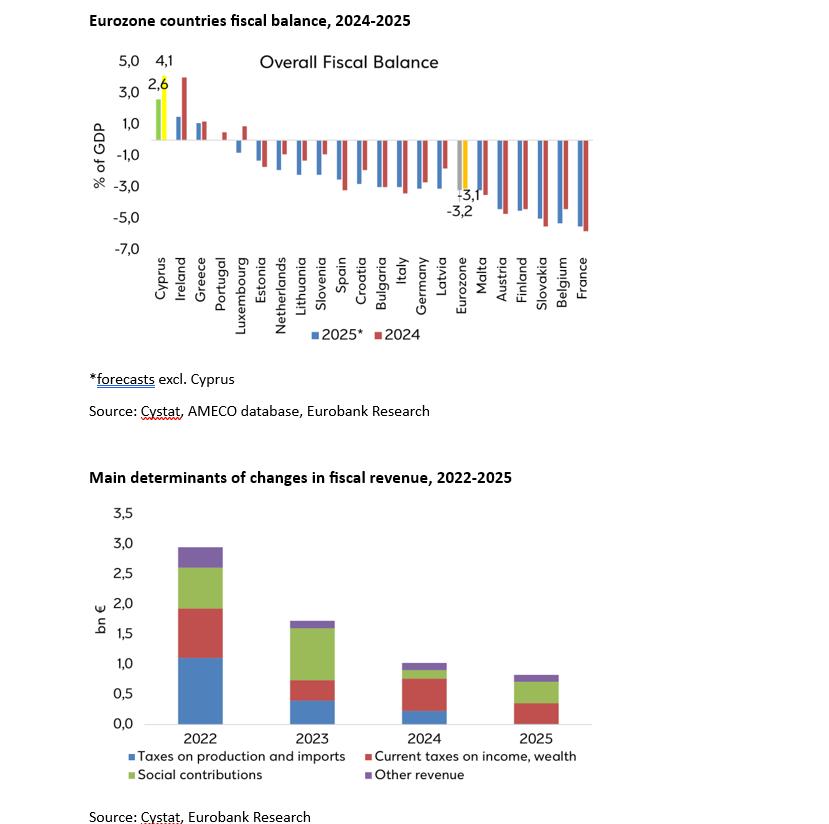
Based on preliminary fiscal data and the first estimate of GDP for 2025, Cyprus outperformed most Eurozone peers in fiscal balance for fourth consecutive year.
Having the highest overall surplus in the Eurozone over 2022–2024 and the biggest primary (excluding interest payments) surplus in 2022 and 2024, the country is estimated to have recorded an overall surplus of 2.6% of GDP in 2025 and a primary surplus of 3.7% of GDP. Although both metrics moderated from the 2024 peaks (4.1% and 5.4% of GDP, respectively), based on fiscal balance projections in the latest European Commission European Economic Forecast (November 2025), Cyprus continued last year to be the top Eurozone performer in overall balance terms and rank second behind Greece in primary balance terms.
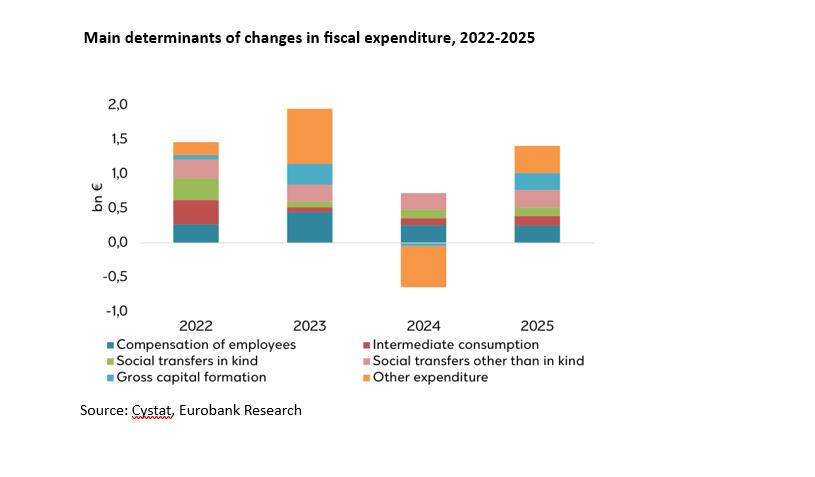
Importantly, elevated fiscal surpluses were achieved despite policy easing on the revenue and expenditure fronts. The VAT reduction on electricity since past April is reflected in a 1.7% decline in VAT receipts in 2025, compared with a 6.4% increase in 2024. In addition, public sector wages and pensions were raised beyond the standard partial indexation mechanism for the first time since 2009, resulting in expenditure growth of 6.5% and 7.6%, respectively. Nevertheless, total revenues expanded last year by 5.9% (2024: +7.4%), supported primarily by higher social security contributions (+7.9%) and corporate income tax receipts (+9.5%). On the expenditure side, total spending rose by 10.3% (vs. +1.0% in 2024), driven mainly by the increases in compensation of employees previously mentioned and in social transfers other than in kind, the latter particularly in Q1. Higher gross fixed capital formation and pension outlays also fuelled government spending.
The revenue categories underpinning fiscal performance in 2025—namely social security contributions and corporate taxation—continue to reflect structural tailwinds. These include tax incentives introduced in 2022 to attract foreign nationals to work and/or establish businesses in Cyprus, as well as sustained strength in construction activity. The impact is visible in robust labour market dynamics: employment grew by 2.7% in 2025, reaching a new all-time high, driven primarily by professional, scientific and technical services and construction. Additional job creation stemmed from administrative services and financial and insurance activities, the latter benefiting from ongoing sectoral transformation through mergers and acquisitions.
Looking ahead, the sustainability of elevated fiscal surpluses, above 3.0% of GDP, as projected in the medium-term fiscal framework, will hinge on the resilience of these structural drivers. Over 2026–2028, higher corporate tax and social security receipts are expected to remain the main contributors to revenue growth. By contrast, personal income tax (PIT) revenues are projected to decline modestly through 2028, reflecting the recent PIT reform. That said, the reduction in the effective tax burden—particularly for low- and middle-income earners—is expected to support labour force participation, which stood near historical highs in 2025 (65.2% vs. 65.5% in 2023), and to further attract foreign workers, who accounted for more than 90% of employment growth over 2023–2025. Together, these dynamics should underpin the projected increase in social security revenues.
Regarding the increase in the statutory corporate income tax rate to 15% from 12.5% as of 2026, the net revenue impact will depend critically on the elasticity of operating surplus with respect to the tax rate. Notwithstanding the hike, Cyprus will remain among the four lowest-tax jurisdictions in the EU, alongside Hungary, Bulgaria and Ireland, thereby preserving its relative competitive positioning. Therefore, provided that the geopolitical environment remains relatively stable, business activity could also sustain robust public finances.
*Michail Vassileiadis, Research Economist, Eurobank Group
