







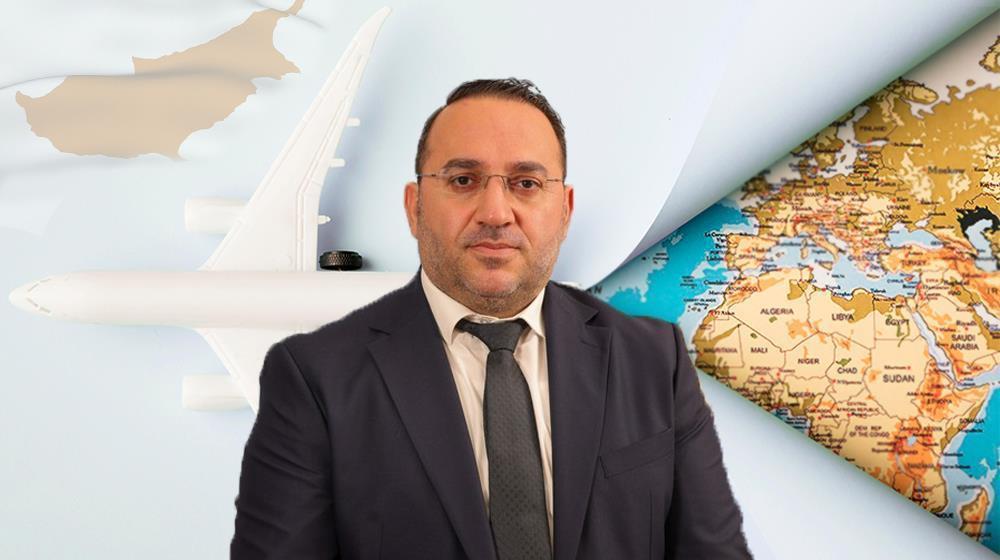
A new National Tourism Strategy with a horizon of 2035 and goals of attracting five million visitors and further upgrading the quality of the tourism product and continuing tourism development with respect for the principles of sustainable development, was approved by the Cabinet, according to Deputy Minister of Tourism Kostas Koumis.
In his statements after the Cabinet meeting, Koumis on 13 February announced the approval of a new, updated National Tourism Strategy, with a horizon of 2035. He noted that it is an updated version of the National Tourism Strategy 2030, which was approved by the Council of Ministers in 2020.
"The new National Tourism Strategy now covers the period until 2035, in order to be consistent with the purpose and time limit for achieving the 2035 vision, which is set out in the long-term strategy for the sustainable development of the Cypriot economy," he added.
The fundamental objectives of the National Strategy 2035, he said, are to further upgrade the quality of the tourism product and continue tourism development with respect for the principles of sustainable development, transform the country into a digitally smart destination, reduce seasonality and gradually transform the country into a year-round destination.
Compared to the National Strategy 2030, he added, the National Strategy 2035 "places particular emphasis" on issues such as sustainable tourism development, the green transition, digital transformation, and the improvement of infrastructure and especially accessibility infrastructure.
Koumis stated that in order to implement the goals set in the National Strategy 2035, the Deputy Ministry of Tourism is proceeding "immediately" with the preparation of action plans.
Responding to a journalist's question, he said that "the goal is to reach 5 million visitors by 2035, but to distribute them differently compared to what is the case today," explaining that he refers to both regions and time periods.
When asked which countries are of most interest, the Deputy Minister noted that "what interests us primarily in the tourism sector is to achieve greater dispersion among all sources of tourism," adding that this goal has been largely achieved in the last three years. "This can be seen through the results and the rise of many markets," Koumis said.
He said, “just two or three days ago, we announced the entry into a new market, and I am referring to the Kazakhstan market.” Asked if efforts are being made to expand into another market, the Deputy Minister noted that Cyprus now has visitors from more than 40 countries. “There are not many new markets left,” he said, noting that this number refers to countries with which there is a direct air connection.
"The remaining countries that do not have a direct air connection and are considered noteworthy in the field of tourism are now the USA, China and India," he added. Actions are being taken for all three of these markets with the aim of increasing demand over time, so that we can discuss in the coming years whether an air connection could also be established.
Responding to another question, he said, "when we talk about sustainable development in the tourism sector, we are primarily interested in the green transition and the digital transition."
"It is very important that participants in the tourism ecosystem, whether it concerns hotel businesses or businesses that offer other services, move towards digital transition, introducing new technologies," he said. He noted that the Deputy Ministry of Tourism is already proceeding in collaboration with the Hellenic Tourism and Tourism Development Authority (TEPAK) in the creation of a digital guide, which is an application, which, as he mentioned, is something that is missing in our country.
Asked if any funds have been allocated for this update, he said that the Deputy Ministry is planning to prepare action plans and that some of them will be carried out with the participation of the private sector. "We are interested in receiving information from the private sector. All these action plans will also have as their main feature the implementation of the required expenditures and will be included in the planning of the coming years," noted Koumis.
(Source: InBusinessNews)
