








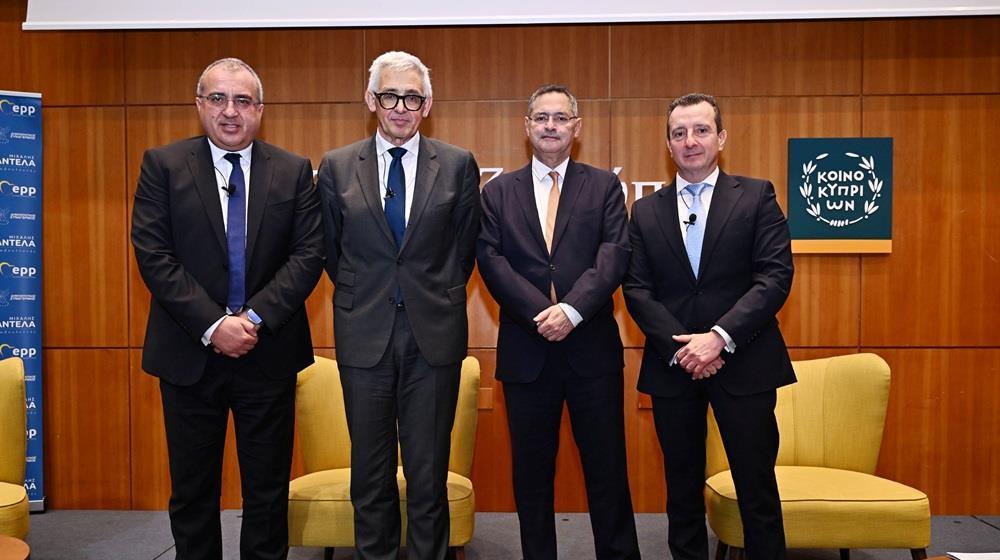
The priority of the Cyprus Presidency of the EU for autonomy through security and competitiveness reflects Europe's ambition to strengthen its independence through building a strong, innovative and competitive economy "in an international environment characterised by rapid change, strategic uncertainty and geopolitical tensions," Piero Cipollone, member of the Executive Board of the ECB emphasised, in a speech at an event in Nicosia entitled 'The Digital Euro in Cyprus.'
"We are not calling for protectionism, but for harnessing Europe's collective capacity to innovate and compete globally," he stressed.
More specifically, speaking at the event co-organised by DISY and EPP MEP Michalis Hadjipantelas and the Association of Cyprus Banks with the participation of the European Central Bank, which was attended by, among others, the Minister of Finance, Makis Keravnos , Cipollone said that the digital euro will bring tangible benefits to citizens, merchants and payment service providers and added that in the retail payments sector, "European sovereignty is already under pressure".
According to the ECB member, almost two-thirds of card transactions in the euro area are carried out by non-European companies. He added that 13 euro area countries, including Cyprus, rely exclusively on international card schemes for in-store payments.
"Cyprus, like the rest of Europe, is heavily dependent on international providers for virtually all use cases, from e-commerce and person-to-person payments to in-store transactions," he underlined.
Citing card payments as a typical example, Cipollone said that in the first half of 2025, card payments represented 74.5% of the total number of cashless transactions in Cyprus.
This is the second-highest percentage in the euro zone, he said, adding that there are no European solutions available for card payments in Cyprus.
“This level of dependence means that critical parts of European payment infrastructures are owned and operated by entities outside the euro area,” Cipollonesaid, adding that at a time when “resilience and strategic autonomy matter more than ever, this creates vulnerabilities that we cannot afford to ignore.”
The adoption of the digital euro regulation is now increasingly urgent, in order to leverage synergies between public and private solutions and reduce our dependence on foreign companies, he said.
The ECB must ensure that, in the digital age, Central Bank money meets the evolving needs of Europeans. In this context, we are preparing to complement physical cash with its digital equivalent: the digital euro, he said.
Noting that today, we rarely use cash, Cipollone cited an ECB survey on consumer payment habits in the Eurozone, saying that in Cyprus the share of e-commerce payments increased from around 1% in 2019 to around 26% in 2024 - "a striking example of the speed with which digital payments have become an integral part of everyday life."
Across the euro area, he continued, digital payments are increasingly the norm and cash can no longer be used to make payments in all situations.
He noted that online shopping already accounts for more than a third of retail transactions, but cash cannot be used online.
At this point, Cipollone clarified that “we will continue to issue banknotes and we are making every effort to ensure that physical cash remains widely accepted and available” and noted that preparations are underway for the issuance of a third series of euro banknotes with new designs that will be more familiar to Europeans.
Regarding consumer benefits, the ECB member said that the digital euro would offer the simplicity and convenience of being able to pay with a single solution - for example, your smartphone - while "ensuring that we will always have the freedom to choose to pay with a public payment instrument - not only in physical form, but also digitally".
He reported that, according to a survey conducted by the Eurosystem, 66% of Europeans said they would be interested in trying out the digital euro.
In relation to the benefits for merchants, Cipollone said that today many European merchants are very dependent on international card schemes, which are often accompanied by high and opaque fees, and he added that this is especially true for merchants in Cyprus, where it is mandatory for retail businesses to accept card payments.
The digital euro would offer a European alternative that would be acceptable across the eurozone, thus allowing traders to negotiate commissions from a stronger position, he added.
He noted that with the digital euro, small merchants can expect to pay about half of what they pay today for digital payments.
Regarding the benefits for payment service providers, Cipollone said that the digital euro is designed in a way that ensures that banks do not lose their intermediation role and added that digital euro holdings will not bear interest and will be subject to caps, in order to avoid the risk of excessive deposit outflows, especially in times of stress.
He also said, among other things, that while it will preserve financial stability, the digital euro will also make it easier for banks to offer payment solutions to their customers and added that the Eurosystem will not charge fees for the scheme or settlement, thus saving amounts that can be distributed between banks and merchants.
He also referred, among other things, to European infrastructures for digital payments and to the public-private partnership in terms of improving the resilience of payment systems and strengthening autonomy.
Christodoulides Patsalides: The digital euro is a strategic milestone
In his welcome address, the Governor of the Central Bank of Cyprus, Christodoulos Patsalides, emphasised that the digital euro is about ensuring a secure, dominant European payment option in an increasingly digital economy, in a world that requires certainty in an environment of increased uncertainty.
Patsalides then referred to Cipollone's decisive role in promoting the digital euro initiative - an important and strategic milestone in the ongoing shaping of the eurozone monetary system, as he said.
With his expertise and vision, Cipollone has made a decisive contribution to shaping the future architecture of the European financial market, he added.
He said that at the core of this vision lies a fundamental purpose of central banking: serving the public interest by providing Europeans with a sovereign, resilient and universally accepted digital form of payment.
This is a position, according to the Governor of the CBC, which Cipollone has consistently and clearly expressed during his repeated participations in the hearings of the European Parliament's Committee on Economic and Monetary Affairs (ECON), where he has underlined how Europe's strong dependence on non-European payment providers creates risks to the continent's resilience, competition, autonomy and ability to act independently in an increasingly digital global economy.
Finally, Mr. Patsallides said that within the framework of the Cypriot Presidency of the Council of the EU, we have expressed our commitment to completing the Single Currency package as soon as possible.
"As the Council has adopted the General Approach, we stand ready to work with the European Parliament in the trilogues as we enter the last mile towards establishing legal certainty for the digital euro project," he concluded.
Michalis Hadjipantelas: Cyprus's role is essential
In his speech, DISY and EPP MEP Michalis Hadjipantelas highlighted the importance of Cyprus' active participation in the European dialogue on the digital euro, as well as the need for substantial and timely information for citizens and the business world.
Hadjipantelas emphasised that "today's conference proves that Cyprus, although a small country, can play an active and substantial role in the dialogue and development of the digital euro, contributing to the shaping of European decisions that will determine the financial environment of the coming years."
The MEP pointed out that the digital euro will ensure the centrality of public money, offer fast and low-cost pan-European payments, enhance the competitiveness and innovation of the European Union and be a secure and comprehensive means of payment for 450 million citizens, without undermining the role of banks.
In his greeting, the Director General of the Association of Cyprus Banks, Marios Skandalis, said that “the implementation of the digital euro is coming to a critical turning point.
As the world rapidly digitises, the Eurozone must ensure that our common currency remains relevant, resilient and safe for everyone to use."
(Source: InBusinessNews)
