








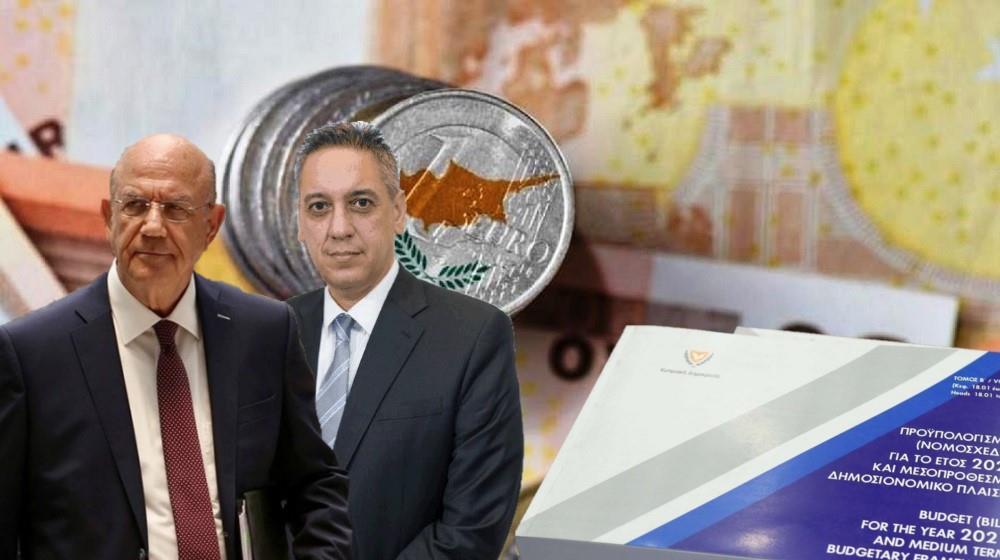
The Permanent Secretary of the Ministry of Finance, Andreas Zachariades has made strict recommendations instructing Ministries, Deputy Ministries and Independent Services to contain spending and avoid submitting new requests.
This was within his circular regarding the approval and implementation of the state budget for 2026, where Zachariades clarified that the government does not intend to submit supplementary budgets. He is pictured above right with Finance Minister Makis Keravnos.
As it specifically states in its circular, "the ongoing economic uncertainty at the international level, as a result of geopolitical and economic developments, makes responsible fiscal management imperative."
Therefore, Zachariades adds, "requests to promote unbudgeted policies and/or plans, as well as other requests, which inevitably lead to increased commitments and/or expenditures, should be avoided, as there is no intention of submitting supplementary budgets to the House of Representatives."
At the same time, the Permanent Secretary of the Ministry of Finance also points out the need to place particular emphasis on promoting reform and development projects and interventions, which - he emphasises - contribute to the strengthening, diversification and further enrichment of the economic development model of Cyprus.
In particular, he emphasises, "the implementation of projects of the 'THALIA 2021-2027 ' cohesion program and the Recovery and Resilience Plan are expected to contribute significantly to accelerating growth and strengthening economic activity."
Cyprus ' economic prospects
In his circular, after referring to the amendments made to the 2026 budget, as well as the main legislative and other regulations in the budget, including regulations on personnel and financial benefits, the Permanent Secretary also refers extensively to the prospects of the Cypriot economy.
According to Zachariades, in 2026 the economy is expected to continue to record positive performance, with the growth rate forecast at around 3.1%, compared to 3.2% in 2025, based on an estimate by the Ministry of Finance.
As he also points out, "despite the continuous and successive crises that have occurred in recent years, the Cypriot economy has demonstrated in practice its ability to adapt to new realities."
"By maintaining a stable and prudent fiscal policy, the Government continued to implement substantial structural reforms," he explains, noting that "the effective use of the EU's financial tools, and in particular the Cohesion Policy Funds and the Recovery and Resilience Fund, also contributed to this ."
In this context, he continues, the Republic of Cyprus is focused on the implementation of the 'Vision 2035' Long-Term Strategy for the sustainable development of the economy.
Through this Strategy, he underlines, "the strategic objectives and priorities that will contribute to achieving a resilient economy are defined and will lead to the promotion of all three pillars of sustainable development, namely achieving the green transition, promoting social and inclusive development and strengthening the economy."
At the same time, Zachariades adds, the implementation of these measures will enhance the competitiveness and stability of the economy, making it better prepared to face future risks and challenges.
Medium-term prospects
Regarding the medium-term prospects of the economy, Zachariades states that, based on the basic macroeconomic scenario, the prospects of the Cypriot economy in the medium term remain stable, but with a significant degree of uncertainty.
With the slowdown in 2025, he explains, the growth rate is projected to rise to 3.1% in 2026, while in 2027 and 2028 it is expected to fluctuate at 3% and 2.9%, respectively.
At the same time, the inflation rate (Harmonized Index of Consumer Prices) in 2026 is forecast to fluctuate at 2.1% from 0.8% in 2025, while an increase to 2.5% is expected for 2027, as a result of the termination of anti-accuracy measures (reduced electricity purchase rate and zero rate on essential goods), at the end of 2026, while in 2028 inflation is forecast to rise to 2%.
In relation to unemployment, the Permanent Secretary of the Ministry of Finance states that it is expected to remain around 4.6% of the workforce in the period 2026-2027, and then decrease to 4.5% in 2028.
"The implementation of significant domestic and foreign investments, mainly to enrich the tourism product (marinas, casinos, hotel units), the education and research sectors (interconnection of research with the real economy, infrastructure of tertiary academic and research institutions, Centers of Excellence for Research and Innovation), energy (innovative electricity production infrastructure, licenses for hydrocarbon exploration and extraction) and real estate, are expected to contribute to increasing the potential growth rate of the economy," Zachariades concludes.
(Source: InBusinessNews)
