







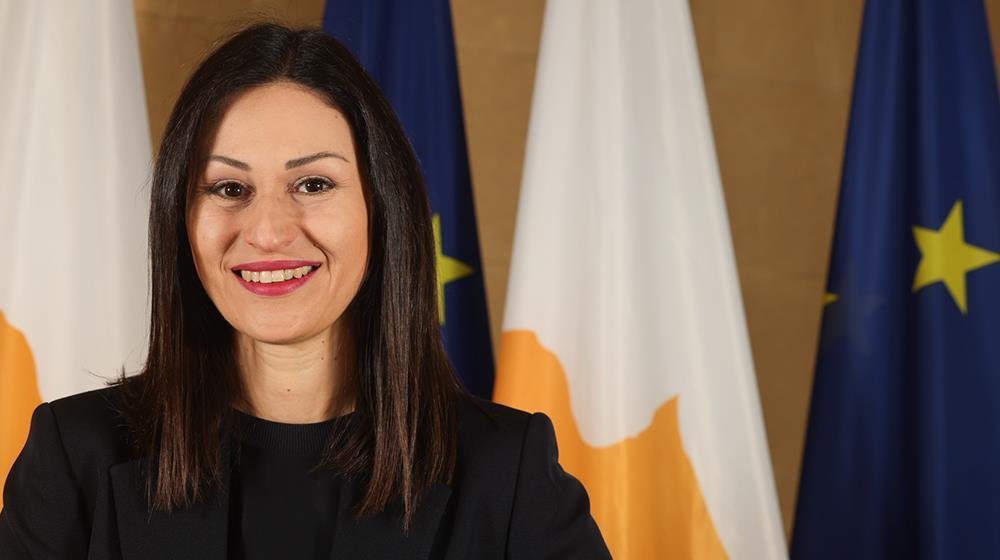
The priorities of the Cyprus Presidency of the Council of the EU in the field of agriculture were presented on Wednesday by the Minister of Agriculture, Rural Development and Environment, Maria Panayiotou, before the European Parliament’s Committee on Agriculture and Rural Development (AGRI).
Panayiotou on 28 January outlined the political context, the challenges, and the ambitions for the next six months, stressing the Presidency's strong political commitment to sustainable agriculture, innovation and the uptake of new technologies.
In her opening remarks, the Minister underlined the particular symbolism of her presence before the AGRI Committee, just days after the first Agriculture Council meeting held under the Cyprus Presidency. Panayiotou referred extensively to Cyprus’s geopolitical and environmental particularities, linking them to broader European challenges. “Cyprus, as an island member state at the southeastern border of the Union in the Mediterranean, has long been shaped by geopolitical tensions, while remaining firmly committed to peace, cooperation and shared prosperity,” she noted.
As she stressed, Cyprus has the second smallest agricultural sector in the Union, based primarily on family farming, with strong demographic and environmental characteristics. “With an average farmer age of 59 years old, generational renewal is a key challenge. At the same time, as an environmental hotspot, Cyprus faces high temperatures, severe droughts and increasingly extreme weather events, which intensify water scarcity and climate vulnerability,” she added.
Against this backdrop, the Minister made clear that the Cyprus Presidency approaches its mandate with a clear political direction. “Our response is a strong political commitment to sustainable agriculture, innovation and the uptake of new technologies, supported by targeted funding for a resilient agri-food sector,” she stressed.
“We come with a strong sense of responsibility and a focus on delivering results,” Panayiotou said, explaining that the Cyprus Presidency is assuming its duties in a particularly demanding international environment, with the war in Ukraine and rising global tensions directly affecting European agricultural policy.
“We assume the Presidency with the highest sense of responsibility and with a clear focus on delivering tangible results for farmers and rural areas, strengthening food security and enhancing competitiveness and sustainability,” she underlined. In the same context, she thanked the previous Presidencies for the work already carried out. “I would like to express my sincere appreciation to the Danish Presidency for its excellent work, which provides a strong and solid basis for the months ahead,” she said.
New Multiannual Financial Framework (MFF)
A central pillar of the Minister’s intervention was the new Multiannual Financial Framework (MFF), and more specifically the negotiations concerning the future of the Common Agricultural Policy (CAP). “Our first priority concerns the new Multiannual Financial Framework and the files related to the CAP. We are fully aware of the serious concerns regarding the limited financial envelope of the CAP,” she noted.
As Panayiotou stated, the Cyprus Presidency is committed to playing the role of an honest broker. “The Presidency is determined to facilitate a balanced and constructive discussion, so that the final outcome provides the necessary support, stability and visibility for the Common Agricultural Policy,” Panayiotou said.
She placed particular emphasis on financing instruments that respond to contemporary challenges. “Crisis management, generational renewal, skills development, innovation, modernisation, the green transition, climate action and decarbonisation all require adequate and targeted funding. Adequate funding for the CAP is of utmost importance,” she underlined.
Referring to the progress achieved on a number of legislative files, Panayiotou noted that “the completion of negotiations on files such as the wine package, horizontal simplification measures and unfair trading practices represents a significant step forward and demonstrates our commitment to supporting, protecting and investing in farmers.”
“Our objective is to substantially strengthen farmers’ negotiating power and to ensure a fairer and more resilient agri-food supply chain. As Presidency, we will work with the European Parliament and the Commission towards an agreement that is both ambitious and workable,” she added.
Organic farming was highlighted as a strategic priority of the Cyprus Presidency, with the Minister underlining its “long-term benefits for environmental protection, biodiversity and sustainable rural development, while adding value to farmers’ products and enhancing the attractiveness of the profession.” At the same time, she referred to the need for targeted adjustments to the relevant legislation. “The implementation of the current legislation has highlighted the need for improvements that enhance legal clarity and reduce complexity for organic producers. Advancing negotiations on the amendment of the regulation is a priority for the Cyprus Presidency,” she said.
Animal welfare
Regarding animal welfare, Panayiotou noted that “the alignment of animal welfare standards for imports is essential to ensure a level playing field. At the same time, high standards must go hand in hand with a competitive and resilient European livestock sector.”
Responding to questions from members of the European Parliament, the Minister highlighted the role of research and technology. “Research and innovation are critical to increasing productivity, sustainability and resilience to climate change, as well as to long-term profitability and food security,” she said.
As she explained, tools such as precision agriculture, artificial intelligence, drones and sensors can transform the production model. “Farmers can optimise resource use, reduce costs and respond more effectively to environmental challenges,” she said.
Concluding the discussion, Panayiotou acknowledged the difficulty of the reforms, while sending a message of determination. “Strengthening farmers’ position is not an easy task. It is a marathon, not a sprint. But we will go all the way to the end,” she said, reiterating the Cyprus Presidency’s commitment to close cooperation with the European Parliament.
“The Presidency is fully committed to working hand in hand with the European Parliament to deliver concrete and balanced outcomes. Dialogue, trust and transparency are essential to ensure that the voices of farmers and rural communities remain at the heart of European policies,” she concluded.
CNA/EK/MK/2026
