







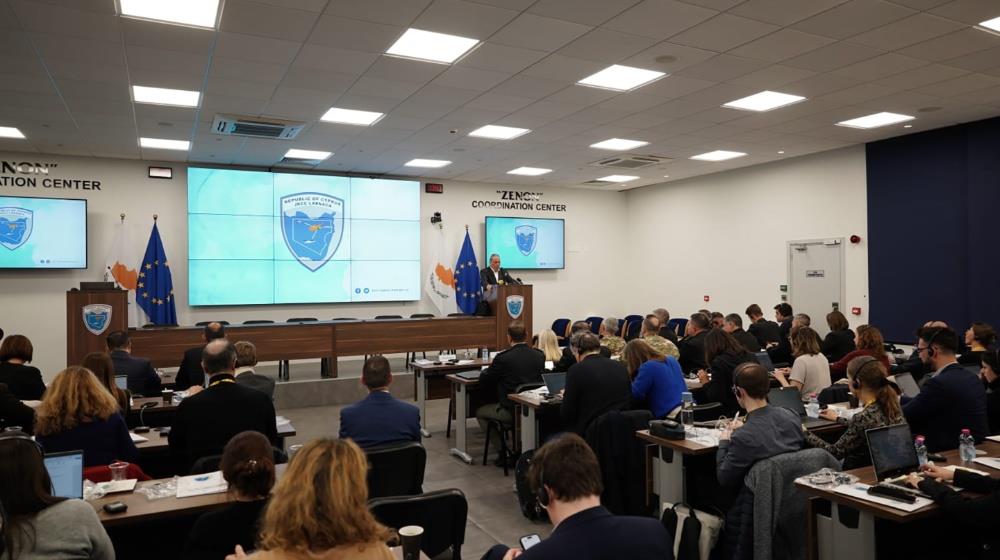
The Cyprus Presidency of the Council of the EU will focus on enhancing European cooperation in maritime security, protecting critical maritime infrastructure, and implementing the European Maritime Security Strategy in close collaboration with EU member states, European institutions, and international partners, Defence Minister Vasilis Palmas has said.
Addressing accredited European and international media correspondents, at the Joint Rescue Coordination Center (JRCC) in Larnaca on 13 January, Palmas highlighted the upgrade of Limassol Port – Mari Naval Base as a project of strategic importance. He emphasised that the Naval Base at Mari is one of the key pillars of the Republic of Cyprus’ defence infrastructure.
Referring to Cyprus’ role in a complex and demanding security environment, the Minister noted that the Republic of Cyprus has assumed the Presidency of the Council of the European Union during a period of intense geopolitical realignments.
"Europe faces simultaneous, multi-level challenges," the Defence Minister remarked, adding that "in this context, security and defence are not merely regional policy issues but key pillars of European cohesion and credibility."
Upgrade projects
Regarding the Naval Base at Mari, Palmas stressed that it is a fundamental pillar of the Republic of Cyprus’ defence infrastructure. "The upgrade projects implemented in recent years are part of a holistic and long-term plan aimed at gradually enhancing the operational capability of the National Guard, improving maritime security, and strengthening Cyprus’ ability to contribute substantially within the framework of cooperation with EU member states and international partners," he explained.
The Defence Minister described the upgrade of the Mari Naval Base as strategically significant, "as it enhances berthing capabilities, logistical, and operational support for European allied forces." As the Republic of Cyprus, he added, "we are investing in our capabilities, which strengthen collective European security in the Eastern Mediterranean." The infrastructure being developed, he continued, "can support both military needs and humanitarian missions and civil protection operations, always in full alignment with Cyprus’ European and international commitments."
He further stressed that Cyprus’ geographical position gives it particular strategic importance. "Therefore, investing in our naval infrastructure is an investment in stability and international legitimacy," he said. Palmas noted that Cyprus, as the easternmost point of the EU and a crossroads between Europe, the Middle East, and Africa, holds a unique position in the European military mobility architecture. "Our ports, airports, and infrastructure have repeatedly supported humanitarian operations and the evacuation of citizens from conflict zones, contributing to the EU’s ability to manage crises and project stability in its neighbourhood," he added.
Critical funding
He described securing adequate European funding as "critical" to enable Cyprus to further contribute to the EU’s goals in military mobility and crisis management within a modern, evolving environment. Referring to the enhancement of military mobility within the European transport network, he stressed that it is crucial for ensuring rapid, coordinated, and reliable movement of military personnel, equipment, and resources.
In this context, Palmas pointed out that the Cypriot Presidency aims to maintain momentum at the political and legislative levels, strengthening cooperation among member states and ensuring the continuity of this strategic dossier.
"The successful implementation of these goals requires adequate European funding so that member states can address critical gaps," he stated. He noted that "the EU is called upon to strengthen its strategic autonomy, particularly in the areas of security and defense, without deviating from the principles of multilateralism and international law. A more autonomous EU, with greater capacity for prevention, deterrence, and effective crisis management," he added.
Maritime security
In this framework, he noted, maritime security takes on particular significance. "The Republic of Cyprus will work to strengthen European cooperation, protect critical maritime infrastructure, and implement the European maritime security strategy in close collaboration with member states, European institutions, and partners," he highlighted.
In conclusion, Palmas stressed that the Republic of Cyprus approaches defence through the lens of cooperation and prevention with EU member states and regional and international partners, based on transparency, mutual respect, and international law. "These efforts are not directed against third parties but aim to achieve stability and security in a region of particular strategic importance," he said.
Defence and security are not abstract concepts; they are directly linked to peace, stability, and the prosperity of our societies, the Defence Minister stated.
"As the Republic of Cyprus, assuming the Presidency of the Council of the European Union, we are ready to contribute responsibly, seriously, and with a clear orientation to shaping a Europe that is safer, more resilient, and more united," he concluded.
(Source: CNA)