







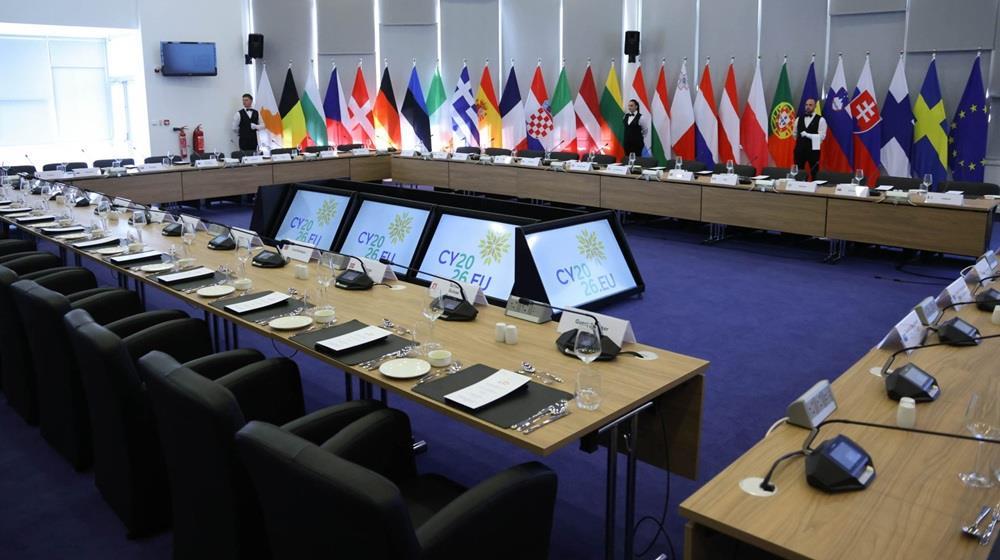
Cyprus is expected to host a series of important meetings and high-level summits during its Presidency of the Council of the European Union.
According to the calendar of events published on the official website of the Cyprus Presidency of the Council of the EU, Cyprus will host, among others, the College of Commissioners, the Informal Summit of Heads of State or Government, the Informal Meeting of Ministers of Economy and Finance (ECOFIN), an EU–US Ministerial Meeting, and the Informal Ministerial Meeting on Housing.
College of Commissioners in Cyprus
More specefically, on 15–16 January, the College of Commissioners will travel to Cyprus together with the President of the European Commission, Ursula von der Leyen, with the aim of strengthening and further deepening cooperation between the European Commission and the Member States of the European Union.
The meeting will be hosted at the new Limassol Port.
This will be followed by the 108th Meeting of the Management Board of the European Border and Coast Guard Agency (Frontex), to be held on 19–21 January at the Filoxenia Conference Centre, as well as the Informal Meeting of Justice and Home Affairs Ministers, scheduled for 21–23 January.
During the Justice and Home Affairs meeting, ministers will discuss issues related to returns, the Schengen area, asset recovery, the cross-border return of illegally removed cultural property, as well as the treatment of adolescents and young adults within the criminal justice system.
Education, Competitiveness and Environment
The Informal Meeting of Ministers of Education is scheduled for 29–30 January, aiming to promote dialogue among EU ministers on issues related to strengthening the teaching profession.
On 2–3 February, the Informal meeting of COMPET ministers - Internal Market and Industry will take place, focusing on the competitiveness of European industry and the removal of obstacles within the single market.
The Informal Meeting of Environment and Climate Ministers will be held on 5–6 February, aiming to facilitate an open and future-oriented high-level political dialogue on Europe’s water and climate resilience.
Against the backdrop of increasing water scarcity and the intensifying impacts of climate change, discussions will focus on aligning legislation and financial instruments to strengthen coherence between European climate and water resilience policies. Ministers will examine the effective implementation of the European Water Resilience Strategy, the development of the new European Climate Change Adaptation Plan, and the integration of water resilience into key policy areas such as agriculture, tourism, energy and climate legislation.
Ministers will also assess the European Union’s experience in international climate negotiations, drawing lessons from COP30, and exchange views on enhancing the EU’s effectiveness in global climate processes.
In addition, the meeting will address key challenges related to the circular economy, taking as a starting point the European Commission’s Winter Package, presented in December 2025, with discussions focusing on plastics recycling, market conditions for recycled materials, regulatory coherence and the path towards the upcoming Circular Economy Regulation.
Committee of the Regions and Social Policy
The Environment Ministers’ meeting will be followed by the External meeting of the European Committee of the Regions' Conference of Presidents and Bureau, from 8 to 10 February. High-level speakers and experts will discuss how digital innovation, research and blue technologies can strengthen the preparedness and resilience of Europe’s cities, regions and coastal communities, as well as the role of local and regional authorities in implementing these solutions.
On 12–13 February, the Informal meeting of employment and social affairs ministers (EPSCO) will take place, focusing on the European Anti-Poverty Strategy and the EU’s objective of eradicating poverty, as well as challenges related to access to high-quality long-term care in ageing societies.
Trade, Health, Culture and Defence
The Informal Meeting of FAC (Trade) Ministers, scheduled for 19–20 February, will address current trade files, including the EU’s ongoing trade negotiations with third countries, EU–US relations, and preparations for the 14th Ministerial Conference of the World Trade Organization (WTO).
On 25–26 February, the Informal Meeting of Health Ministers will focus on issues such as mental health and the establishment of a European Centre of Excellence for Pharmaceuticals.
This will be followed by the Informal Meeting of the General Affairs Council on 2–3 March, the Informal Meeting of Ministers of Culture on 5–6 March, and the Informal Meeting of Defence Ministers on 11–12 March, which will focus on priorities of the Common Security and Defence Policy (CSDP) and Europe’s defence preparedness.
Economy, Finance and Tourism
On 23–24 March, the Informal Meeting of Telecommunications Ministers will be held, followed on 26–27 March by the Informal Meeting of Ministers of Economy and Finance and the Governors of the Central Banks of the EU (ECOFIN).
According to the programme, the Minister of Finance of the Republic of Cyprus, Makis Keravnos, and the Governor of the Central Bank of Cyprus, Christodoulos Patsalides, will welcome ministers and governors in Nicosia for informal discussions on economic and financial policymaking and the EU’s economic challenges.
Subsequent meetings include the Informal Meeting of Research & Innovation Ministers on 30–31 March and the Informal Meeting of Tourism Ministers on 16–17 April, focusing on strengthening cooperation within the EU tourism sector.
Informal Summit of Heads of State or Government
The Informal Meeting of the Heads of State or Government of the European Union, along with leaders from the wider region, will take place on 23–24 April. The Government has indicated that invitations to leaders from neighbouring and partner countries are being considered.
This will be followed by the Informal Meeting of Transport Ministers on 28–29 April, during which ministers will discuss strategic priorities for the future of the maritime industry, including the Nicosia Declaration on Strengthening the Education of Seafarers and Promoting the Participation of Women in the Maritime Industry.
Agriculture, Housing and Energy
The Informal Meeting of Ministers of Agriculture and Fisheries (AGRIFISH) will take place on 3–5 May, providing an opportunity for in-depth dialogue on strategic challenges facing European agriculture and fisheries in a less formal setting.
The Informal Ministerial Meeting on Housing is scheduled for 11–12 May, focusing on affordable, sustainable and social housing, as well as emerging housing market trends.
Additional meetings include the Informal Meeting of Energy Ministers on 12–13 May, the Informal Meeting of Ministers responsible for Cohesion Policy on 21–22 May, and the Informal Meeting of Foreign Ministers (Gymnich format) in Limassol on 27–28 May.
EU–US Ministerial Meeting
According to the planning of the Cyprus Presidency of the Council of the EU, Cyprus will also host an EU–US Ministerial Meeting, a high-level forum during which representatives of the European Union and the United States exchange views on strategic priorities and key policy issues.
Participation on the US side typically includes senior officials, depending on the agenda, such as representatives responsible for justice, home affairs, security or related policy areas.
(Source: InBusinessNews)
