








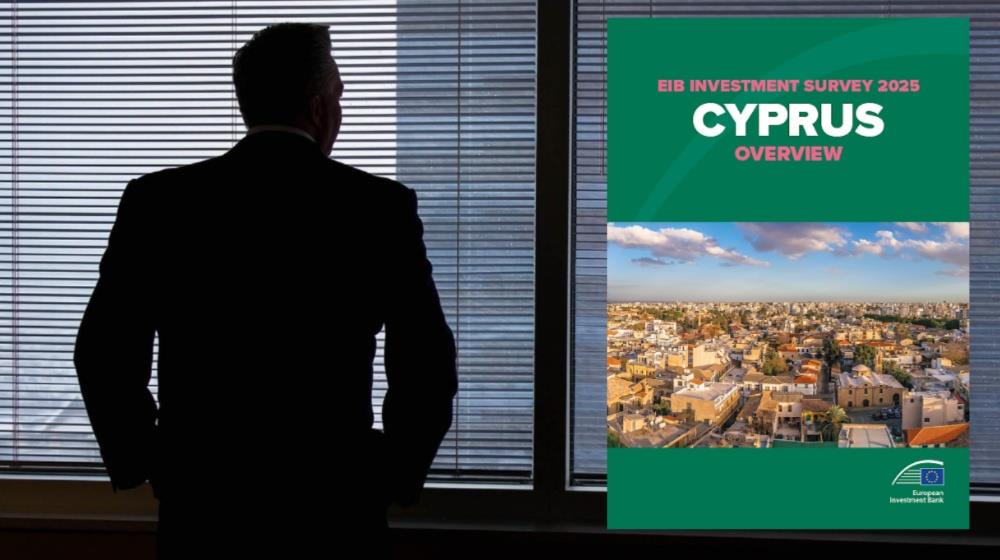
Cypriot businesses continue to invest, innovate, and remain resilient despite cautious economic prospects, according to the recent European Investment Bank’s (EIB) Investment Survey.
As it is noted in the report, investment activity in Cyprus remains strong, with almost all firms making investments focused on innovation, even though overall sentiment is more reserved compared with the EU average. Companies are adopting advanced digital tools, including artificial intelligence, and are adjusting their supply chains to strengthen their resilience. Business action on climate issues is increasing—mainly through waste reduction and recycling—while the transition to stricter environmental standards is viewed more as a challenge than an opportunity.
Cypriot firms remain optimistic about their future
The EIB survey for Cyprus highlights that Cypriot firms remain optimistic about their future despite geopolitical tensions and global disruptions to trade. Pressures on supply chains have eased significantly, as companies increased their inventories and diversified their import sources, ensuring much easier access to raw materials and essential goods than last year. As a result, the share of firms reporting difficulties fell from 41% to 20%.
According to the survey, 94% of Cypriot firms made investments in the past financial year, an increase compared with 2024 and higher than the EU average (86%). More firms also expect to increase their investments in the current financial year (10%), exceeding the EU average (4%). Investment levels remain high across all sectors, with at least 92% of firms investing, while the majority of spending goes toward replacing existing equipment (54%), and fewer firms invest in capacity expansion compared with the EU average.
“Cypriot businesses continue to invest, digitalise, and strengthen their resilience even in this challenging global environment. The growing use of artificial intelligence and the strong commitment to innovation are clear signals of a private sector that is forward-looking. The EIB stands ready to support Cypriot companies as they innovate, upgrade, and contribute to Europe’s competitiveness,” said EIB Vice-President, Marek Mora.
Cypriot companies among the most active international traders in the EU
The survey shows that Cypriot companies are among the most active international traders in the EU, with 81% engaged in cross-border trade and service-sector firms showing the highest level of international activity (95%). Although supply chain pressures have eased, firms remain cautious about changes in tariffs, compliance with new regulations, and fluctuations in transport costs.
Digitalisation and the adoption of artificial intelligence continue to expand: 23% of Cypriot firms make systematic use of generative AI tools, mainly for internal processes (75%), product development (41%), and customer service (39%). However, the use of multiple digital technologies remains lower than the EU average (32% compared with 51%). Even so, Cyprus stands out in innovation, as one in two firms invests in new products, processes, or services — a rate far above the EU average (32%).
“The Investment Survey provides a clear picture of how businesses in Cyprus and across Europe are adapting to technological, geopolitical, and climate pressures. For Cyprus, the challenge now is to turn the green transition from a perceived risk into a long-term opportunity for innovation and competitiveness. The survey helps policymakers understand where support can have the greatest impact,” said Debora Revoltella, Chief Economist of the EIB.
On climate-related issues, Cypriot firms express less concern about physical climate risks than their EU peers (60% versus 68%), while more than half (52%) believe they will not be significantly affected by stricter environmental regulations. Although 69% of firms have taken some action to reduce emissions—mainly through waste minimisation and recycling—only a limited number have conducted energy audits (44%) or developed adaptation strategies (10%). Setting and monitoring greenhouse gas emission targets remains modest (20%, compared with 47% in the EU).
Investment obstacles persist
Investment obstacles persist, particularly shortages of skilled labour (89%), high energy costs (87%), uncertainty about the future (84%), and labour market regulations (82%). Infrastructure poses a greater challenge in Cyprus than in the EU, especially in transport (74% versus 45%) and digital networks (70% versus 44%). Despite these challenges, access to finance has improved significantly, with the share of firms facing financial constraints falling to 6.8%, the lowest level since 2019, and firms reporting better access to external finance compared with the EU average.
As regards gender equality 42% of firms have at least 40% women in senior management positions, while 22% have women as the majority of owners — significantly higher than the EU averages. Overall, the picture is of a business sector that remains dynamic, adaptable, and strongly inclined toward innovation despite ongoing challenges.
Click here to view the full report on Cyprus.
(Source: CNA)
