





Connecting Europe Facility (CEF) under the 2028–2034 Multiannual Financial Framework (MFF), the recently announced European Commission package on European electricity grids and discussions on the nexus between energy and security, were on the agenda of the EU Energy Council held Monday in Brussels.
Ministers reached a partial agreement on CEF and Cyprus Minister Michalis Damianos presented the priorities of the upcoming Cyprus EU Presidency.
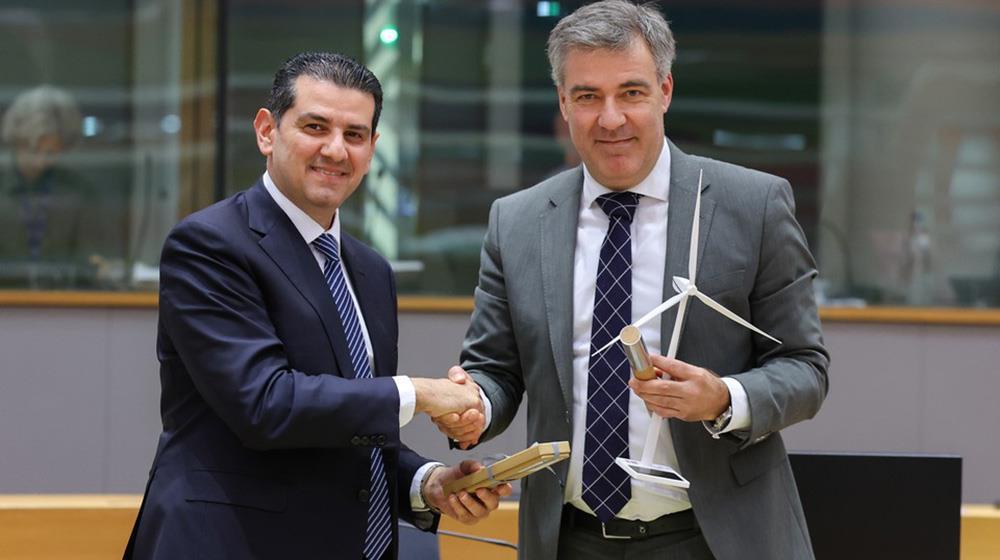
Presiding Danish Minister Lars Aagaard (pictured above with Damianos), offered advice to the Cypriot Presidency on the management of legislative files within the energy portfolio, as well as on cooperation with the EU institutions.
Ministers reached a partial agreement on the CEF under the next MFF, with the proposal providing a legal basis for investments in trans-European transport and energy infrastructure, including military mobility and cross-border renewable energy projects.
Minister Damianos welcomed the agreement, placing particular emphasis on provisions addressing the specific situation of island Member States, the improved integration of the internal energy market, the lifting of energy isolation, and the reduction of bottlenecks in electricity interconnections. In this context, he underlined the need for a fair and transparent framework that takes into account the specific characteristics of all regions.
This was followed by a policy debate on the European electricity grids package, announced by the European Commission on 10 December 2025.
The aim of the package is to modernise and expand European grids in support of rapid electrification and to help citizens and businesses gain access to affordable, secure and clean energy.
The Minister highlighted the importance of completing the internal electricity market and promoting interconnection projects, while also stressing the need for grid upgrades and the timely implementation of projects, in order to achieve EU objectives on affordable energy prices and enhanced competitiveness.
He added that the vision of a genuine European Energy Union goes beyond infrastructure and markets; it represents a shared commitment ensuring that all Member States, industry and citizens participate on an equal footing in the energy transition.
Exchange of views with NATO
The Ministers also exchanged views with NATO Deputy Secretary General, Radmila Shekerinska, on the evolving energy security landscape, which is increasingly linked to the protection of critical infrastructure across all sectors.
Minister Damianos stressed that EU–NATO cooperation is important in addressing complex challenges, while ensuring that all members of both organisations benefit equally.
He supported a coordinated approach based on stable dialogue, a shared situational awareness and mutually beneficial cooperation, with the aim of strengthening Europe’s energy resilience.
At the close of the meeting, the Minister presented the work programme of the Cypriot Presidency in the field of energy, noting that the objective is a connected and secure Energy Union that fully harnesses renewable and innovative energy sources.
At the same time, he underlined the importance of ensuring affordable energy for households, businesses and industry, while supporting a clean and sustainable energy transition.
Danish Minister speaks of the decisive role of CEF
During the press conference, the Danish Minister for Climate, Energy and Utilities, Lars Aagaard, emphasised the decisive role of the CEF as the backbone of Europe’s energy infrastructure in advancing decarbonisation, energy security and affordable energy for households and industry.
Referring to the handover of the Presidency, he noted that “the Cypriot Presidency will take over the work from here,” expressing confidence that continuity and progress would be ensured, particularly with regard to the grids package.
He explicitly called on the forthcoming Cypriot Presidency, in cooperation with the European Commission, “to really focus on the grids package and to advance it so that we can reach conclusions,” stressing that “time is not on our side” and that Europe needs “clear and firm conclusions on the framework for developing the European energy grid,” which is closely linked to funding instruments such as the CEF.
The Danish Minister also offered additional advice concerning the role of parliament, addressing the upcoming Cypriot Presidency.
“My first recommendation would be to try to have an arrangement with your national parliament that allows you to work on European matters,” he said.
He added that “there is still a lot of work to be done.” He stressed, however, that the role of the Presidency is not only to give political weight to European issues, but above all “to seek the common European interest,” warning that while dialogue is essential, “time is not on our side” and timely decision-making is required.
(Source: CNA)