






The ongoing deficit in the Cyprus Energy Regulatory Authority (CERA) budget as well as uncertainty about the final cost and viability of the GSI Cyprus-Greece electricity interconnection project were highlighted by the discussion on CERA's budget by the House Finance Committee.
CERA Chairman Polyvios Lemonaris reported that the Authority's budget for 2026 is in deficit for the sixth consecutive year. It projects revenues of €3.1 million and expenditures of €5.9 million, with the deficit of €2.8 million to be covered by existing reserves, which are estimated to be limited to €2.2 million by the end of 2026.
The annual fees paid by licensees constitute 87% of the Authority's revenue, while almost half of the expenses (48%) concern staff salaries.
CERA has already submitted a revised list of fees to ensure balanced budgets in the future and is awaiting approval from the competent Ministry.
GSI: If costs increase, sustainability is in doubt
In his statement on the GSI, the Vice Chairman of CERA Alkis Philippou explained that projects included in the European list of Projects of Common Interest (PCIs) receive community funding precisely because they are not viable on their own at the initial stage.
After the sponsorship, he said, the specific project - estimated at €1.9 billion - is considered viable. However, he noted that if the cost increases, it is not certain that viability will be maintained.
The Chairman of CERA also said that pending issues remain, such as the final cost of the substations, while the seabed survey and cable laying, which have not yet been carried out due to known obstacles, may highlight the need for additional cable, with consequences on the overall cost.
AKEL MP Andreas Kafkalias asked for clarification of the landscape surrounding the sustainability of the interconnection, both for public finances and for consumers.
The Chairman of CERA reported that Greece's Independent Power Transmission Operator (IPTO) has not announced any change to the project completion target by 31 December, 2029.
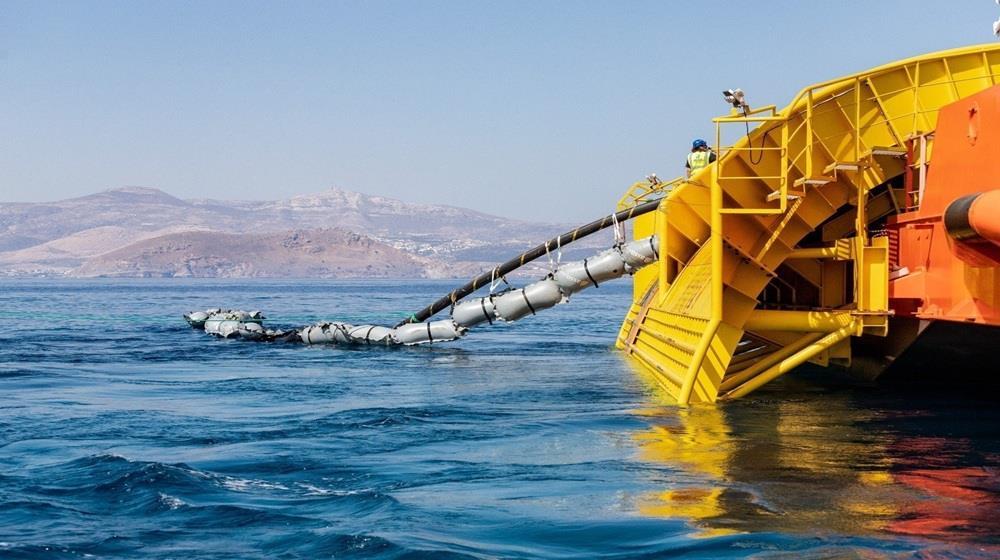
According to an update on 19 September, 200km of cable have already been constructed and another 81km are in the process of being constructed, while the production of deep-sea cables is also progressing. A new progress report is also expected.
Lemonaris said that CERA continues to operate within European regulations and has not received any information about the termination or freezing of the project.
"The project remains on the EU list of projects of common interest with EU support," he said. At the same time, he noted that two approvals are pending from CERA, one for the contract between IPTO and the GSI company and the approval of IPTO's operating expenses for the years 2024-2025. He underlined that CERA is in constant communication with IPTO, for joint decisions to be taken.
Electricity market: First steps and waiting for stabilisation
Responding to questions from DISY MP Onoufrios Koulla about the course of market opening, the Chairman of CERA stated that the first two months of operation of the competitive model (since 1 October) was still too early for safe conclusions.
Today, two producers, 11 suppliers, nine cumulative representation bodies and three RES producers are active. The wholesale price, as he said, is at the same levels as the previous transitional model, while the retail assessment requires time to mature. CERA, he added, expects that market forces will push prices downwards when the new system stabilizes.
Lemonaris recalled that the energy system of Cyprus presents a large seasonal mismatch since for approximately six months the energy supply is much greater than the demand (500–600 MW per day), leading to RES outages.
Power adequacy and storage projects: 2029 the critical year
In the area of capacity adequacy, CERA warned that Cyprus will face a problem with long-term adequacy from 2029, if both the natural gas project and the electricity interconnection are not implemented on time.
Today, the system has 169.5 MW of wind energy, 420 MW of photovoltaic parks, 12 MW of biomass, 572 MW of photovoltaics for self-consumption and 1,482 MW of conventional generation.
Despite the 40 storage licenses that have been issued (with a total capacity of 990 MW) and the 547 hybrid system licenses, no corresponding project has been implemented so far.
CERA has already granted licenses to the operator for three 40 MW central storage systems.
Natural gas: completion of regulatory framework
On the issue of natural gas, the CERA Chairman stated that "the regulatory framework has been completed with the decision on the operational separation of the Natural Gas Public Company (DEFA)", noting that the Authority has already granted three licenses to DEFA. He recalled that Natural Gas Infrastructure Company ETYFA is not under CERA and that the project is supervised by other bodies.
CERA is awaiting the critical gap analysis study from the manager of the natural gas project, which will identify whether there are gaps between the infrastructure and specifications.
At the same time, within the framework of its supervisory powers, the Authority has already imposed administrative fines of €450,000 until September for delays in the procedures provided for in the DEFA license.
These fines, as noted, are paid to the Ministry of Finance and not to CERA.
(Source: InBusinessNews)