





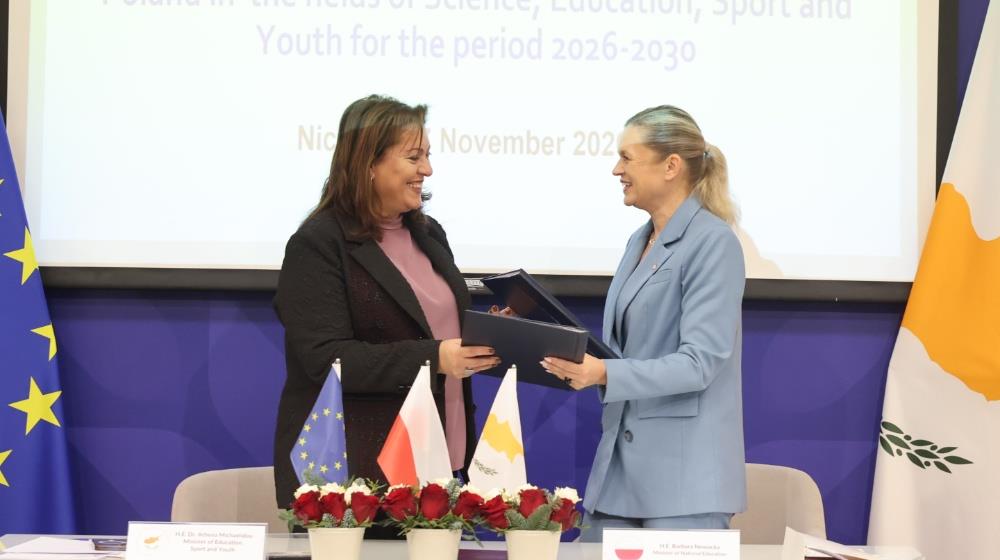
Cyprus and Poland signed on Friday a renewed Programme of Cooperation in the fields of science, education, sport and youth for the period 2026-2030, with the launch of a nationwide educational competition inspired by the life and achievements of Maria Sklodowska-Curie marking the first initiative under the agreement.
The programme was signed at the Ministry of Education, Sport and Youth in Nicosia by Minister Athena Michaelidou and her Polish counterpart, Barbara Nowacka, who is paying an official visit to Cyprus from November 26 to 28, at the invitation of Michaelidou.
The renewed programme promotes school partnerships, student and teacher exchanges through European programmes such as Erasmus+ and eTwinning, and the sharing of good practices.
In her address, Michaelidou described the signing as an important milestone in the longstanding friendship and cooperation between the two countries, which celebrate 65 years of diplomatic relations.
She noted that the programme provides a modern and forward-looking framework for cooperation between schools, universities and vocational education institutions, supporting academic mobility and the exchange of expertise.
Referring to the educational competition “The Spark of Discovery: Inspiring Future Scientists through Maria Sklodowska-Curie”, launched in partnership with the Polish Embassy and the European Commission Representation in Cyprus, Michaelidou said that it constitutes the first deliverable of the new programme.
“This competition demonstrates how bilateral agreements can translate into tangible opportunities that directly benefit young people and strengthen the bonds between our countries,” she said.
She added that the competition aims to promote scientific curiosity, innovation, critical thinking and research skills among young people, while encouraging greater participation by girls and young women in science, technology, engineering and mathematics (STEM).
Michaelidou noted that schools across Cyprus have already been informed and interested teachers have been invited to participate in a specialised professional development webinar, to be delivered in cooperation with the Maria Sklodowska-Curie Museum in Poland, to equip educators with the necessary tools to support participating students.
The Minister also recalled her discussions with Nowacka during the informal meeting of Education Ministers held in Nicosia in January, in the context of the Cyprus Presidency of the Council of the EU.
“I am particularly pleased that, within such a short period of time, we have transformed that shared ambition into concrete action,” she said.
For her part, Nowacka referred to cooperation between the two countries within the framework of the trio of Presidencies of the Council of the EU, noting that her meeting with Michaelidou provided an opportunity to discuss educational priorities, ongoing reforms and common challenges.
She said that discussions focused on the exchange of good practices, STEM education, inclusive education and the challenges of digital transformation, particularly the development of young people’s digital and artificial intelligence skills.
Referring to regulations concerning social media, the Polish Minister noted that Cyprus was more advanced than Poland in this area.
“We are both of the same view that the age of 15 years is the age that should apply not only in our countries but throughout the entire European Union,” she said, stressing the importance of children’s safety and expressing readiness for closer cooperation on the issue.
“Poland is ready to share its expertise and support Cyprus in further developing this important area,” she added, referring to STEM education, which she described as a priority at EU level and essential for Europe’s competitiveness and innovation.
Nowacka also referred to security and preparedness as areas in which Poland could learn from Cyprus, citing school drills and societal preparedness as good examples of how to address contemporary challenges.
Referring to Maria Sklodowska-Curie, the first woman to win a Nobel Prize and one of the few people to receive the award twice, she described her as a role model for young women, not only in science but also in public life.
Addressing the ceremony, Head of the European Commission Representation in Cyprus Panicos Pourgourides welcomed the launch of the competition, noting that the Representation was supporting the initiative, including through a financial contribution.
“Her legacy reminds us that curiosity knows no borders, scientific talent knows no gender and knowledge grows when it is shared,” he said, referring to Maria Sklodowska-Curie.
He noted that the EU promotes this spirit through the Marie Sklodowska-Curie Actions, adding that investing in education, research and innovation, while ensuring equal opportunities for all, is essential to Europe’s future competitiveness and prosperity.
During her visit to Cyprus, Nowacka also visited the Pancyprian Gymnasium, where she was briefed on STEM programmes and spoke with students and teachers.