






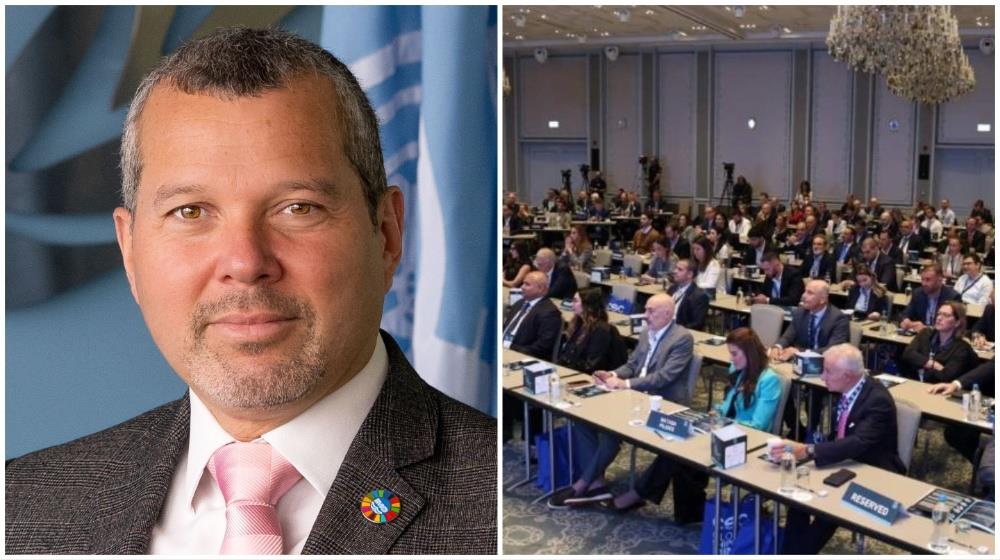
“Global energy security and fuel supply rely on shipping, but this must be done without endangering the lives of seafarers,” said Arsenio Dominguez, Secretary-General of the International Maritime Organization (IMO), addressing the participants of the CSC Global Shipping Minds Summit, conveying his own perspective on the developments and prospects of international shipping.
In his message, Dominguez described this year as particularly demanding for the global shipping industry, as the sector faces acute geopolitical challenges at the same time as the need to advance the energy transition at sea.
expressed his deep concern over the fact that sailors, ordinary workers performing their duty, continue to lose their lives in the ongoing conflicts in the Strait of Hormuz, the Black Sea, the Sea of Azov and the Red Sea.
As he noted, these workers suffer serious injuries, face abandonment, are denied the right to repatriation, and are left without basic human goods, such as water, food, and medical care.
Safe sea lanes and shipowners' responsibility
In his view, vital sea lanes must remain open and safe, while seafarers must be protected wherever they are, regardless of nationality. He underlined the obligation of shipowners and operators to conduct a thorough risk assessment and ensure that adequate protection measures are taken, calling on them to continue to strictly adhere to the IMO's technical and operational requirements.
Although, in his opinion, the root causes of these conflicts go beyond the Organization's technical interventions, he assured that he is in constant contact with all Member States to find solutions.
Energy transition, digitalization and automation
Referring to the green transition of the maritime sector, the IMO Secretary-General announced that negotiations are underway on the next measures to reduce greenhouse gas emissions from ships, expressing his gratitude for the active participation of Member States in this process.
He also pointed out that the future of shipping will be equally decisively influenced by digitalization and automation, emphasizing that the IMO will remain in close cooperation with all stakeholders in order to enhance the safety, efficiency and sustainability of international maritime transport.
Through his intervention, Arsenio Dominguez concluded that the protection of human life at sea is the highest priority, calling on the international maritime community to move forward with cooperation and responsibility in the face of geopolitical and technological changes.