

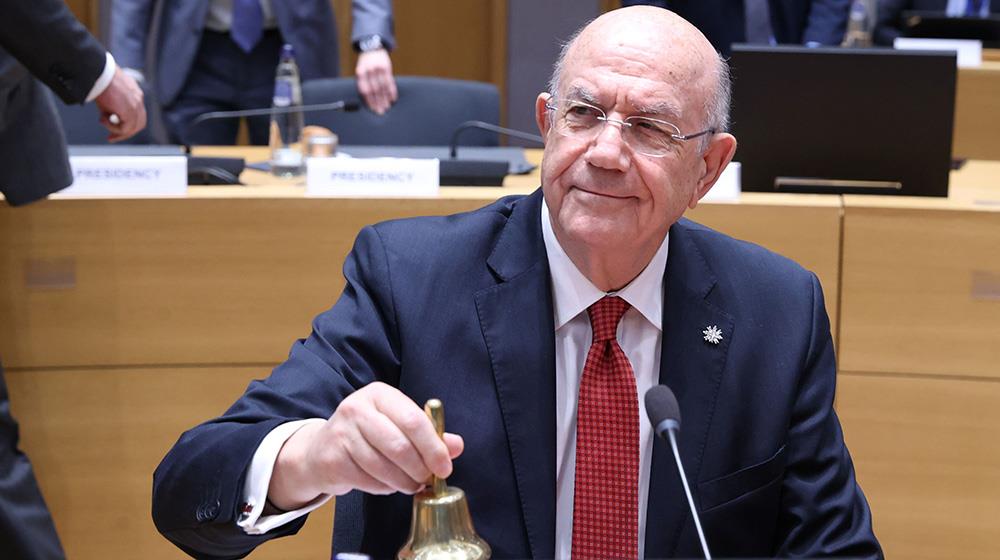
The Economic and Financial Affairs Council (ECOFIN) has concluded its work in Brussels, where Cyprus was represented by Finance Minister Makis Keravnos.
During the Council 9 November, ministers examined a compromise proposal from the Irish Presidency, building on progress made under the Cyprus Presidency, but were unable to secure agreement among all member states. The proposals aim to modernise the EU's framework for tobacco excise duties, extend its scope to new products and improve the functioning of the internal market, while also contributing to public health objectives.
In his intervention, Keravnos thanked the Irish Presidency for its efforts and said he supported the latest compromise text. He described it as balanced, saying it combines the necessary ambition with respect for the sensitivities of certain member states.
Ministers also exchanged views on the economic impact of EU legislation on businesses and the public sector, on the basis of a paper prepared by the Irish Presidency.
They welcomed efforts to speed up simplification, which they said must continue, while stressing the obligation to carry out thorough impact assessments for all legislation advanced at EU level. Ministers then discussed the economic and fiscal impact of Russia's invasion of Ukraine and were updated on progress in implementing the Recovery and Resilience Facility.
The Council adopted recommendations extending the national escape clause for Italy for expenditure contributing to strengthening defence and energy security. Finally, the Council was briefed on the outcome of the meeting of G20 finance ministers and central bank governors held in Bangkok on October 15, 2026.
At the Eurogroup meeting, ministers reviewed macroeconomic developments and prospects for the eurozone. They acknowledged the resilience of the European economy despite higher energy prices, inflationary pressures and increased borrowing costs.
They also stressed the need to monitor the situation closely and to implement the economic governance framework effectively, given the multiple challenges and the uncertainty stemming from geopolitical developments.
In an enlarged format, with the participation of all EU member states, ministers exchanged views on improving the efficiency of defence financing. They recognised the need to strengthen investment in defence and security, but in a way that does not jeopardise the sustainability of public finances.
In his intervention, Keravnos underlined the need to continue strengthening the EU's defence capabilities through investments that support research and innovation for the development of cutting-edge technologies, particularly by backing start-ups across all member states. This, he said, improves the added value of defence investment, supporting not only the EU's autonomy but also the competitiveness of its economy.
On the possible participation of third countries in defence capability development programmes, Keravnos stressed that any third country wishing to take part in EU programmes must respect the sovereignty of all EU member states.
(Source: CNA)