



Raluca Ioana Man, Business Strategist, Board Advisor and Founder of RSEVEN, examines why companies must look beyond financial projections when making important investment decisions, and what this means for the future of business in Cyprus.
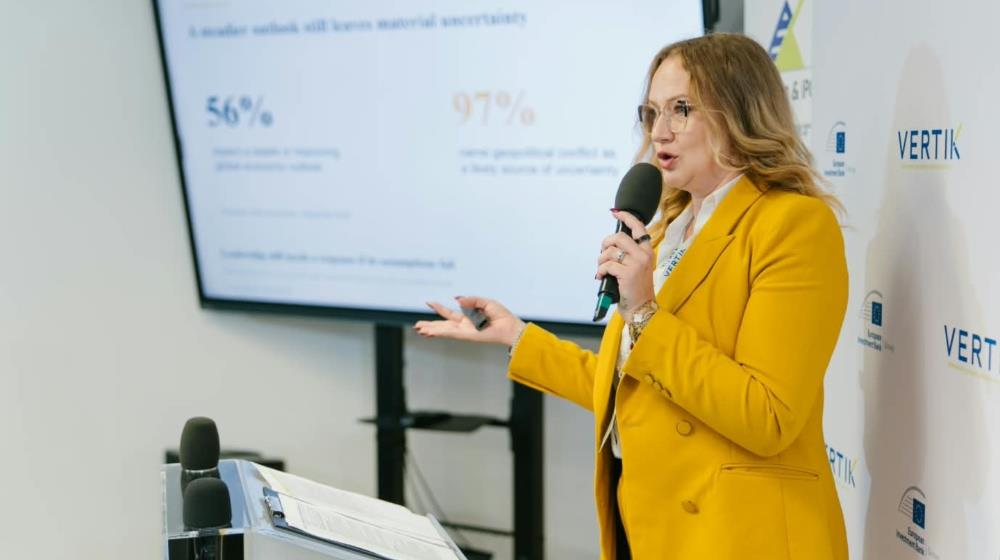
Following her participation as a speaker at the Financing & IPO Summit 2026 in Bucharest, organized by VERTIK, Raluca Ioana Man shares her perspective on how strategic thinking, forecasting and strong governance can improve investment decisions and prepare companies for sustainable growth.
You recently spoke at the Financing & IPO Summit in Romania. What was the central message behind your presentation, and why is it relevant to companies in Cyprus?
My central message was that before a company decides how to finance its growth, it must understand what that growth requires and whether its underlying assumptions are credible.
The summit brought together business leaders, investors and financial institutions to discuss financing alternatives, including private credit, mezzanine financing, bonds and routes towards an IPO.
These instruments can create significant opportunities for established and expanding businesses.
However, my contribution focused on the strategic decisions that should come before selecting a financing instrument.
What exactly is the company investing in? Where will the expected growth come from? Can its management, systems and operations support that growth? What happens if market conditions change?
These questions are particularly relevant to Cyprus.
We have companies with strong commercial capabilities, international ambitions and opportunities to expand beyond our domestic market. But growth brings additional complexity, particularly when businesses enter new countries, develop new operations or move from founder-led management towards more structured corporate governance.
Financing should support a credible strategic direction. That direction needs to be examined before significant financial commitments are made.
Cyprus has a well-developed banking sector, yet access to alternative financing remains a challenge. How do you assess the situation?
The financing structure of the Cypriot economy is an important issue. The European Commission's June 2026 Country Report identifies limited access to non-bank financing as a constraint on business expansion and diversification. Bank lending continues to dominate corporate financing, while capital markets remain relatively underdeveloped. This is a structural challenge, and we should recognize it as such.
Cyprus needs a broader range of financing opportunities, particularly for innovative companies, established businesses pursuing international expansion and organizations seeking capital for substantial investments.
There are encouraging initiatives, including the Cyprus Equity Fund and other measures intended to improve financing opportunities. However, the European Commission also notes that the scale of funding mobilized remains limited.
At the company level, I believe we need to examine a second issue alongside the availability of capital: investment readiness. A business may have a commercially attractive opportunity but lack the financial visibility, management structures or evidence needed to present a convincing investment case.
Equally, a well-prepared company may still face genuine market constraints when seeking suitable financing.
These are two different problems, and they require different solutions.
Improving access to capital is important for Cyprus's competitiveness. Improving the ability of companies to evaluate, present and execute investment opportunities is equally important.
What do you consider one of the biggest strategic mistakes companies make when planning expansion?
One recurring risk is treating growth as though it automatically translates into greater financial strength. It does not always work that way.
A company may increase revenue significantly while simultaneously placing pressure on its cash flow, operational capacity and profitability.
Consider a hotel group planning to expand its portfolio. Higher expected occupancy and additional rooms may support an attractive revenue forecast. But management must also examine staffing requirements, refurbishment costs, energy expenses, seasonality and the timing of cash receipts.
A real estate developer faces different considerations: construction costs, project delays, financing commitments, buyer demand and the timing of sales and collections.
A technology company expanding internationally may need to invest heavily in recruitment, product development and customer acquisition before new contracts generate sufficient recurring revenue.
These are different business models, but they share one important characteristic.
The growth opportunity may be attractive while the timing, cost and financing requirements make the investment difficult to sustain.
This is why I encourage businesses to examine the quality of growth, including margins, cash conversion, capacity and execution risks, rather than focusing exclusively on revenue projections.
A growing company can still experience a cash shortage. Management must understand the financial consequences of growth before deciding how quickly to pursue it.
You place considerable emphasis on forecasting, scenario planning and challenging assumptions. But with today's geopolitical tensions, inflationary pressures and rapidly changing market conditions, isn't forecasting becoming increasingly risky? What should CEOs and boards be doing differently?
I would argue exactly the opposite. Forecasting and scenario planning are more important than ever, precisely because we are operating in an environment of considerable uncertainty.
Look at what businesses have experienced over the past few years: geopolitical conflicts, inflation, changes in interest rates, supply chain disruptions, technological developments and shifts in consumer behavior.
These are not isolated issues. They are interconnected forces that can fundamentally change a company's operating environment, sometimes within a matter of months.
The World Economic Forum's September 2026 Chief Economists' Outlook illustrates this very well. Although 56% of the economists surveyed expected global economic conditions to remain stable or improve over the following year, only 25% expected the global economy to become more resilient. Furthermore, 97% identified geopolitical conflicts as a likely source of economic uncertainty.
These figures reflect expert expectations rather than predictions of specific events, but they highlight an important distinction: a more positive economic outlook does not necessarily mean greater predictability.
This has significant implications for how businesses plan.
The traditional approach of preparing a three- or five-year business plan, establishing financial targets and then following that plan almost unchanged is increasingly inadequate.
Of course, companies still need a long-term vision and strategic direction. In fact, I would argue that these are essential. But we must distinguish between having a five-year strategy and assuming we can accurately predict what the next five years will look like.
We cannot.
A company can know where it wants to be in five years without pretending to know exactly how the next five years will unfold.
This is where forecasting and scenario planning become particularly valuable.
Forecasting helps management understand what current evidence suggests about future performance. Scenario planning allows leaders to consider different plausible developments and examine how these could affect their strategy, financial position and investment decisions.
For example, a Cypriot company planning international expansion may have a five-year growth ambition. But changes in geopolitical conditions, customer demand, financing costs or regulation could affect both the timing and the economics of that expansion.
The company does not necessarily need to abandon its strategy. It may need to change the pace of investment, reconsider certain markets, protect liquidity or allocate resources differently.
That is why I believe businesses need to move towards more adaptive strategic planning: maintaining a clear long-term direction, reviewing forecasts regularly, testing assumptions and establishing indicators that signal when decisions should be reconsidered.
I would also encourage boards to challenge the phrase "we assume".
There is nothing wrong with assumptions. Every strategy and financial forecast depends on them. The problem arises when assumptions are treated as facts without sufficient evidence or regular reassessment.
If we assume demand will continue increasing, what supports that expectation? If we assume operating costs will remain stable, how exposed are we to external pressures? And if those assumptions change, what decisions would we make differently?
These are questions that leadership teams must be prepared to answer.
For me, the purpose of forecasting is not to promise an accurate picture of the future. It is to make the financial consequences of our assumptions visible and enable better decisions.
The future will remain uncertain. But uncertainty should never become an excuse for inadequate preparation.
Many Cypriot companies are family-owned or founder-led. Does this create additional challenges when considering growth or external investment?
It can introduce an additional layer of complexity, particularly when ownership, management and family responsibilities overlap.
Family businesses make an important contribution to the Cypriot economy. Many have built strong reputations, loyal customer relationships and valuable commercial knowledge over generations.
However, growth can require a different level of management structure from the one that supported the company's earlier development.
Decisions that were previously made by one founder may eventually require formal investment criteria, clearly assigned responsibilities, professional management and structured board oversight.
Succession planning also becomes increasingly important.
The Institute of Certified Public Accountants of Cyprus has recognized the significance of governance for family-owned businesses through its Family Business Corporate Governance White Paper.
From my perspective, the issue extends beyond preparing for the next generation.
A business should be able to operate, make decisions and maintain accountability without depending excessively on one individual.
When external investors become involved, the questions become even more important.
Who has the authority to approve significant investments? How are profits allocated between distributions and reinvestment? What is the role of non-family executives? How are ownership interests protected while the business becomes more professionally managed?
These are strategic and governance decisions, not simply administrative matters.
And even where a family business has no intention of bringing in external shareholders, stronger governance can improve continuity, accountability and long-term performance.
Should more Cypriot companies be considering alternative financing instead of relying primarily on bank lending?
Companies should certainly understand the alternatives available to them, but I would avoid suggesting that alternative financing is automatically superior.
Traditional bank lending remains appropriate for many businesses.
The question is whether the financing structure matches the company's investment needs, cash-generating capacity, ownership priorities and risk profile.
Debt financing creates repayment obligations and may involve security requirements or financial covenants.
Equity financing can provide capital without the same contractual repayment obligations, but it involves ownership dilution and potentially significant governance considerations.
Hybrid instruments combine characteristics of debt and equity, with terms that can vary substantially.
An IPO can create access to public equity markets, but it also brings demanding reporting, disclosure, governance and ongoing compliance responsibilities.
Each route has different implications.
For a Cypriot company considering an acquisition, a regional expansion or a substantial technology investment, the objective should be to identify the financing structure that is commercially and financially appropriate.
I would also encourage management to consider timing.
Raising capital before a business is operationally ready may create pressure to accelerate expansion prematurely. Waiting too long may result in missed commercial opportunities.
There is a cost to moving too quickly, and there can also be a cost to delaying.
A strong strategy should help management understand both.
How can scenario planning improve decision-making for companies operating in sectors such as tourism, real estate and professional services?
Scenario planning is particularly relevant when several external conditions can change at the same time.
A tourism business may experience changes in international demand, operating costs and airline connectivity.
A real estate company may face changes in buyer demand, financing conditions, construction costs and completion schedules.
A professional services firm expanding internationally may encounter different regulatory requirements, recruitment challenges, client expectations and competitive pressures.
Forecasting estimates performance based on a defined set of assumptions. Scenario planning examines how plausible alternative environments could affect those assumptions and the company's decisions.
It is important to distinguish genuine scenario planning from simply adjusting projected revenue upwards or downwards by a fixed percentage.
For example, a company may conclude that international expansion remains commercially attractive under several possible conditions.
However, its analysis could show that committing the full investment immediately would create excessive financial exposure if demand developed more slowly than expected.
Management may therefore decide to proceed in phases, preserve additional liquidity or establish specific performance thresholds before releasing further capital.
This is where scenario planning becomes valuable.
It allows businesses to prepare responses before circumstances become urgent.
And it should be connected to measurable indicators and clearly assigned decision-making responsibilities.
What should a CEO or board be able to demonstrate before approaching investors or committing to a significant investment?
I would expect management to have a clear explanation of the opportunity, the evidence supporting it and the financial and organizational consequences of pursuing it.
That includes understanding the company's competitive position, its sources of revenue and profitability, the resources needed to deliver growth, and the risks that could materially affect performance.
It also requires a credible forecast, an assessment of plausible downside conditions, and clarity over how the investment will be financed.
But I would add two more elements.
The first is accountability.
Who is responsible for delivering the strategy? Who monitors the indicators? What authority exists to change direction when performance deviates?
The second is capital allocation.
A project may be profitable, strategically relevant and financially viable without necessarily representing the best use of the company's available resources.
Before approving an investment, boards should examine what alternative opportunities they may be giving up.
These questions are especially important when investment decisions involve substantial borrowing, changes in ownership or commitments that may be difficult to reverse.
Finally, what would you like to see change in the way Cypriot businesses approach growth over the coming years?
I would like to see more companies treat strategy, financial forecasting and governance as connected management disciplines.
Cyprus has businesses with considerable potential, particularly in internationally oriented services, technology, tourism and other established sectors, but future competitiveness will depend on more than identifying attractive market opportunities.
Companies need to develop the management capacity, operating systems, financial understanding and decision-making processes required to pursue those opportunities successfully.
This applies to an established family business considering succession, a growing company entering a new market and a larger organization preparing for institutional investment.
I would also like to see a change in how we define successful business planning.
An effective strategy should not be judged only by whether a company achieved the targets it originally established.
We should also examine whether management recognized important changes, challenged its assumptions, allocated resources effectively and adjusted its decisions when necessary.
A business that refuses to reconsider its plans despite clear evidence of change is not demonstrating strategic discipline.
Equally, changing direction should not automatically be interpreted as failure. When supported by evidence and sound judgment, it can be a sign of responsible leadership.
External financing can create opportunities that would otherwise be difficult to pursue. The business must be ready to turn those opportunities into lasting value.
My final thought is this:
Cyprus needs ambitious companies willing to invest, expand and compete internationally. Access to capital is essential, and broader financing opportunities can strengthen the country's business competitiveness.
But growth also demands discipline. Every major investment place management's judgment, commercial assumptions and ability to execute under greater scrutiny.
A company should know what drives its profitability, where its vulnerability lie, how much financial pressure it can absorb and when circumstances require a change of direction.
Capital can create extraordinary opportunities. In the wrong hands, or behind poorly examined decisions, it can also magnify the cost of getting things wrong.
The companies that deserve serious attention are those whose leadership can demonstrate sound judgment before capital is committed and accountability long after it arrives.
About Raluca Ioana Man
Raluca Ioana Man is an international Business Strategist, Board Advisor and Founder of RSEVEN, a strategic advisory firm based in Cyprus. With nearly 20 years of experience, she advises businesses and leadership teams on corporate strategy, business growth, strategic forecasting, brand positioning and investment readiness. She serves on multiple boards and is Vice President of ICC Women Network Cyprus. An international speaker and mentor, she focuses on strengthening strategic decision-making, governance and long-term business performance.