



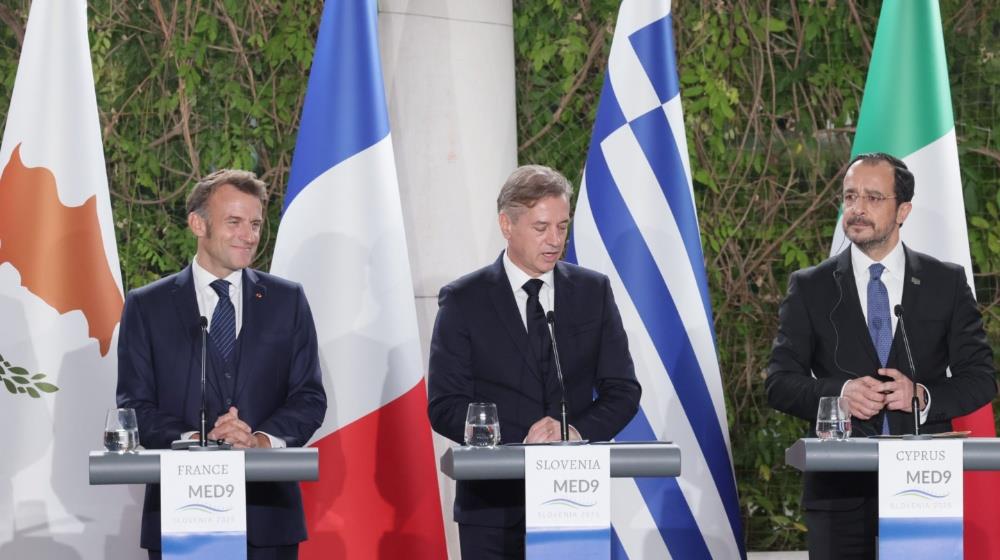
The Cyprus issue, developments in the Eastern Mediterranean and the Middle East, the protection of external borders and energy security will be at the heart of the 13th Summit of the Southern Countries of the EU (MED9), taking place on Wednesday, Wednesday 7 October, in Split, Croatia.
The leaders of Croatia, the current MED9 chair, Cyprus, France, Greece, Italy, Malta, Portugal, Slovenia and Spain are taking part in the summit. Guests include Prince Albert II of Monaco, the Crown Prince of Jordan, European Council President António Costa, European Commission President Ursula von der Leyen and Commissioner for the Mediterranean Dubravka Šuica.
In the security chapter, the nine leaders reaffirm their commitment to a comprehensive settlement of the Cyprus issue within the UN framework, as defined by the relevant UN Security Council resolutions and in line with EU law, values and principles. They express appreciation for the efforts of the UN Secretary-General and welcome his intention to convene an enlarged meeting with all parties to relaunch official negotiations, within the agreed framework and building on existing convergences. They stress that Τurkey's "concrete contribution" to the swift resumption and successful conduct of the talks remains crucial and is a key element in advancing EU-Turkey relations, while underlining that avoiding unilateral actions, including in Varosha and along the ceasefire line, is essential to creating an environment conducive to the resumption of talks.
On the Eastern Mediterranean, the draft underlines the EU's strategic interest in a stable and secure environment and in a cooperative relationship with Türkiye "in line with established conditionalities". It provides that disputes must be resolved by peaceful means and in full respect of international law, including UNCLOS, and that the sovereignty, territorial integrity and sovereign rights of all member states must be respected.
The text expresses the nine leaders' deep concern over the deteriorating security environment, with references to Russia's war against Ukraine, Gaza and the West Bank, Iran, Lebanon, Syria and Yemen, and voices support for the two-state solution for the Israeli–Palestinian conflict. It also refers to the upcoming EU-Gulf Cooperation Council (GCC) Summit on 24 October, scheduled to take place in Saudi Arabia, and to progress on enlargement, with an emphasis on the Western Balkans.
On migration, the leaders call for a united European response to situations of heavy pressure on the borders, citing this summer's events in Ceuta, and support the full implementation of the Pact on Migration and Asylum, faster returns and partnerships with countries of origin and transit.
On climate, the draft notes that this summer's wildfires showed that no country can face such disasters alone, and calls for a strengthened EU Civil Protection Mechanism, including through joint exercises and the pre-positioning of rescEU capacities. It welcomes the establishment of the Cyprus Regional Aerial Firefighting Station (CRAFS). Water scarcity is described as a strategic priority.
On energy, the leaders call for regular cross-border stress tests, stronger interconnections and infrastructure, and support for the Trans-Mediterranean clean tech initiative (T-MED) under the Pact for the Mediterranean. On the 2028-2034 budget, the nine call for an "ambitious and balanced" MFF, with continued Cohesion Policy, CAP and CFP, and no return of national rebates.
The next MED9 summit is expected to take place in Portugal in 2027.