







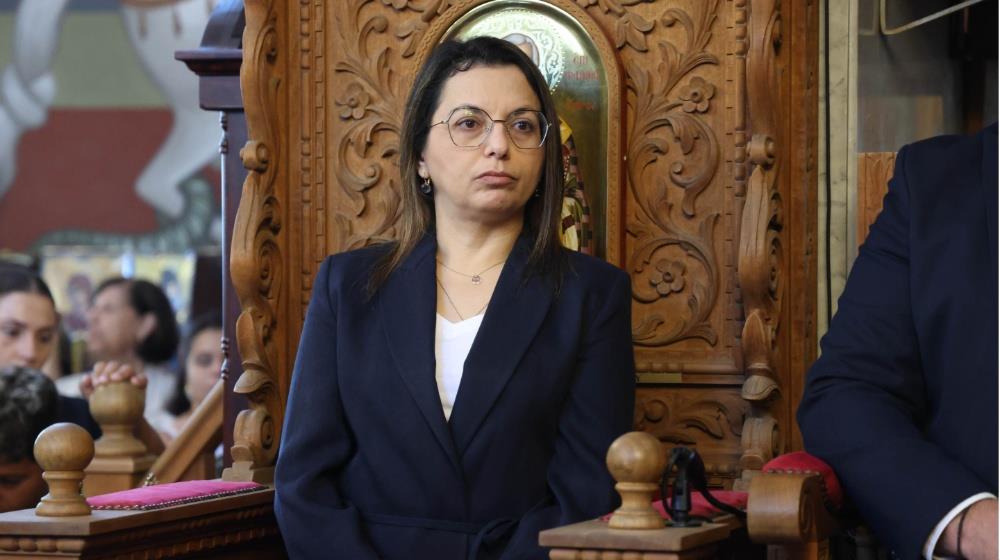
Safety in the transport sector, and particularly in aviation, is not a technical detail but the state’s “first and non-negotiable obligation,” Transport, Communications and Works Minister Evanthia Tsolaki said on Sunday, 9 August, addressing the annual memorial service for the victims of the Helios Airways air disaster of 14 August, 2005.
The memorial service was held at the Metropolitan Church of St George in Paralimni, from where many of the 121 victims originated. It was presided over by the Metropolitan of Constantia and Famagusta Vasilios. Tsolaki delivered the memorial address and laid a wreath on behalf of the President of the Republic, Nikos Christodoulides.
In her address, Tsolaki described 14 August, 2005 as one of the darkest days in Cyprus’ modern history, saying that a journey that had begun as an ordinary flight had turned into an unspeakable tragedy.
She made particular reference to the families of the victims, stressing that, despite the passage of time, for those who lost loved ones, time is not measured in dates.
“It is measured by the empty seats at the table, the voices that are missing, the celebrations that are never the same and the moments their loved ones should have lived but never did,” she said.
Tsolaki noted that the presence of the state at the memorial was not a formality but a duty towards the victims’ families. Their pain, she stressed, was neither private nor forgotten, but formed part of Cyprus’ collective memory.
She also stressed that remembering the tragedy must be linked to the state’s responsibility for aviation safety. In the transport sector, and particularly in aviation, she said, safety is not a technical detail but the “first and non-negotiable obligation.”
Every rule, procedure, inspection and oversight mechanism, she said, exists for one purpose: to protect human life. Human life, she stressed, leaves no room for compromises, omissions or complacency.
Tsolaki underlined the need for continuous assessment, monitoring and improvement of procedures, so that safety is never taken for granted but treated as a daily obligation and an ongoing effort.
She stressed that the memory of the Helios victims would remain alive “not as pain, but as responsibility” not merely as an anniversary, but as a constant reminder that the state has a duty to protect, prevent and be accountable.
The Helios Airways Boeing 737-300 crashed near Grammatiko, north of Athens, on 14 August, 2005, while operating a flight from Larnaca to Prague via Athens. All 121 people on board — 115 passengers and six crew members — were killed, making it the deadliest air disaster in Cyprus’ history.
(Source: CNA)
